

Dr. Darrius Hills is a 2025-2026 PRRI Public Fellow focusing on LGBTQ rights and gender. He is also an Associate Professor of Religious Studies at Grinnell College.
In a March 13 press briefing on the escalating war in Iran, Defense Secretary Pete Hegseth boasted of the prowess of American military capabilities in contrast to the destruction of Iran’s “meaningful military capabilities at a pace the world has never seen before.” To further emphasize this point, he went on to say, “We will keep pressing. We will keep pushing, keep advancing, no quarter, no mercy for our enemies.” Many critics singled out the “no quarter” qualification, noting the potential for escalating desperation during combat. Moreover, many registered alarm at the prospect of refusing surrender to combatants, as “no quarter” is a wartime reference tied to allowing enemies to lay down arms. Ultimately, such a violent declaration of wartime policy, which deviates from precedent, raises the question of what lies behind this approach. This Spotlight Analysis examines views on political violence and its relationship to the religious right and American evangelicalism.
Given that Hegseth’s chosen faith community is tied to a branch of fundamentalist evangelical Christianity, it may be instructive to consider the intersection of American evangelicalism and the prospect of political violence in American culture. Generally speaking, contemporary surveys on Americans’ perceptions of the primary drivers of violence across political lines are mixed. PRRI’s 2025 political violence survey found that 67% of all Americans hold political leaders accountable — that is, most Americans believe political leaders failing to condemn the violent rhetoric of their own followers contributes to violence a lot. What is interesting, however, is the partisan, racial, and religious breakdown pertaining to the justification of political violence, and which parameters of violence are acceptable versus unacceptable.
Overall, most Americans do not favor the use of violence to advance political ends. For example, just 3% of Americans completely agree with “killing a political opponent if they are believed to pose a clear threat to America,” or “doxxing the home address or private information of a political opponent” for the purposes of harassment.
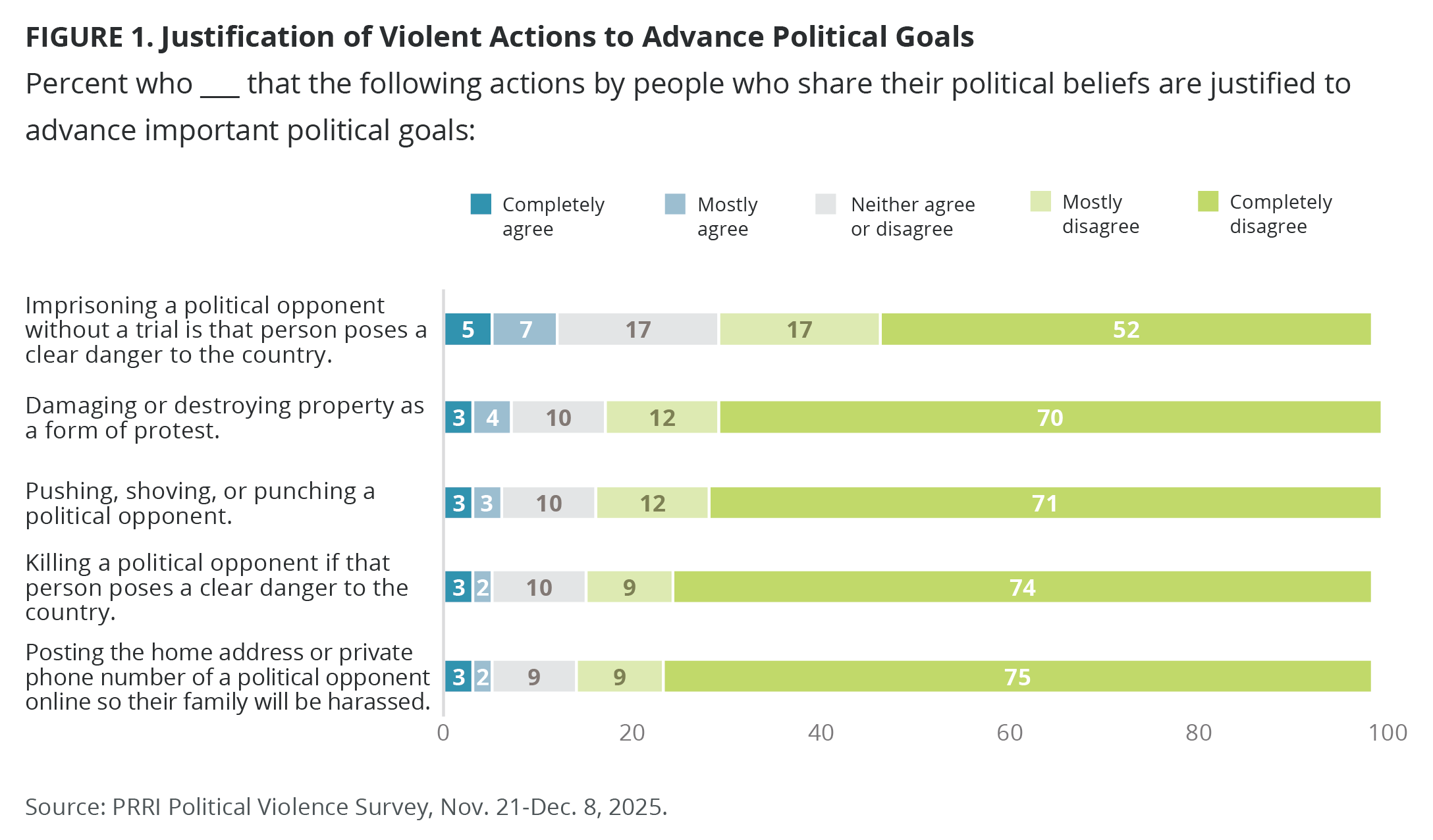
However, there have been fluctuations in the support for political violence along partisan and religious lines that seem to correlate with the ruling party. During Joe Biden’s presidency, for example, between 27 and 35% of Republicans agreed with the statement “Because things have gotten so far off track, true American patriots may have to resort to political violence in order to save our country.” Well into President Donald Trump’s second term, however, that number has shrunk to 19%. It is also true that across different religious affiliations, support for political violence tends to be higher among white evangelical Protestants.
There are additional ties between self-identified “born-again” American evangelicals and Christian nationalism that deserve more consideration. PRRI’s 2025 American Values Atlas data finds that 67% of white evangelical Protestants hold Christian nationalist beliefs, higher than any other American religious group. Therefore, when scaled by different levels of support for Christian nationalism in particular, the embrace of political violence among evangelicals reveals both overt and more subtle findings. A February 2023 PRRI survey report established solid links between a Christian nationalist worldview, political violence as a useful tool for restoring democracy, and the QAnon worldview, which is also positively linked to an idealization of political violence.
The first data point worth considering in that report hinges upon authoritarian leanings among Christian nationalists; nearly four in ten Christian nationalist Sympathizers (38%) and half of Christian nationalist Adherents (50%) advocated for an authoritarian leader in American governance. Support for authoritarianism is an important consideration as this political ideology is likewise associated with the legitimization of violent reprisals toward one’s perceived political opponents and critics — a trait well-entrenched in authoritarian governments and leaders. In fact, PRRI finds a strong correlation between Christian nationalism and authoritarianism.
Carrying over authoritarian inclinations in Christian nationalists’ voting choices and leadership preferences to consider this group’s everyday social interactions and the proclivity for political violence also yields interesting considerations. A recent study by PRRI finds that only 17% of Americans agreed with the idea that true American patriots are needed to take up arms in violent resistance to save our country. Christian nationalists, however, were far more likely to agree that violence may be necessary to save the country. Three in ten Christian nationalism Adherents (30%) agreed with this assertion, followed by 23% of Sympathizers.
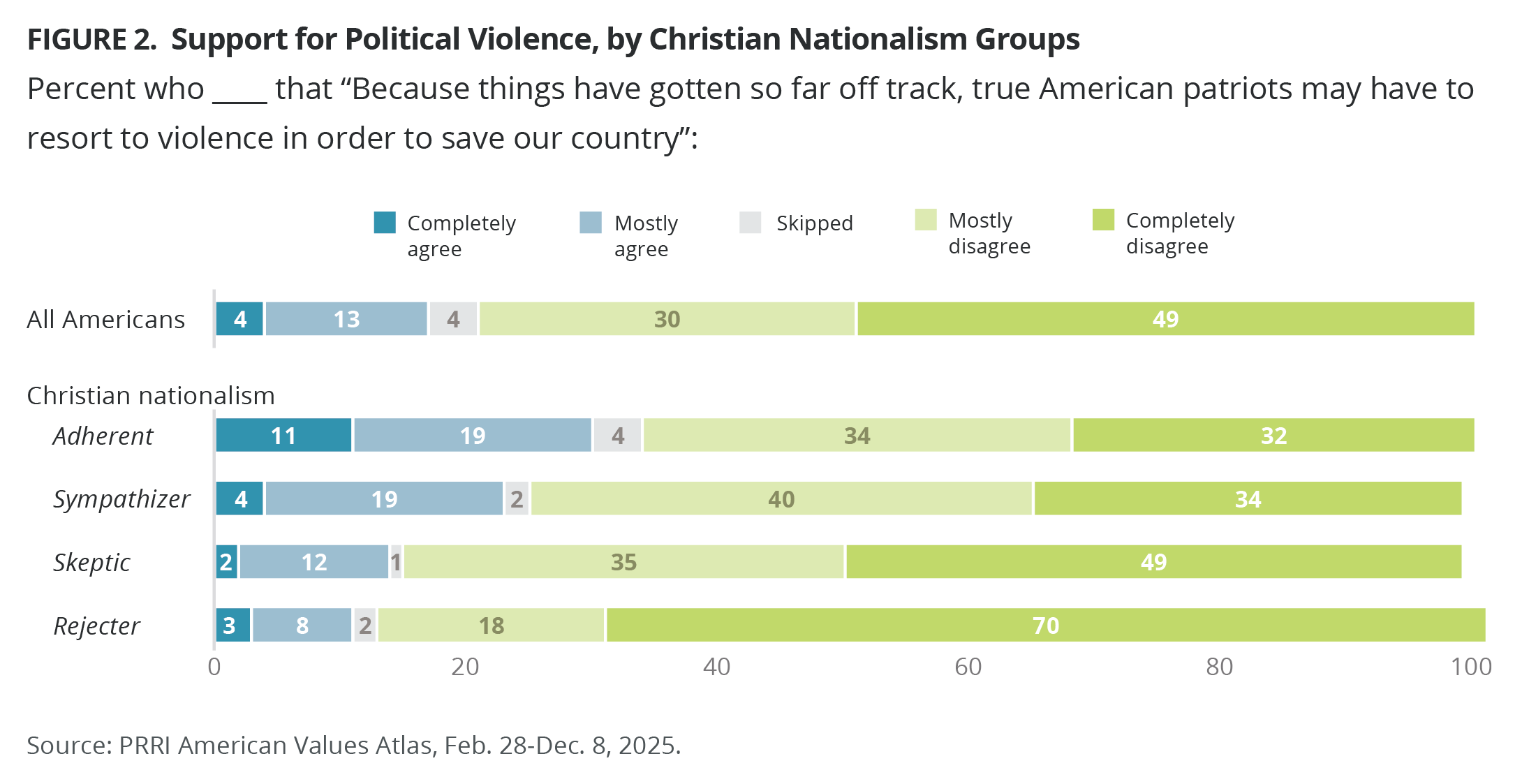
These observations are further confirmed in the studies of independent researchers. Miles T. Armaly, David T. Buckley, and Adam M. Enders (2022) and James A. Piazza (2026) found distinctive correlations between Christian nationalists and the endorsement of political violence, with Piazza noting an additional correlate, namely apocalyptic and eschatological ideation, which manifests specifically in a more robust hatred and legitimization of violence toward perceived out-groups in light of beliefs about cosmic, end-of-times events in human history.
In the shifting tides of American political leadership and partisan politics, it is natural to expect these commitments to shift as well. While it may appear odd to link political violence to the myriad of commitments prominent in our political landscape, the data indicate the need for sober, public-facing discourses that look squarely at the motivations, justifications, and rationales that prompt the embrace of violence as a tool of the political process at all.
In the case of the American evangelical community and for those who qualify as Christian nationalists, the turn to violence raises important questions about the nature and scope of 21st-century American Christianity, but perhaps also reveals important fissures in the larger framework of American Christendom and its history of theological and social critiques that indict, rather than defend, the use of violence as a means of political gain. Whatever the consequences for the acceptance of political violence by white conservative Christians may be, only time will tell. What does seem necessary, however, is our collective lament toward any character of violence, as well as our intentional scrutiny of the ties between religious sanctioning of political violence, and the overall threat this poses to democracy and the overall public good.