

To view a replay of PRRI’s March 26, 2026, webinar on this topic or the slides presented during the webinar, please click here.
Executive Summary
Trump’s immigration approval is waning.
- Over one-third of Americans (35%) rate President Donald Trump’s handling of immigration favorably, compared with 61% who rate his actions unfavorably; nearly half (48%) of Americans hold very unfavorable views of his handling of immigration.
- In March 2025, 48% of Americans approved of the job Donald Trump was doing on immigration.
- Support for Trump’s handling of immigration has dropped across all partisan and religious groups since last year.
Americans are twice as likely to hold favorable views of local police than ICE officers and broadly oppose increased ICE funding.
- Two-thirds of Americans (67%) express favorable views of local police officers, up from 63% in September 2025. By contrast, one-third of Americans hold favorable views of ICE officers (33%), down from 39% in September 2025.
- Only white evangelical Protestants (65%) and white Catholics (51%) express majority favorable views of ICE officers.
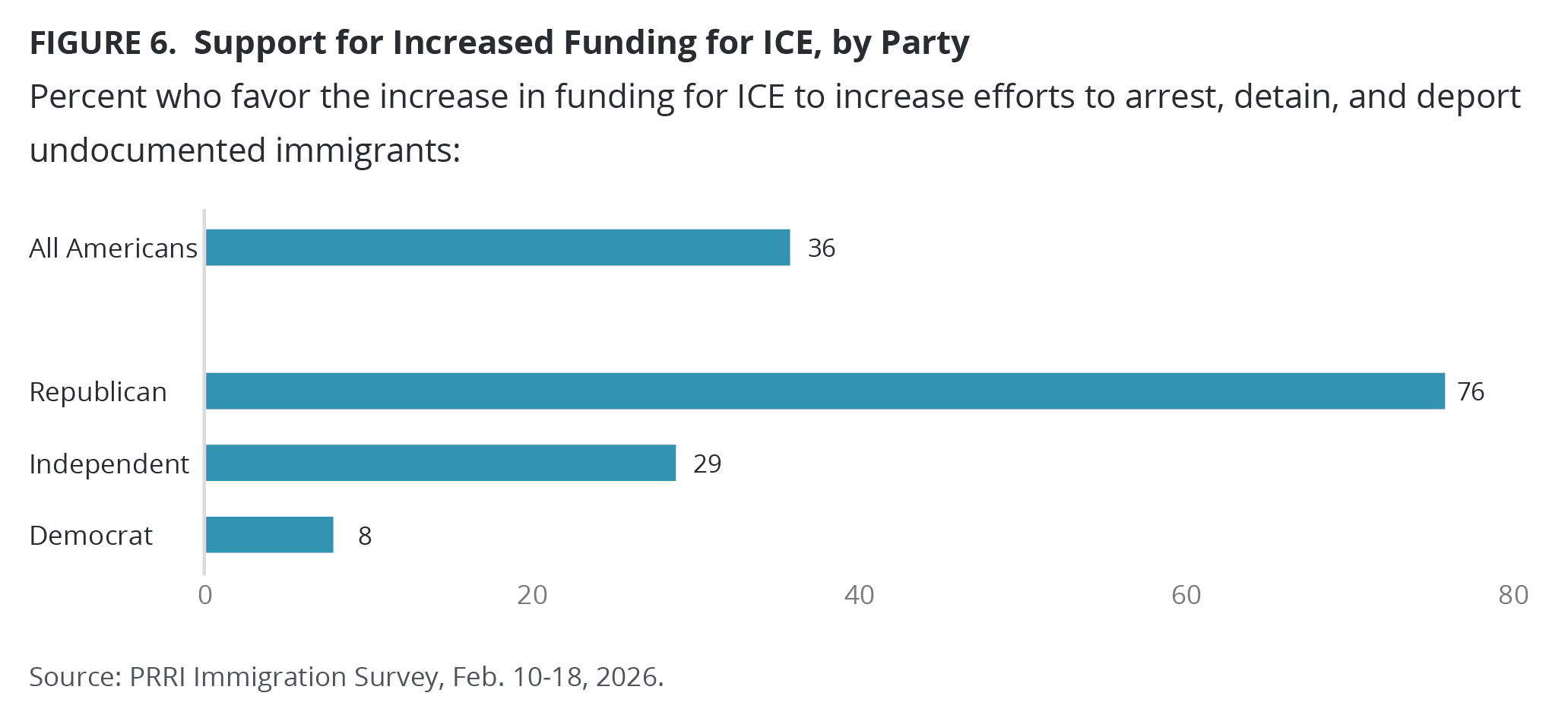
- Only 36% of Americans favor the increase in funding for ICE to increase efforts to arrest, detain, and deport undocumented immigrants. Republicans are outliers: Three in four Republicans (76%) are in favor, compared with 29% of independents and only 8% of Democrats.
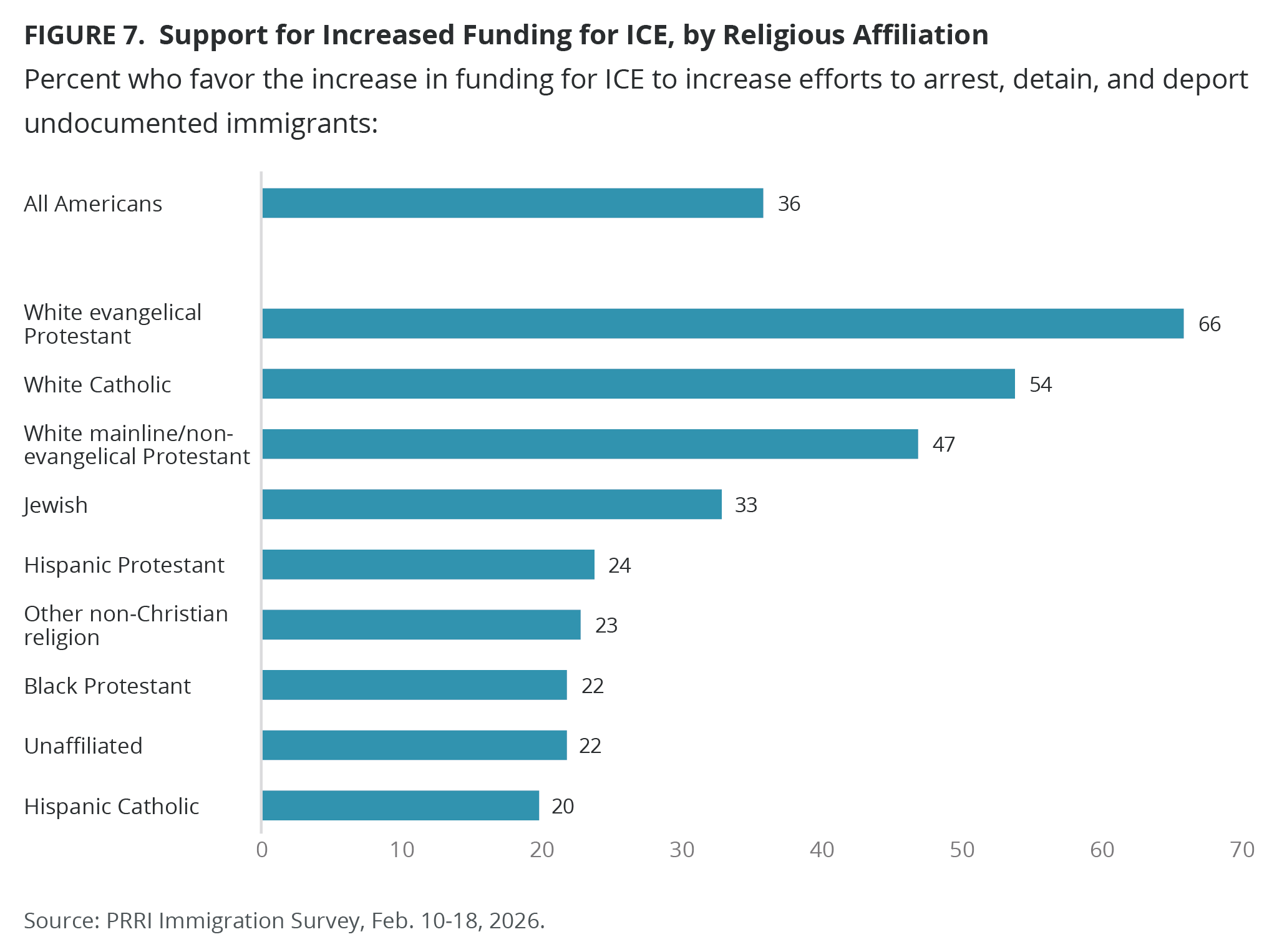
- Only white evangelical Protestants (66%) and white Catholics (54%) show majority support for increasing ICE funding.
Democrats and independents strongly oppose harsh ICE enforcement tactics and believe ICE is making communities less safe, while most Republicans support them.
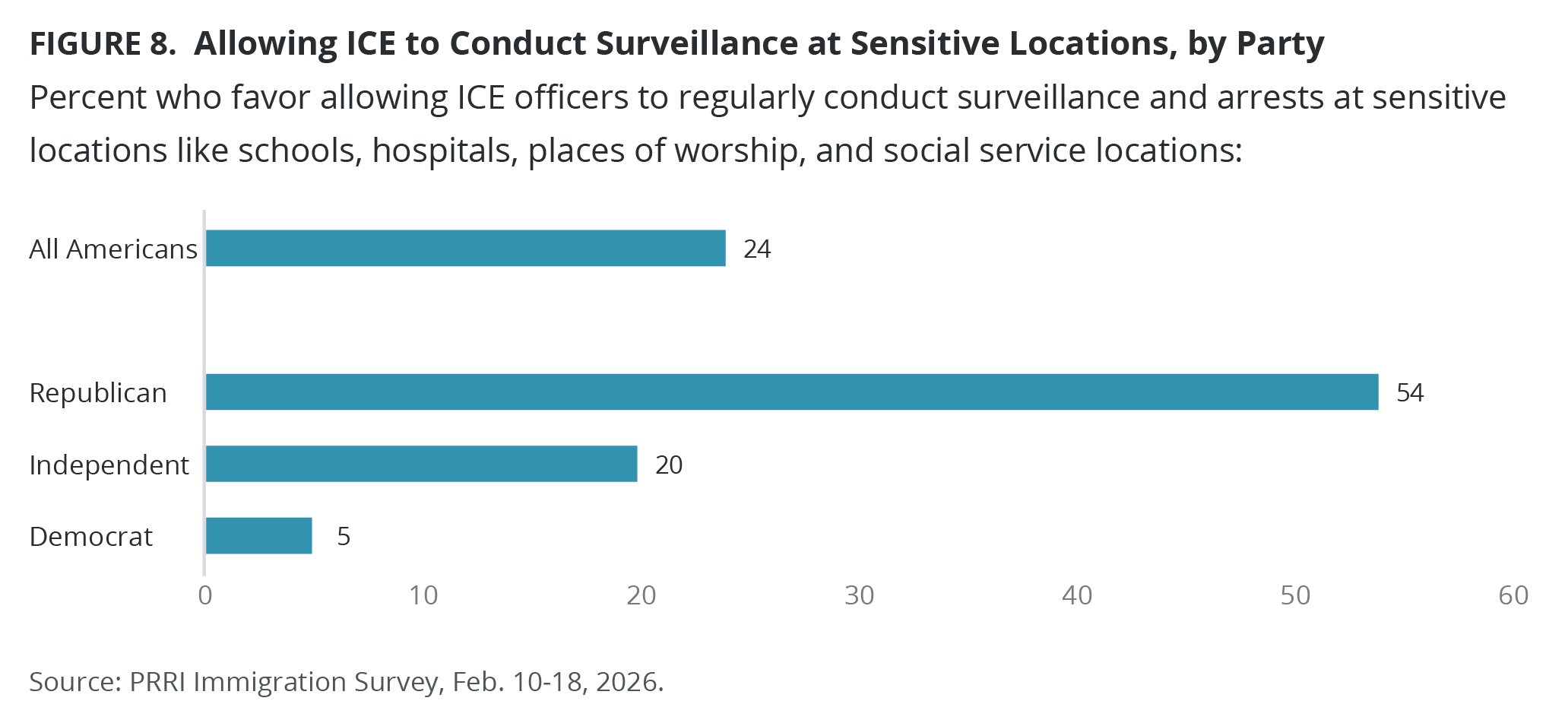
- One in four Americans (24%) favor allowing ICE officers to regularly conduct surveillance and arrests at sensitive locations like schools, hospitals, places of worship, and social service locations, with Republicans (54%) far more likely than independents (20%) and Democrats (5%) to favor this policy.
- Few Americans (28%) favor allowing ICE officers to arrest and relocate undocumented immigrants to detention centers in states far from their home. Most Republicans (61%) are in favor, compared with 23% of independents and just 6% of Democrats.
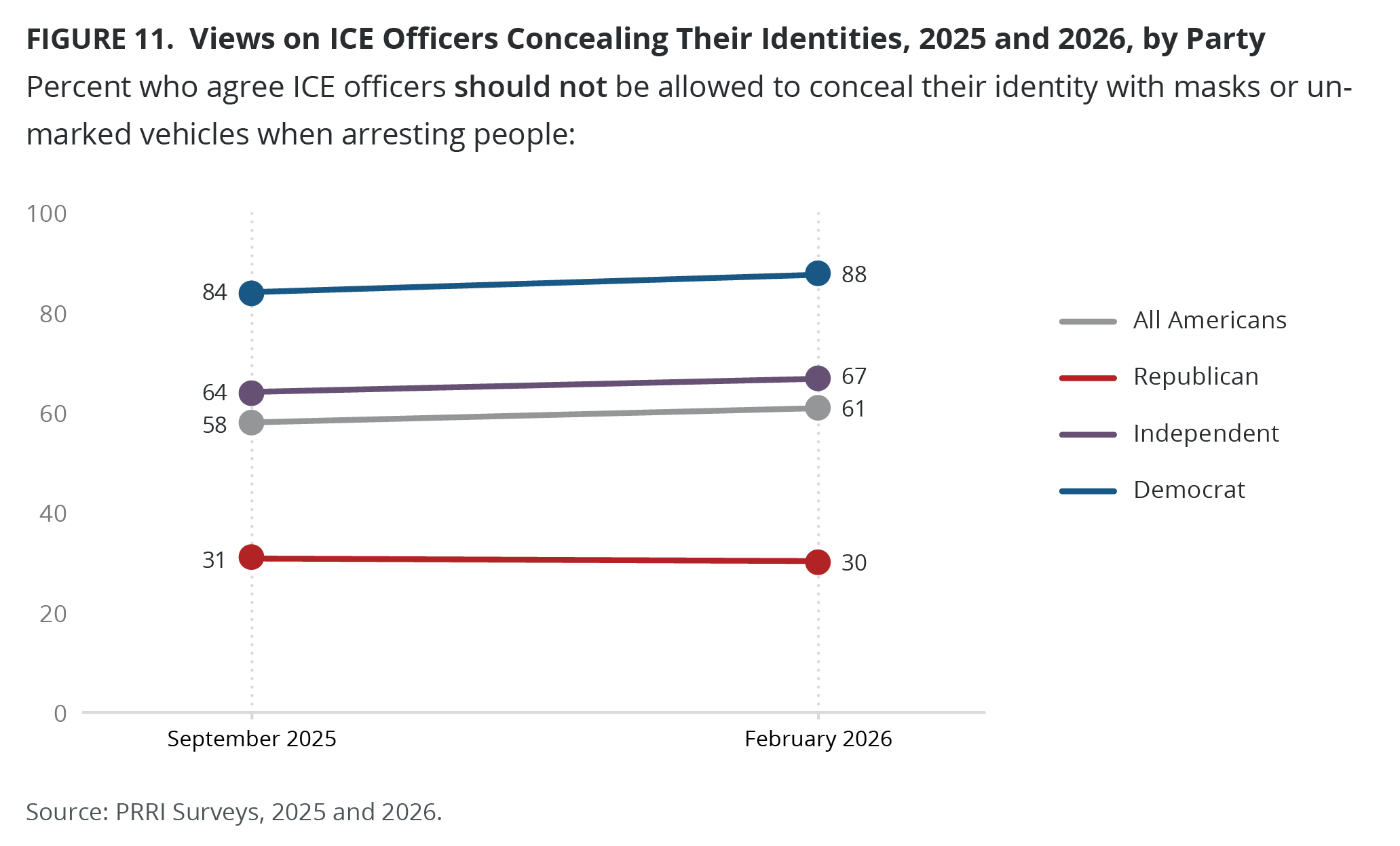
- Six in ten Americans (61%) agree that ICE officers should not be allowed to conceal their identity with masks or unmarked vehicles when arresting people. Only 30% of Republicans agree, compared with most independents (67%) and Democrats (88%).
- The majority of Americans (57%) agree that the surge of ICE officers in places like Minnesota are making communities less safe. Most Democrats (88%) and independents (64%) agree, compared with 24% of Republicans.
Support for internment camps is concentrated among Republicans and Christian nationalists.
- Four in ten Americans (41%) agree that the federal government should detain immigrants who are in the country illegally in internment camps until they can be deported. Agreement slightly increased from 37% since September 2025. Most Republicans (73%) agree, compared with 37% of independents and 17% of Democrats.
- White evangelical Protestants (63%) and white Catholics (55%), as well as Christian nationalism Adherents (75%) and Sympathizers (62%), are the only religious groups in which a majority supports detaining immigrants in internment camps.
Most Americans, including Republicans, oppose so-called “self-deportations” and favor providing refuge for immigrants facing danger in their home countries.
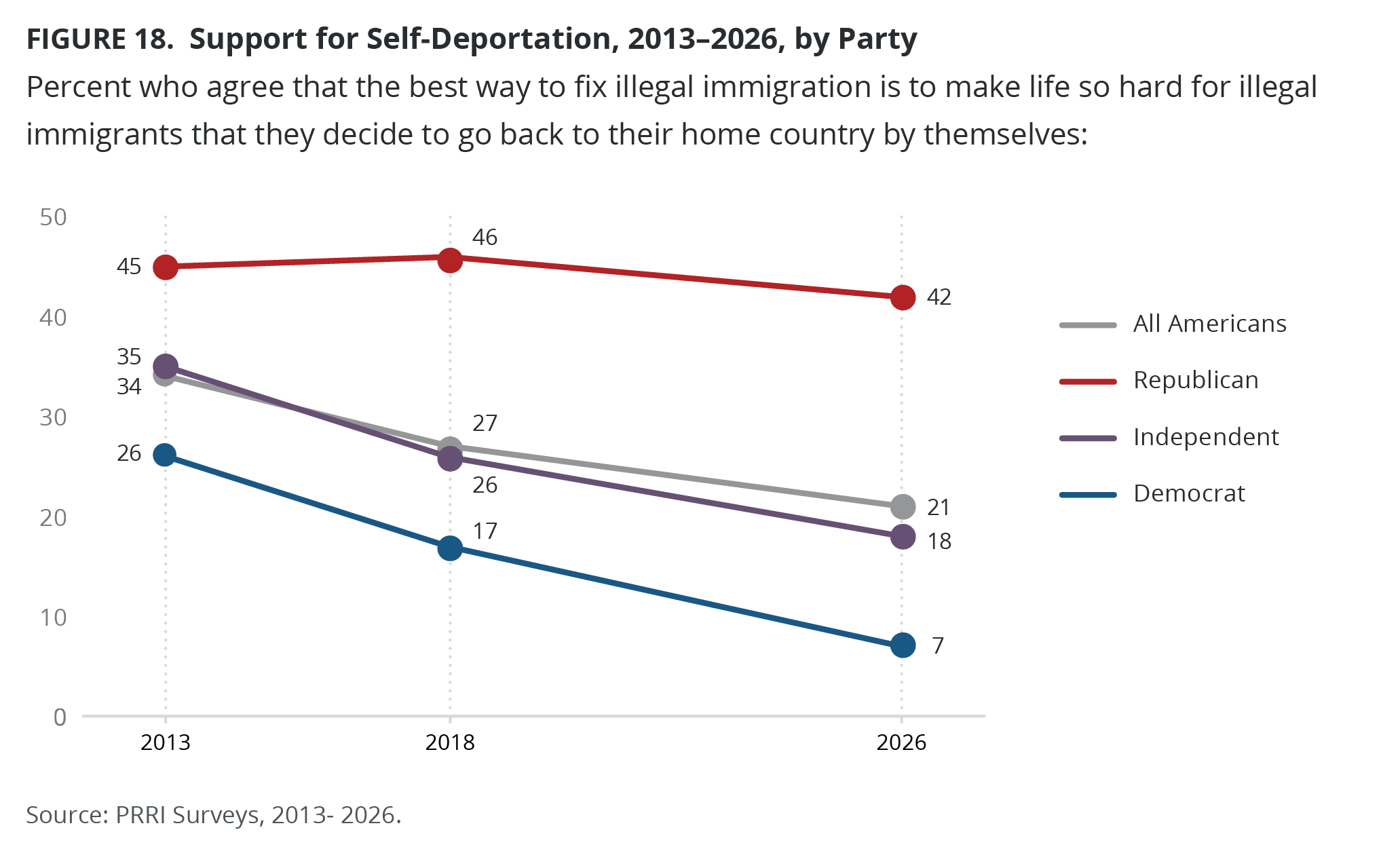
- Just 21% of Americans agree that the best way to fix illegal immigration is to make life so hard for illegal immigrants that they decide to go back to their home country by themselves, a decline from 34% since 2013 when PRRI first asked. Four in ten Republicans (42%), 18% of independents, and 7% of Democrats agree.
- Most Americans (72%) agree that “we should provide refuge for people who come to the U.S. if they are in serious danger in their home country,” though Democrats are 35 points more likely than Republicans to agree (90% vs. 55%).
Perceptions of immigrants, and opinions about their legal rights, are strongly polarized by partisans and religion.
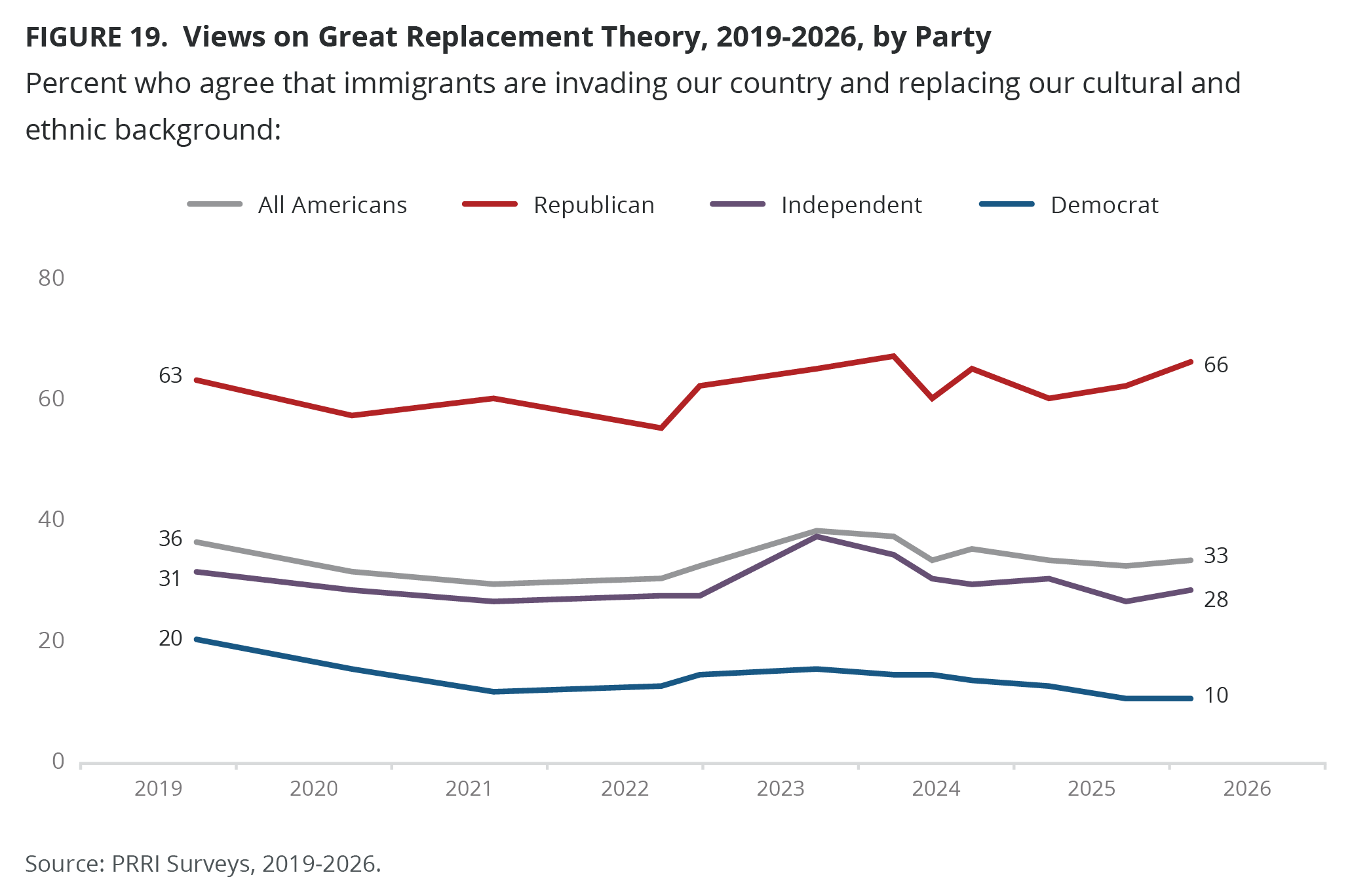
- While one-third of Americans (33%) agree that “immigrants are invading our country and replacing our cultural and ethnic background,” agreement jumps to 66% among Republicans, compared with 28% of independents and 10% of Democrats.
- Most Americans (54%) agree that the growing number of newcomers from other countries strengthens American society, including 82% of Democrats and 57% of independents. Just 26% of Republicans agree.
- Most Americans (61%) agree with the idea that “immigrants, regardless of legal status, should have the right to challenge their deportation in court,” including Democrats (88%) and independents (63%). Just 32% of Republicans agree.
- White Christian groups, as well as Christian nationalists, are more likely to affirm the so-called “great replacement theory” and are less likely to say that immigrants strengthen American society and should have due process regardless of their legal status.
Americans express concerns over declining free speech protections and strongly oppose government surveillance.
- Two-thirds of Americans (67%) agree that “the ability of Americans to freely criticize the government without fear of punishment is a right that seems less protected than in previous years.”
- Most Americans (81%) oppose “allowing the U.S. government to collect personal data and build a database of Americans who protest government actions,” including Democrats (93%), independents (86%), and Republicans (65%), as well as majorities across religious affiliation, Christian nationalism groups, and demographic groups.
Republicans and conservative white Christians are increasingly embracing the term “Christian nationalism.”
- Just 27% of Americans hold favorable views of the term “Christian nationalism,” 47% hold unfavorable views, and 23% have not heard of this term.
- Since 2022, Republicans and Christian nationalism Adherents and Sympathizers are increasingly embracing the term. Favorable views increased 17 points among Republicans (36% to 53%), 14 points among Christian nationalism Adherents (54% to 68%), and 11 points among Sympathizers (39% to 50%).
Introduction
PRRI interviewed more than 5,000 adults to assess Americans’ views on immigration. The report provides a comprehensive assessment of Americans’ views on the immigration enforcement policies of President Donald Trump’s second administration, particularly the role of U.S. Immigration and Customs Enforcement (ICE) officers, due process, and how these attitudes are shaping national debates. The report also examines views on freedom of speech, government surveillance, and deporting U.S. citizens.
Trump Favorability and Handling of Immigration
Trump Favorability
A year into the second Trump administration, our latest data show that 36% of Americans hold favorable views of Trump, down from 40% in September 2025, while six in ten Americans view Trump unfavorably (60%). Most Republicans (81%) continue to hold favorable views of Trump, slightly down from 85% at the end of 2025. Among independents, 28% view Trump favorably, down from 30% in September 2025. By contrast, just 6% of Democrats hold a favorable view of Trump; his favorability among Democrats has remained very low over the past decade.[1]
Trump’s Handling of Immigration
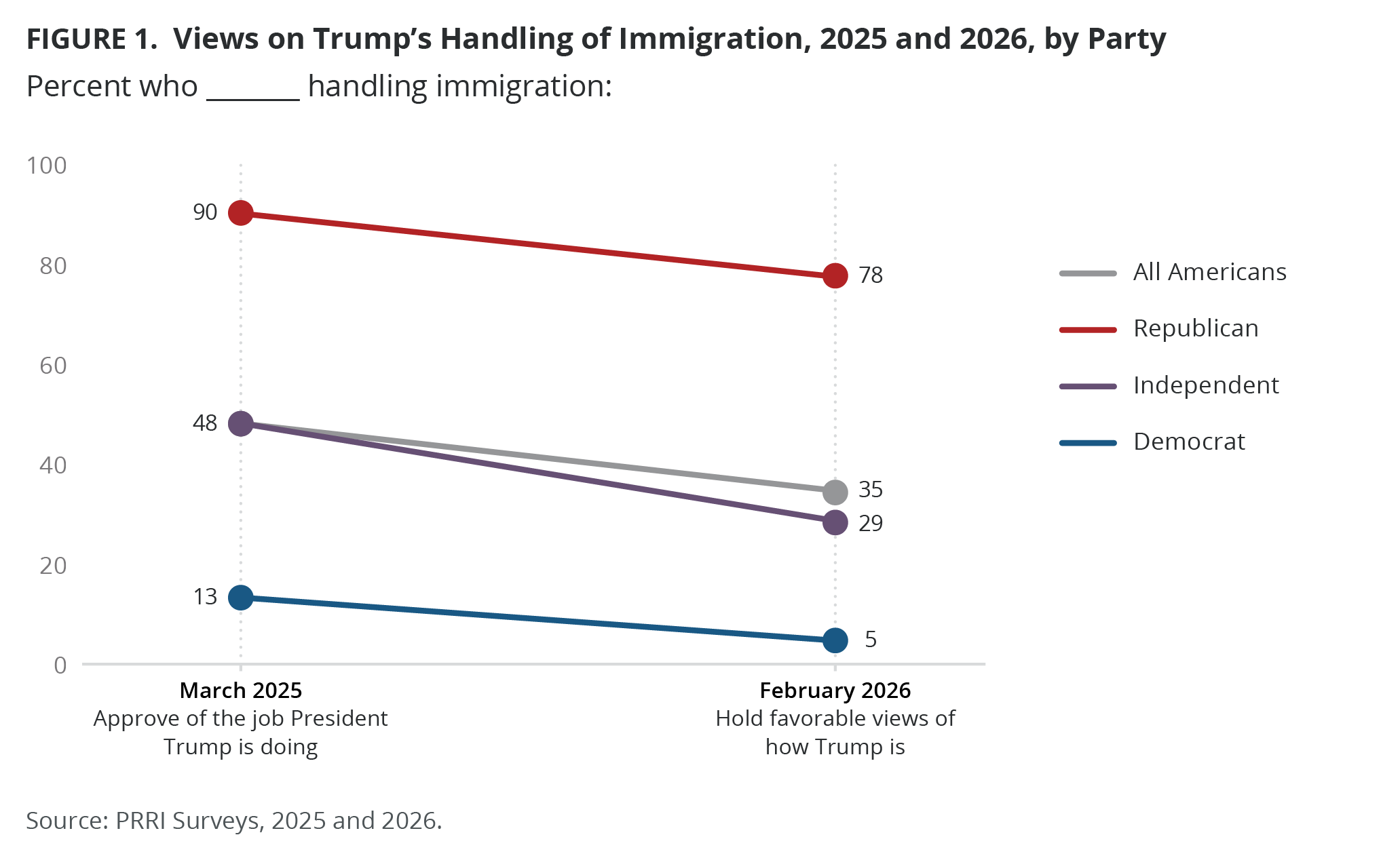
Just over one-third of Americans (35%) hold favorable views of how Trump is handling immigration, while 61% hold unfavorable views. This represents a 13-point decline since March 2025, when Americans were evenly divided (48% approved and 49% disapproved), and an 8-point decline from September 2025, when 43% approved.[2] Favorable views of Trump’s handling of immigration have dropped across all partisans as well since March 2025, with significant declines among Republicans, from 90% to 78%, and Democrats, from 13% to 5%. Notably, favorable views of Trump’s handling of immigration have dropped nearly 20 points among independents, from 48% to 29%.
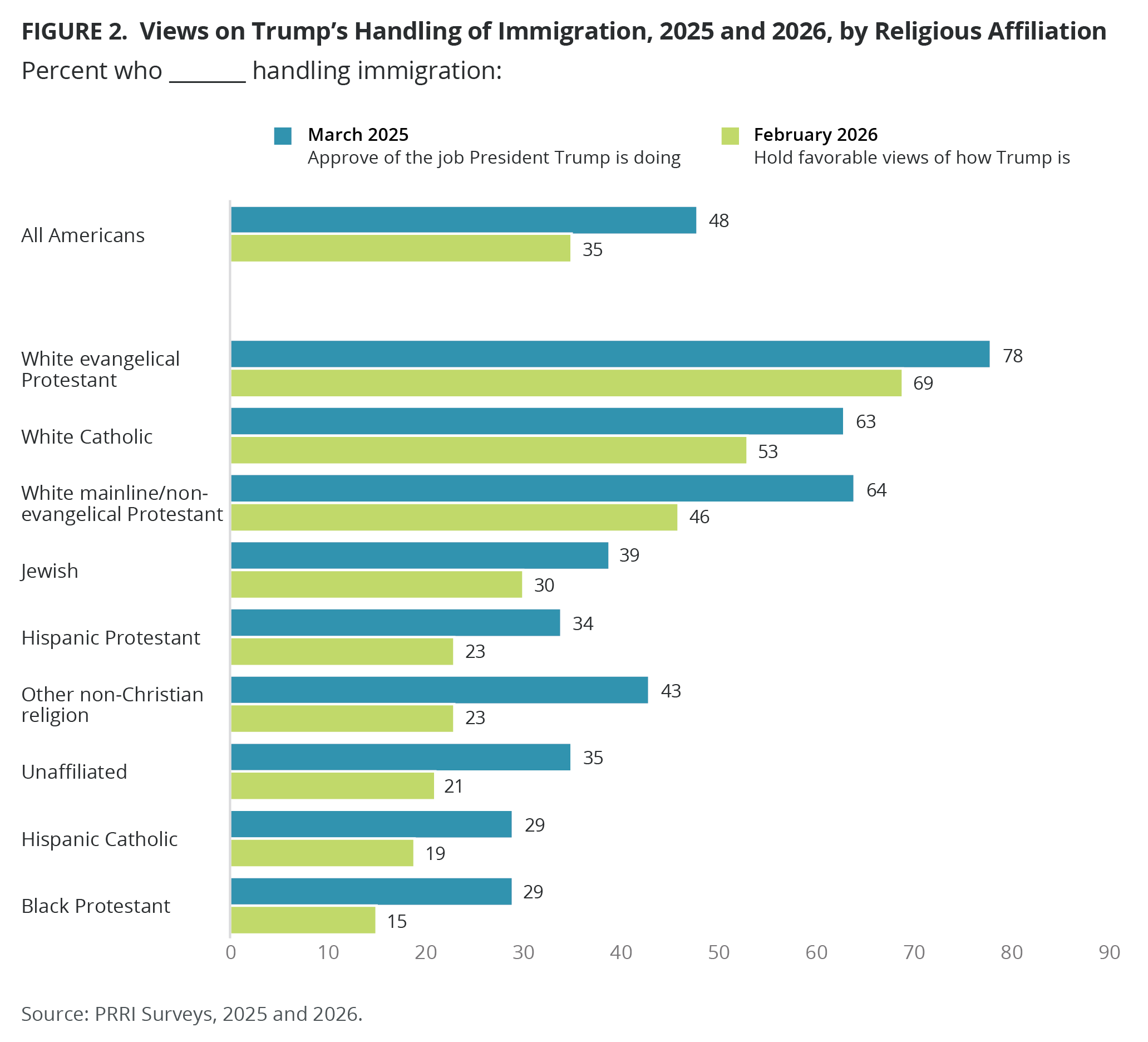
Across white religious groups, white evangelical Protestants are the most supportive, with 69% expressing favorable views of Trump’s handling of immigration, followed by white Catholics (53%). In contrast, 46% of white mainline/non-evangelical Protestants, Jewish Americans, and about two in ten Hispanic Protestants (23%), members of other non-Christian religions (23%), the religiously unaffiliated (21%), Hispanic Catholics (19%), and Black Protestants (15%) hold favorable views of how Trump is handling immigration. Since March 2025, favorable views of Trump’s handling of immigration have declined among all religious groups, with the steepest decline among white mainline/non-evangelical Protestants, from 64% to 46%.
Strong majorities of Christian nationalism Adherents (70%) and Sympathizers (60%) view Trump’s handling of immigration favorably. Only one in three Skeptics (32%) lean more favorable while Rejecters are overwhelmingly opposed: Just 8% express favorable views, while more than nine in ten view Trump’s handling of immigration unfavorably (91%).
Minorities of every racial group hold favorable views regarding how Trump is handling immigration, though white Americans are the most likely to favor his approach (45%), followed by 28% of AAPI, 23% of multiracial Americans, 19% of Hispanic Americans, and 15% of Black Americans.
Although still minorities, older Americans are more likely than younger Americans to hold favorable views of Trump’s handling of immigration, as are non-college graduates and men, compared with college graduates and women. Since March 2025, favorable views of Trump’s handling of immigration have declined among all groups.
Support for U.S. Immigration and Customs Enforcement (ICE) and Their Conduct
Favorable Views of ICE Officers vs. Local Police Officers
Favorable Views of ICE Officers
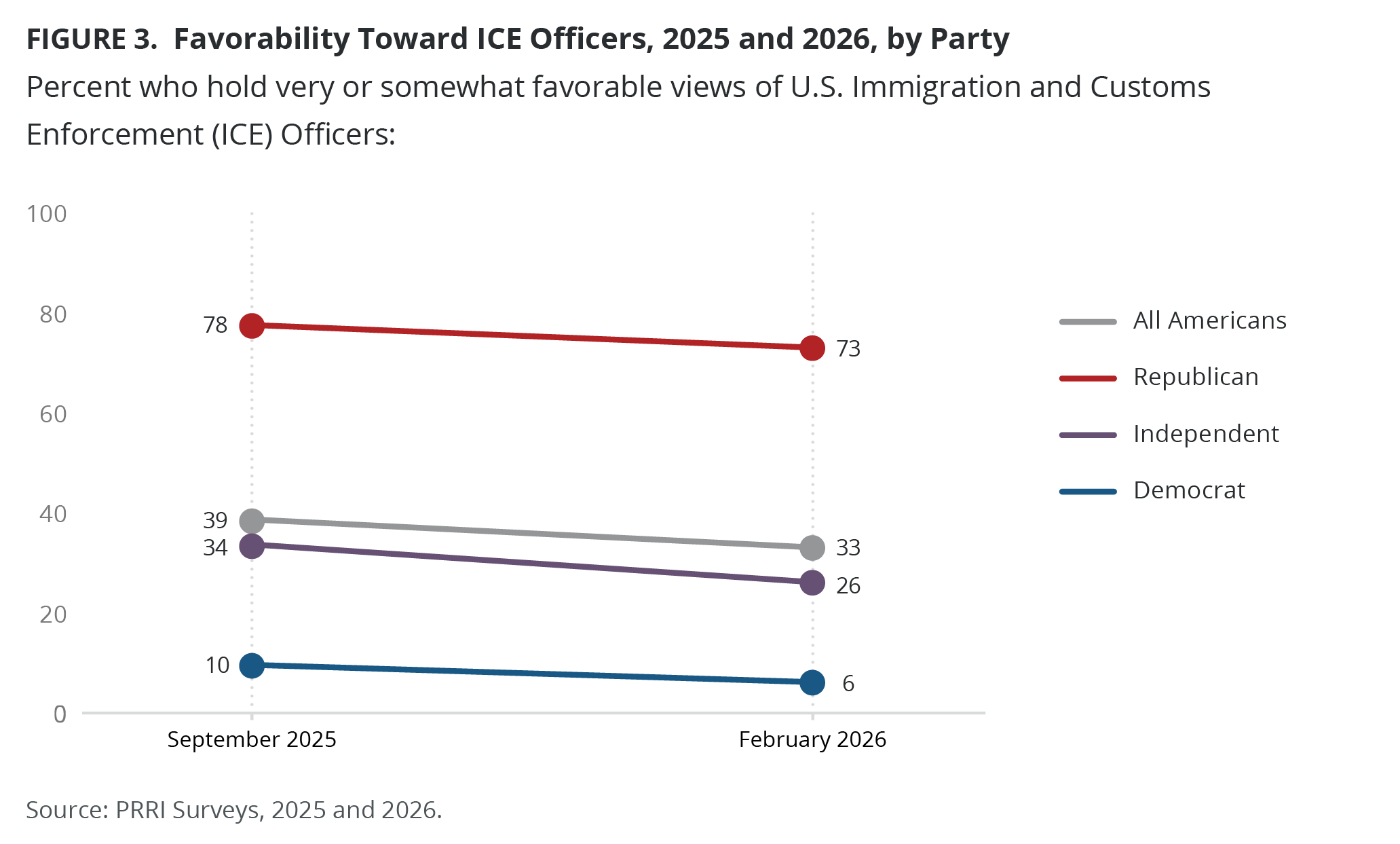
One in three Americans (33%) hold favorable views of U.S. Immigration and Customs Enforcement (ICE) officers, down 6 percentage points from 39% in September 2025. Favorable views of ICE officers have declined across all partisans, with significant drops among Republicans, from 78% to 73%; independents, from 34% to 26%; and Democrats, from 10% to 6%.
Except for white evangelical Protestants (65%) and white Catholics (51%), no other religious group shows majority favorable views toward ICE officers, including white mainline/non-evangelical Protestants (42%, down from 61% in September 2025), Hispanic Protestants (30%), Jewish Americans (29%), other non-Christian groups (20%), the religiously unaffiliated (20%), Black Protestants (16%), and Hispanic Catholics (16%).
Favorability toward ICE officers is high among Christian nationalism Adherents (69%) and Sympathizers (55%) but is significantly lower among Skeptics (30%) and Rejecters (7%).
Although still minorities, white Americans, older Americans, and men are more likely to hold favorable views of ICE officers than Americans of color, younger Americans, and women. Since September 2025, favorable views of ICE officers have declined among all groups.
Local Police Officers
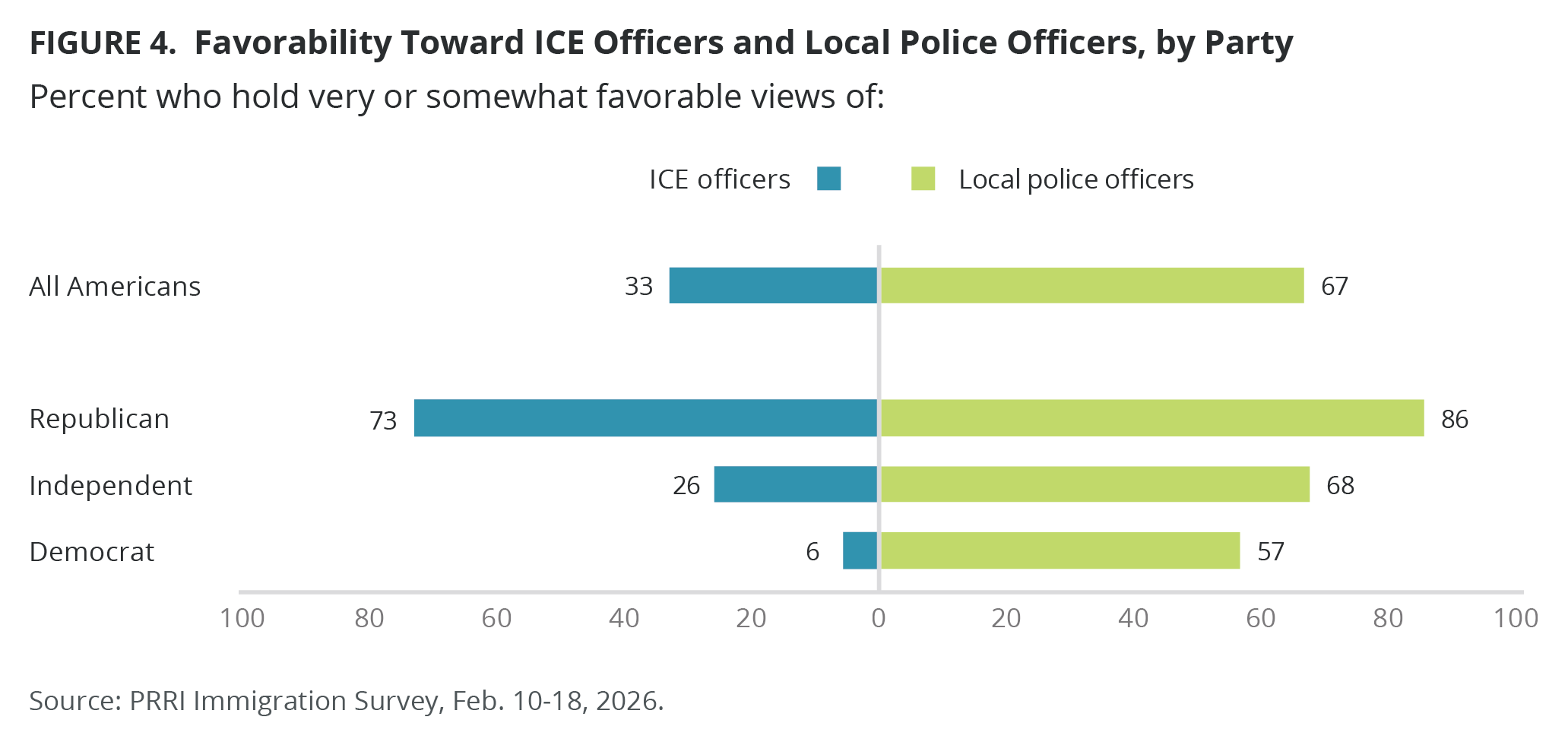
Americans are significantly more likely to hold favorable views of local police officers than ICE officers. Two-thirds of Americans (67%) express favorable views of local police officers, while just 27% hold unfavorable views. Republicans are the most favorable (86%), followed by independents (68%) and Democrats (57%). Favorability toward the police is slightly higher among all Americans than it was in September 2025 (63%), with increases among independents (from 57%) and Democrats (from 51%). Republicans’ favorable views have remained largely unchanged.[3]
Across religious groups, white Christians (over eight in ten) are the most likely to view local police officers favorably, compared with smaller majorities of Christians of color, members of non-Christian religions, and the religiously unaffiliated.
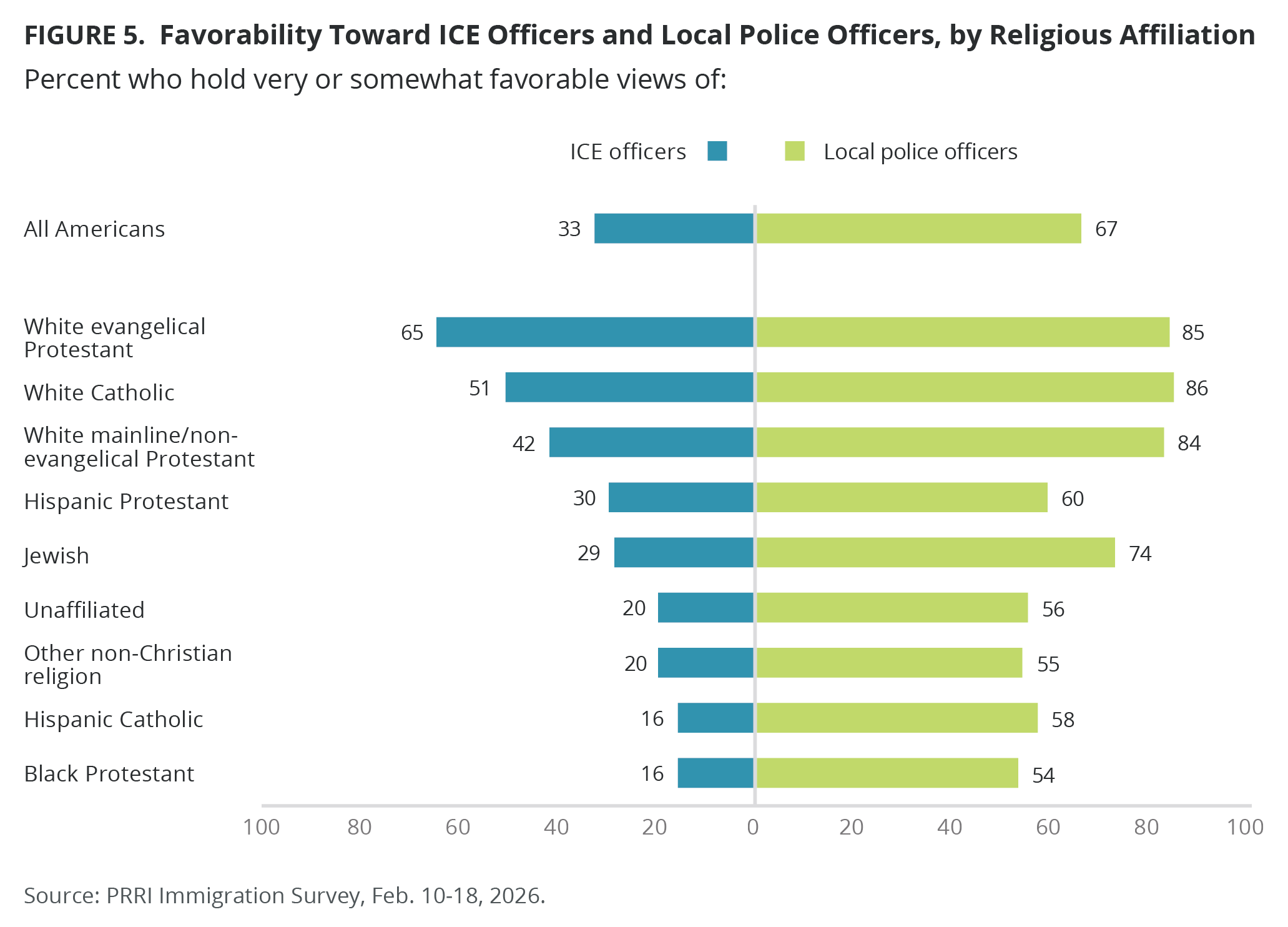
Solid majorities across Christian nationalism groups view local police officers favorably, including Christian nationalism Adherents (80%), Sympathizers (76%), Skeptics (72%), and Rejecters (55%).
White Americans (77%) are the most likely to express favorable views toward local police officers, followed by smaller majorities of AAPI Americans (59%) and Hispanic Americans (55%). By contrast, Black Americans (49% favorable vs. 42% unfavorable) and multiracial Americans (47% favorable vs. 40% unfavorable) are more divided.
Majorities across all age groups and education levels hold favorable views of local police officers, though older Americans and Americans without a college degree are more likely to do so than younger Americans and college graduates. Favorable views of local police officers differ slightly between men and women.
Increase Funding for U.S. Immigration and Customs Enforcement (ICE)
Just 36% of Americans favor the increase in funding for U.S. Immigration and Customs Enforcement (ICE) to increase efforts to arrest, detain, and deport undocumented immigrants, while a majority oppose it (60%). Support varies significantly by party: Around three in four Republicans (76%) favor the funding increase, compared with 29% of independents and only 8% of Democrats.
Among religious groups, white evangelical Protestants (66%) and white Catholics (54%) are the most likely to support the increase in funding for ICE, followed by white mainline/non-evangelical Protestants (47%). Christians of color and non-Christians are less likely to support the increase in ICE funding, including one-third of Jewish Americans (33%), roughly one in four Hispanic Protestants (24%), members of other non-Christian religions (23%), Black Protestants (22%), and unaffiliated Americans (22%), and one in five Hispanic Catholics (20%).
Most Christian nationalism Adherents (70%) and Sympathizers (61%) support the increase in funding, compared with one-third of Skeptics (33%), and only 8% of Rejecters.
Although still a minority, white Americans, older Americans, men, and Americans without a college degree are more likely than Americans of color, younger Americans, women, and Americans with a college degree to favor the increase in funding for ICE.
ICE Conducting Operations at Sensitive Locations
Just one in four Americans (24%) favor allowing ICE officers to regularly conduct surveillance and arrests at sensitive locations like schools, hospitals, places of worship, and social service locations, compared with most Americans who oppose it (72%). A majority of Republicans (54%) favor this policy, compared with 20% of independents and only 5% of Democrats.
Although no religious group shows majority support, white evangelical Protestants (44%) are the most likely to support ICE officers conducting surveillance at sensitive locations, followed by around one-third of white Catholics (35%) and white mainline/non-evangelical Protestants (32%), and one-quarter of Jewish Americans (23%). Less than two in ten members of other non-Christian religions (18%), unaffiliated Americans (18%), Hispanic Protestants (15%), Black Protestants (14%), and just 11% of Hispanic Catholics are in favor.
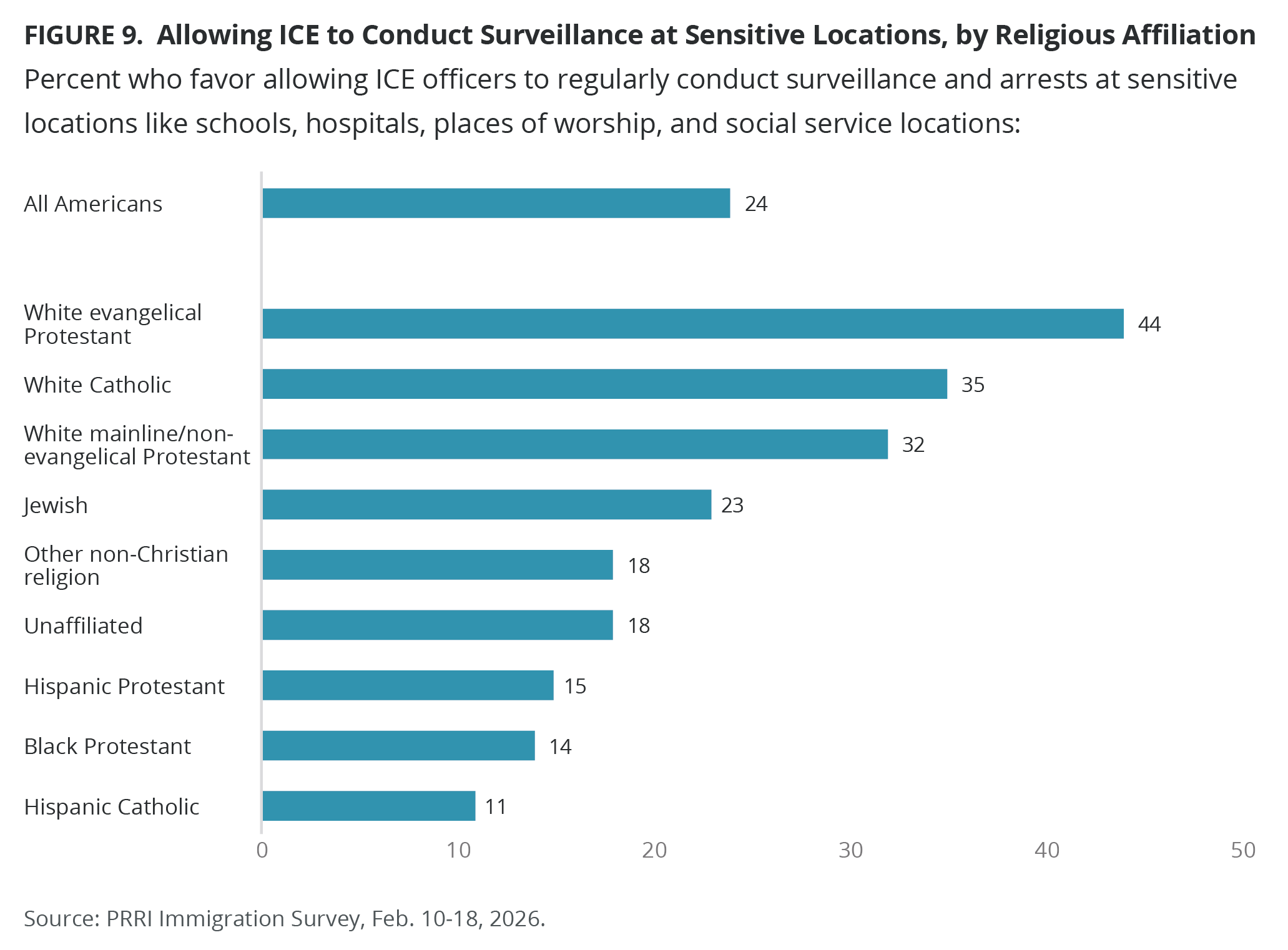
A slim majority of Christian nationalism Adherents (53%) favor ICE officers conducting surveillance at sensitive locations, compared with 41% of Sympathizers, 22% of Skeptics, and only 6% of Rejecters.
Although support remains relatively low overall, white Americans, older Americans, and men are more likely than Americans of color, younger Americans, and women to favor allowing ICE officers to regularly conduct surveillance and arrests at sensitive locations.
Allowing ICE to Detain and Relocate Undocumented Immigrants Without Due Process
Nearly three in ten Americans (28%) favor allowing Immigration, Customs, and Enforcement (ICE) officers to arrest and relocate undocumented immigrants to detention centers in states far from their home without allowing them to challenge their detainment in court, compared with most Americans who oppose it (68%). Republicans (61%) are about three times as likely as independents (23%) and 10 times as likely as Democrats (6%) to favor this policy.
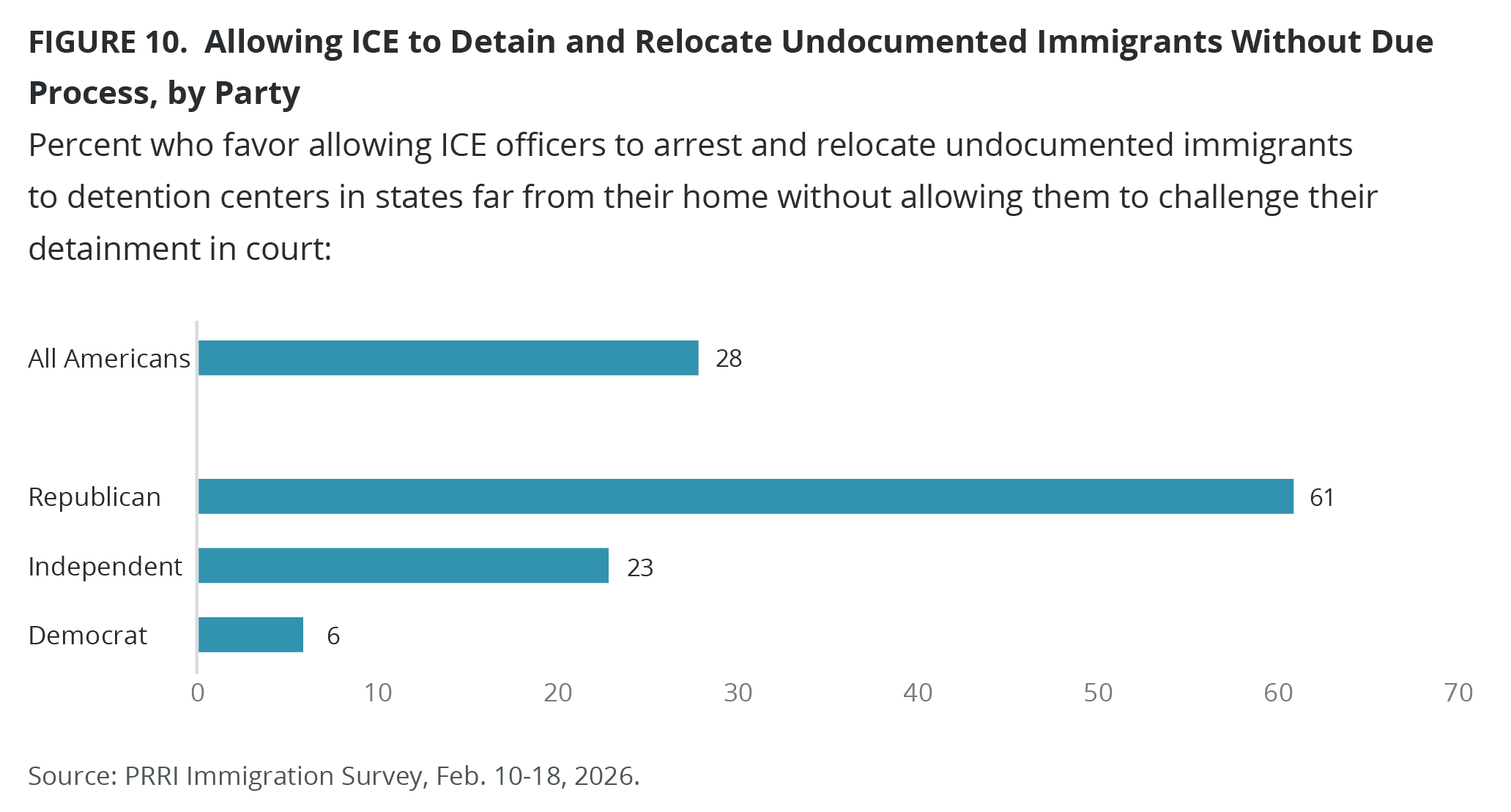
Except for white evangelical Protestants (51%), no other religious group shows majority support for allowing ICE to detain and relocate undocumented immigrants without due process. About four in ten white Catholics (43%) and white mainline/non-evangelical Protestants (38%) also favor this policy, followed by 24% of Jewish Americans and roughly two in ten Hispanic Protestants (20%), members of other non-Christian religions (19%), unaffiliated Americans (18%), Black Protestants (17%). Hispanic Catholics (11%) are the least likely to favor this policy.
A slim majority of Christian nationalism Adherents (57%) favor allowing ICE to detain and relocate undocumented immigrants to detention centers far from their home without due process, compared with 49% of Sympathizers, 26% of Skeptics, and only 7% of Rejecters.
Although support remains relatively low overall, white Americans, older Americans, men, and Americans without a college degree are more likely than Americans of color, younger Americans, and women to favor allowing ICE officers to arrest and relocate undocumented immigrants to detention centers without due process.
ICE Officers Not Being Allowed to Conceal Their Identities
About six in ten Americans (61%) agree that ICE officers should not be allowed to conceal their identity with masks or unmarked vehicles when arresting people, while around one-third of Americans (35%) disagree. Agreement has increased slightly from 58% in September 2025. Most Democrats (88%) and independents (67%) agree that ICE agents should not be allowed to conceal their identities, compared with 30% of Republicans. Agreement slightly increased among both Democrats (from 84%) and independents (from 64%) since September 2025 but remained unchanged among Republicans.
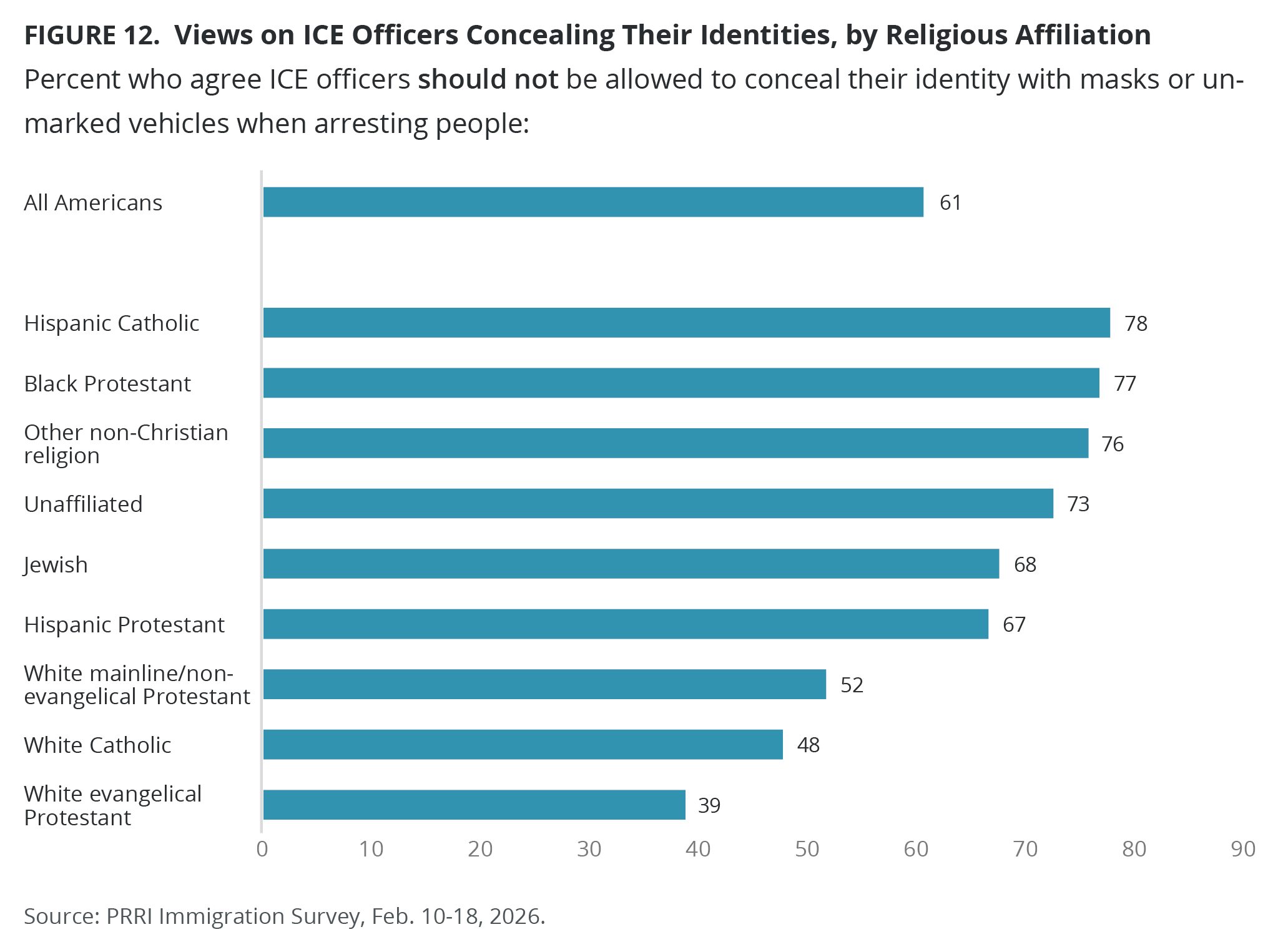
Around three in four Hispanic Catholics (78%), Black Protestants (77%), members of other non-Christian religions (76%), and religiously unaffiliated Americans (73%) agree that ICE officers should not be allowed to conceal their identities, as do around two-thirds of Jewish Americans (68%) and Hispanic Protestants (67%). Around half of white mainline/non-evangelical Protestants (52%) and white Catholics (48%) also agree. White evangelical Protestants are the only religious group in which a majority disagree that ICE officers should not be allowed to conceal their identities (59% disagree vs. 39% agree).
Most Christian nationalism Rejecters (89%) and Skeptics (64%) agree that ICE agents should not be allowed to conceal their identities, compared with 45% of Sympathizers and 34% of Adherents.
While majorities across all racial groups agree that ICE officers should not conceal their identities, multiracial and white Americans are the least likely to hold this view. Similarly, majorities across age groups, education levels, and gender agree. However, younger Americans, women, and college graduates are more likely than older Americans, men, and those without a college degree to agree that ICE officers should not conceal their identities.
Broad Support for Holding ICE Officers Accountable for Violent Actions
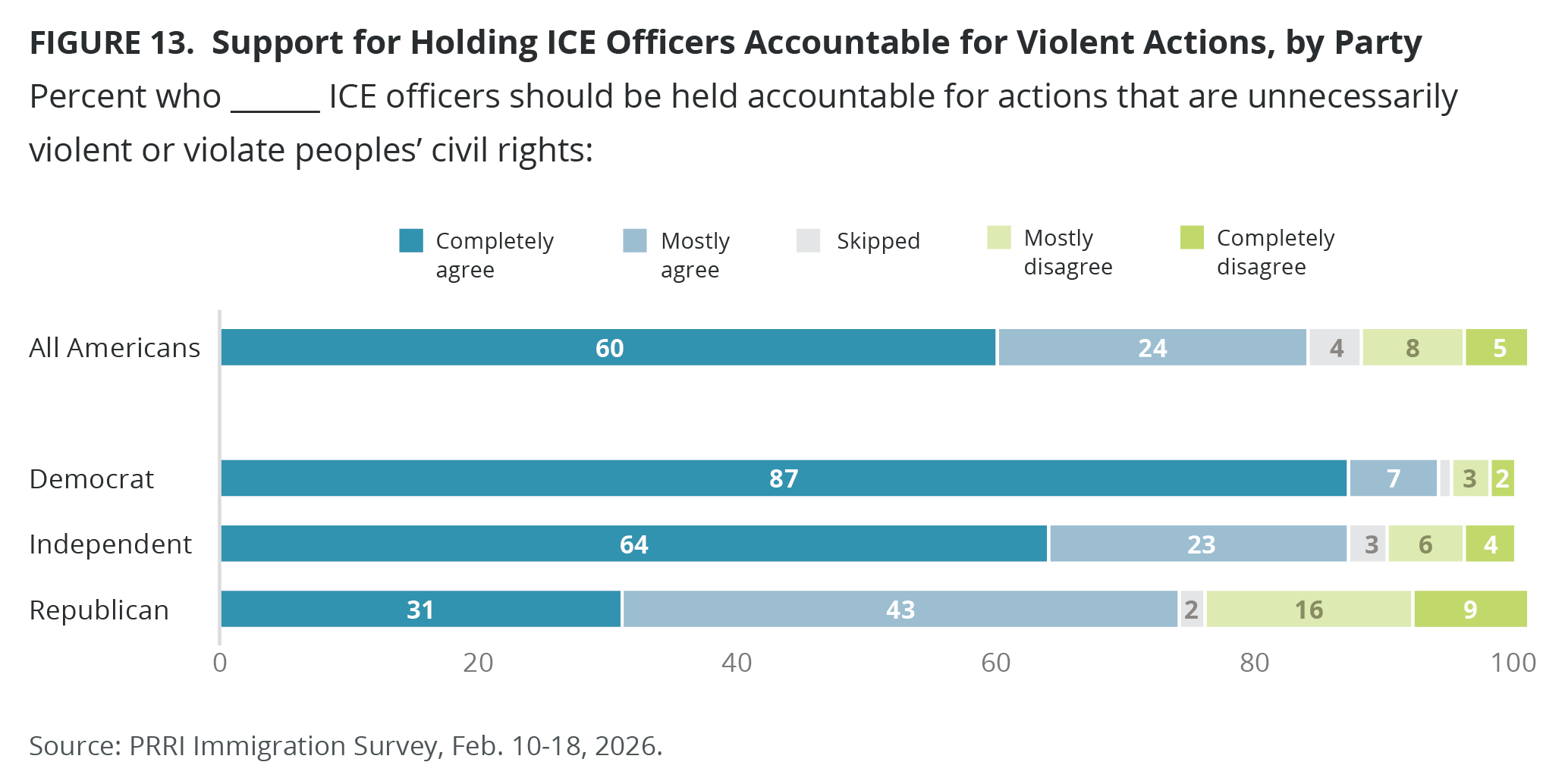
Most Americans (84%) agree that ICE officers should be held accountable for actions that are unnecessarily violent or violate peoples’ civil rights, including 94% of Democrats, 87% of independents, and 74% of Republicans. Only 13% of Americans disagree with this idea. Majorities across religious affiliations agree.
The Surge of ICE Officers Makes Communities Less Safe
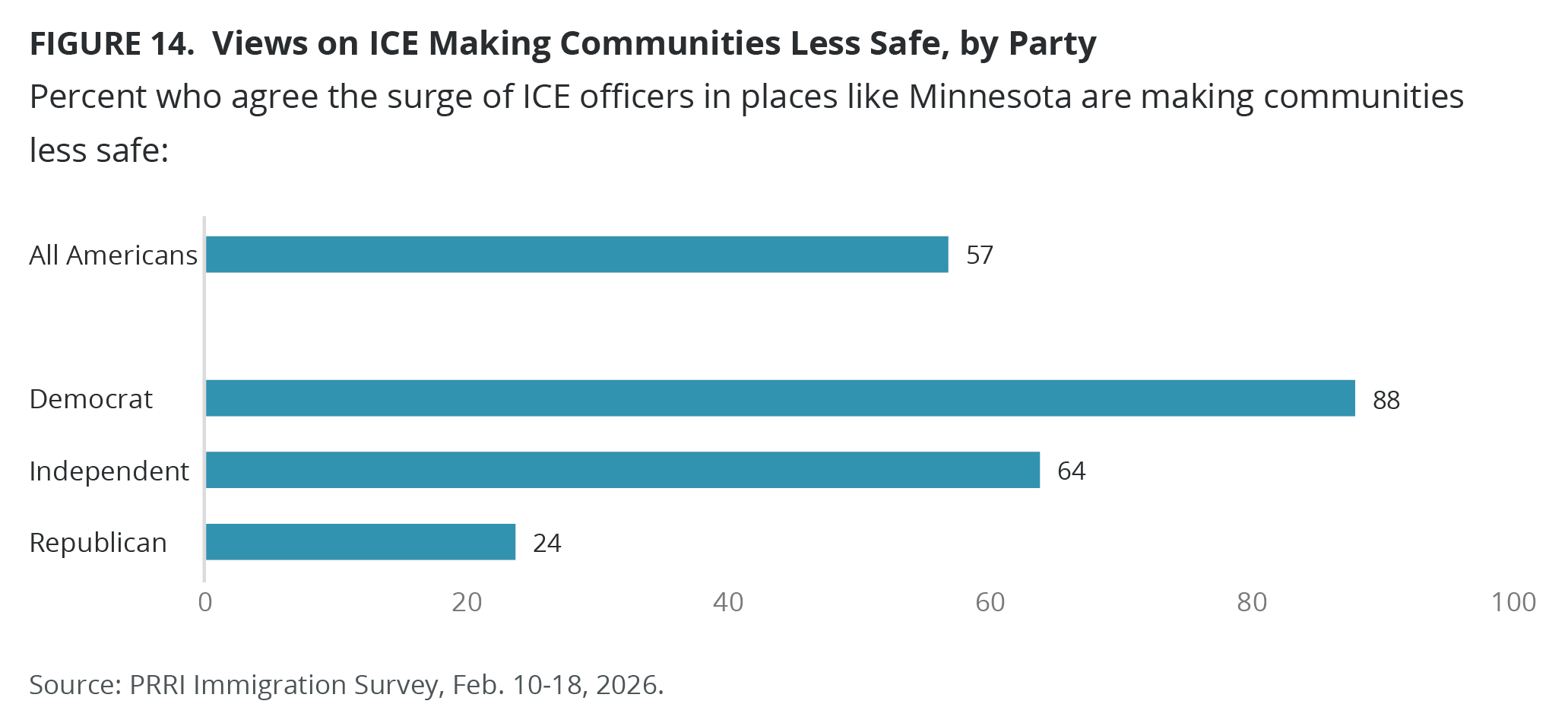
The majority of Americans (57%) agree that the surge of ICE officers in places like Minnesota are making communities less safe, compared with 38% who disagree. Most Democrats (88%) and independents (64%) agree, compared with just 24% of Republicans.
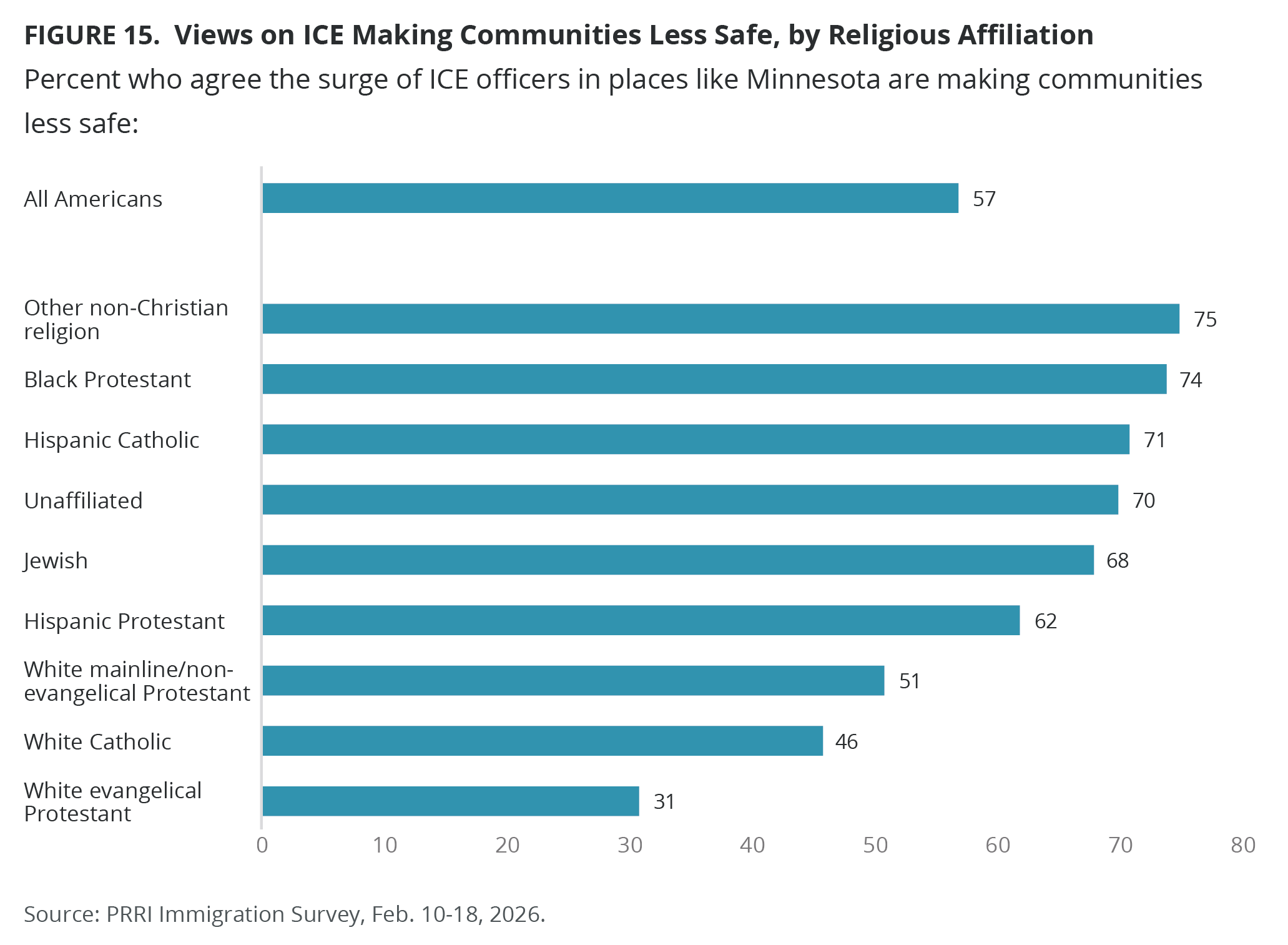
Solid majorities of members of other non-Christian religions (75%), Black Protestants (74%), Hispanic Catholics (71%), religiously unaffiliated Americans (70%), Jewish Americans (68%), and Hispanic Protestants (62%) agree that ICE officers are making communities less safe, compared with about half of white mainline/non-evangelical Protestant (51%) and white Catholics (46%). White evangelical Protestants (31%) are the least likely to agree that ICE officers are making communities less safe.
Most Christian nationalism Rejecters (87%) and Skeptics (59%) agree that ICE officers are making communities less safe, compared with 39% of Sympathizers and 31% of Adherents.
Except for white Americans (50%) and Americans ages 50-64 (51%), solid majorities across racial and age groups, education levels, and gender agree that ICE officers are making communities less safe.
Immigration Policy: Internment Camps, Self-Deportation, and Refugees
Internment Camps for Undocumented Immigrants
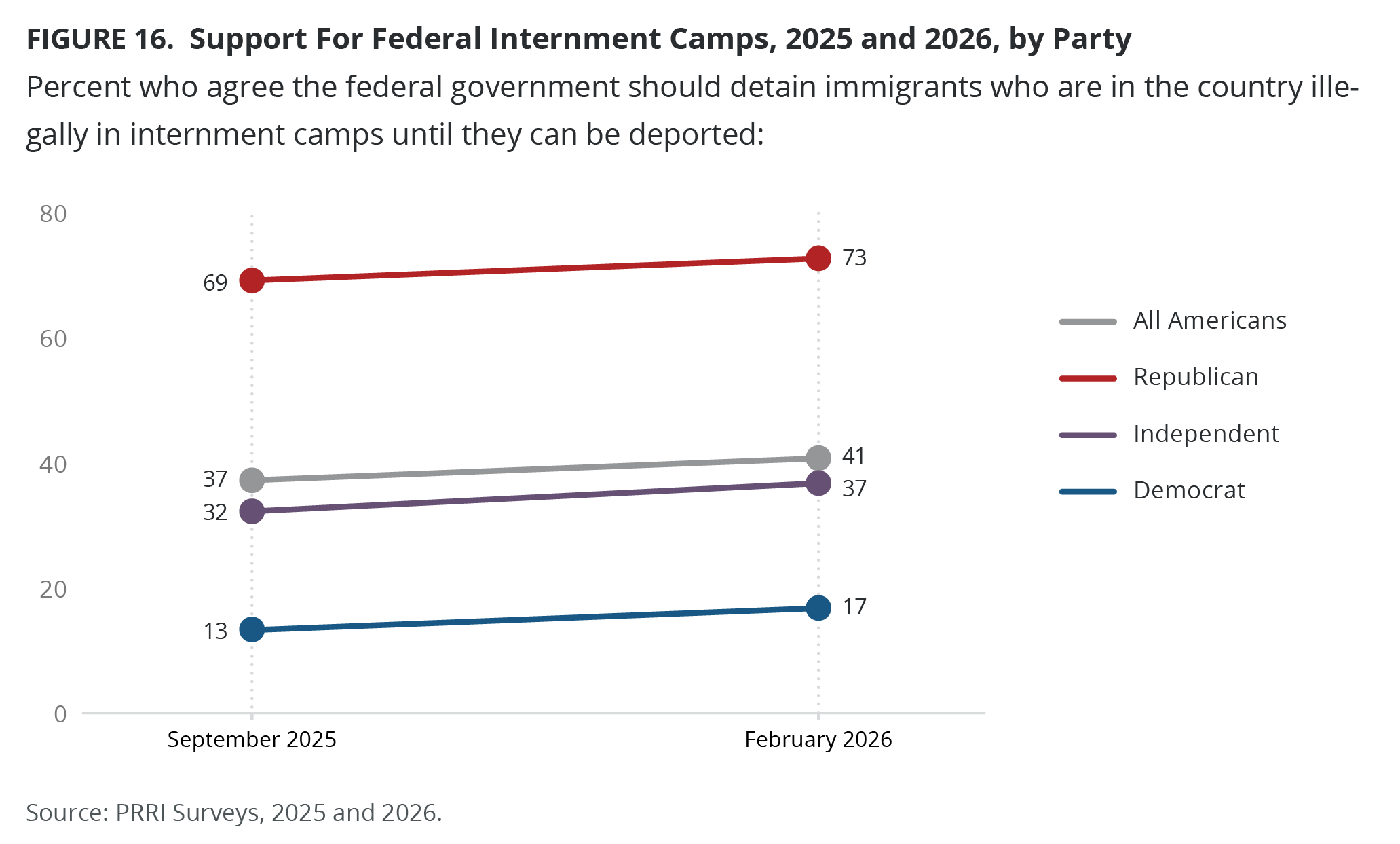
Four in ten Americans (41%) agree that the federal government should detain immigrants who are in the country illegally in internment camps until they can be deported, while 55% disagree. Agreement has increased by 4 percentage points since September 2025, when it stood at 37%. Republicans (73%) are about twice as likely as independents (37%) and four times as likely as Democrats (17%) to agree. However, all partisans have become slightly more likely to agree since September 2025, from 69%, 32%, and 13%, respectively.
White evangelical Protestants (63%) and white Catholics (55%) are the only religious groups with majority agreement, followed by white mainline/non-evangelical Protestants (49%). Smaller shares of Jewish Americans (38%), Black Protestants (36%), religiously unaffiliated (31%), members of other non-Christian religions (30%), Hispanic Protestants (29%), and Hispanic Catholics (25%) agree with the federal government detaining immigrants who are in the country illegally in internment camps until they can be deported.
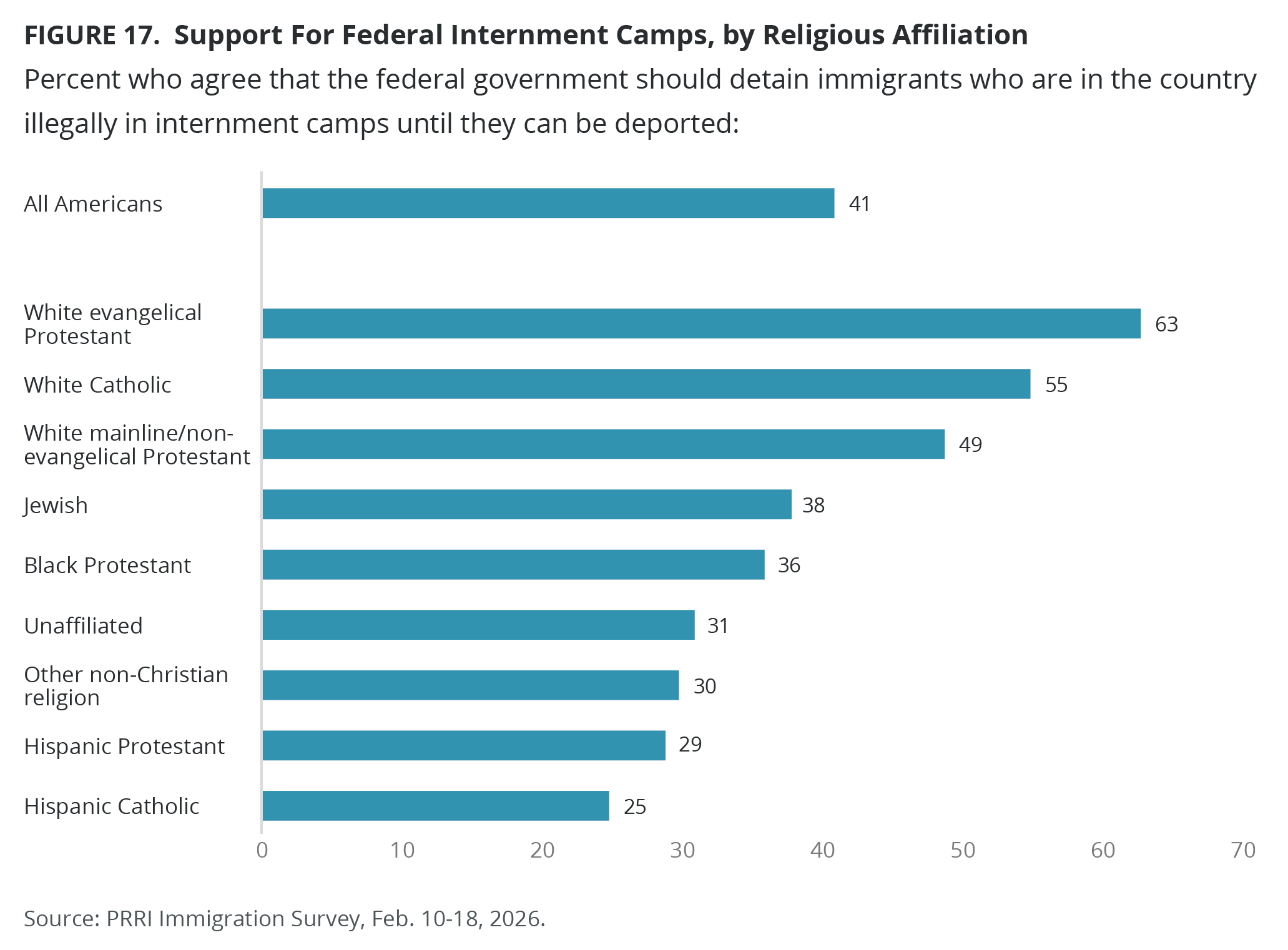
Christian nationalism Adherents (75%) and Sympathizers (62%) are the most likely to agree that the federal government should detain undocumented immigrants in internment camps, compared with 40% of Skeptics and just 15% of Rejecters.
No majority of any racial group, age group, education level, or gender agrees that the federal government should detain immigrants in internment camps until they can be deported, but white and AAPI Americans, older Americans, men, and those without a college education are more likely than Black, multiracial, and Hispanic Americans, as well as younger Americans, women, and college graduates, to agree.
Self-Deportation
Around two in ten Americans agree (21%) that the best way to fix illegal immigration is to make life so hard for illegal immigrants that they decide to go back to their home country by themselves, while 74% disagree. Support for this approach has decreased significantly from 34% since 2013 when this question was first asked. Support for self-deportations has declined across all partisan groups, with independents dropping from 35% to 18%, Democrats from 26% to 7%, and Republicans from 45% to 42%.
No religious group shows majority support for self-deportations. About three in ten white evangelical Protestants (31%) and white Catholics (29%) agree that making life so hard that immigrants leave on their own is the best way to fix illegal immigration, followed by one-quarter of Jewish Americans (25%) and white mainline/ non-evangelical Protestants (23%), and roughly two in ten members of other non-Christian religions (21%), Black Protestants (18%), Hispanic Protestants (17%), the religiously unaffiliated (17%), and Hispanic Catholics (16%).
The only group with majority support for self-deportations is Christian nationalism Adherents (51%). Support drops to 34% among Sympathizers, 18% among Skeptics, and just 7% among Rejecters.
Although very few Americans across racial groups, age groups, education levels, or gender agree that the best way to fix illegal immigration is to make life so hard for illegal immigrants that they decide to go back to their home country by themselves, AAPI and white Americans, older Americans, men, and those without a college education are more likely than multiracial, Black, and Hispanic Americans, as well as younger Americans, women, and college graduates, to agree.
Broad Support for Providing Refuge to People Facing Serious Danger
A large majority of Americans (72%) agree that “we should provide refuge for people who come to the U.S. if they are in serious danger in their home country,” while 24% disagree. Democrats (90%) and independents (74%) are more likely than Republicans (55%) to agree. Solid majorities across religious affiliation, Christian nationalism groups, race, education, age, and gender agree.
Perceptions of Immigrants and Immigrants’ Rights
The “Great Replacement Theory”
One-third of Americans (33%) agree with the statement “Immigrants are invading our country and replacing our cultural and ethnic background,” compared with 62% who disagree. Agreement has declined slightly since PRRI first asked this question in 2019, when it stood at 36%, and from its recent peaks of 38% in September 2023 and 37% in March 2024.
Republicans (66%) are over twice as likely as independents (28%) and over six times as likely as Democrats (10%) to agree. Since 2019, both Democrats and independents have become less likely to agree, declining from 20% and 31%, respectively. By contrast, Republicans have become slightly more likely to agree, increasing from 63% to 66%, close to their peak of 67% in March 2024.
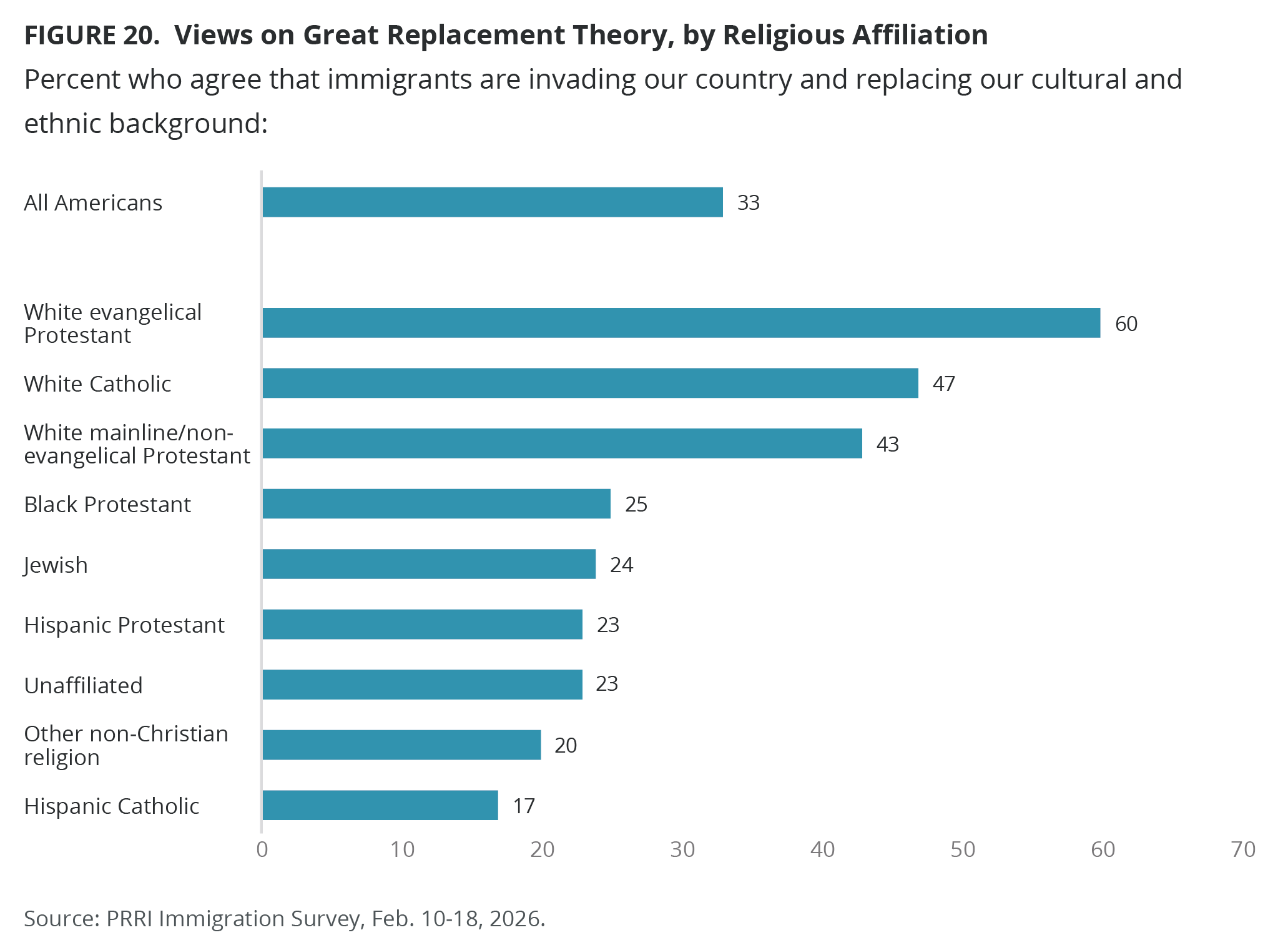
Except for white evangelical Protestants, no religious tradition shows majority agreement with the “great replacement theory.” Around four in ten white Catholics (47%) and white mainline/non-evangelical Protestants (43%) agree, as well as roughly one in four Black Protestants (25%), Jewish Americans (24%), Hispanic Protestants (23%), unaffiliated Americans (23%), members of other non-Christian religions (20%), and Hispanic Catholics (17%). By contrast, most white evangelical Protestants (60%) agree.
Most Christian nationalism Adherents (70%) and Sympathizers (58%) agree that immigrants are invading the country and replacing our cultural and ethnic background, compared with 29% of Skeptics and 8% of Rejecters.
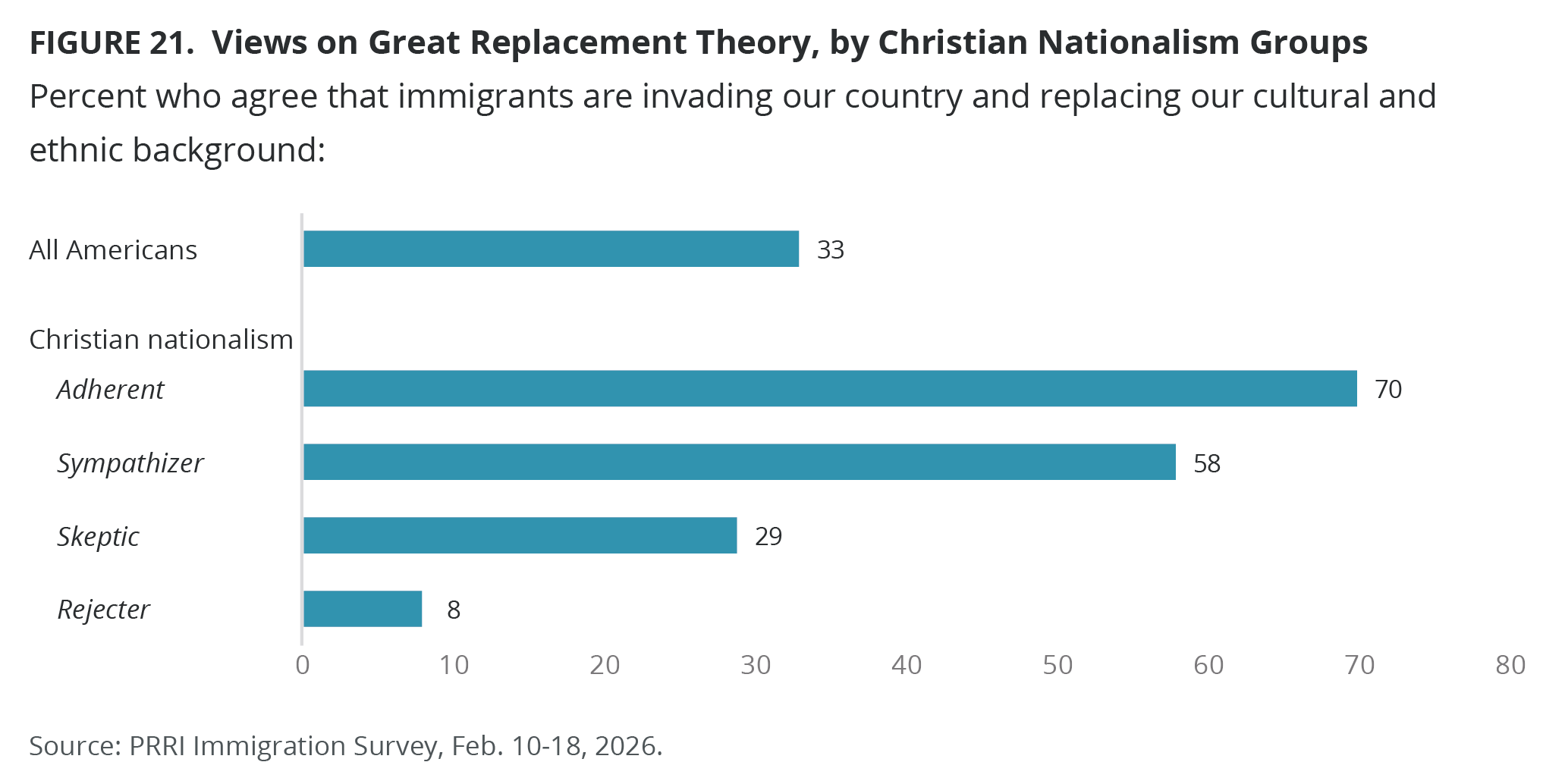
Although few Americans across racial groups, age groups, education levels or gender agree with the “great replacement theory,” white Americans, older Americans, men, and those without a college education are more likely than Americans of color, younger Americans, women, and college graduates to agree.
Immigrants Strengthen American Society
Most Americans (54%) agree with the statement that “the growing number of newcomers from other countries strengthens American society,” while 42% disagree. Agreement has fallen from 63% at the end of 2022, when PRRI first asked this question. The decline is driven mainly by Republicans, from 35% to 26%, and independents, from 67% to 57%. Democrats have remained essentially unchanged (81% to 82%).
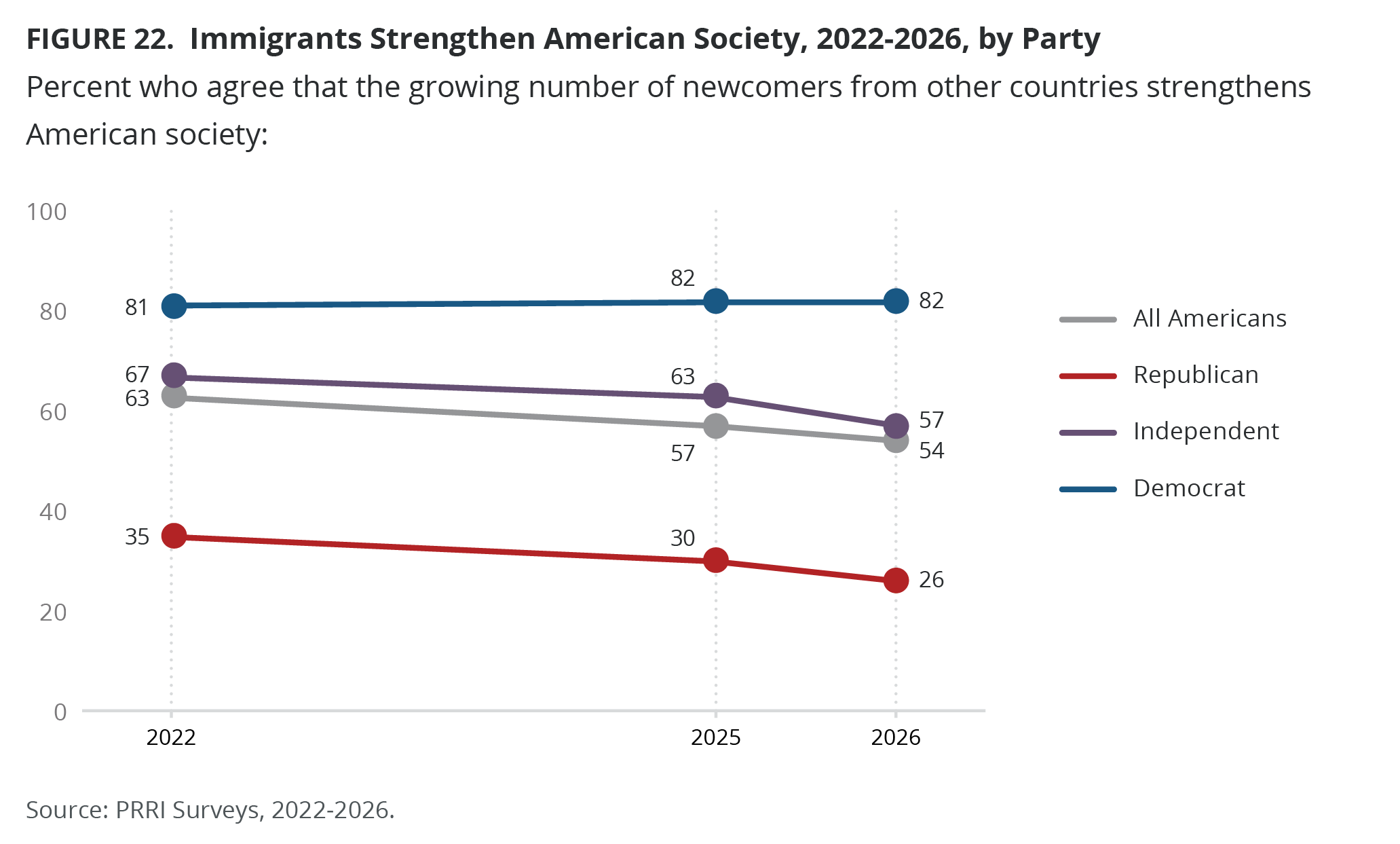
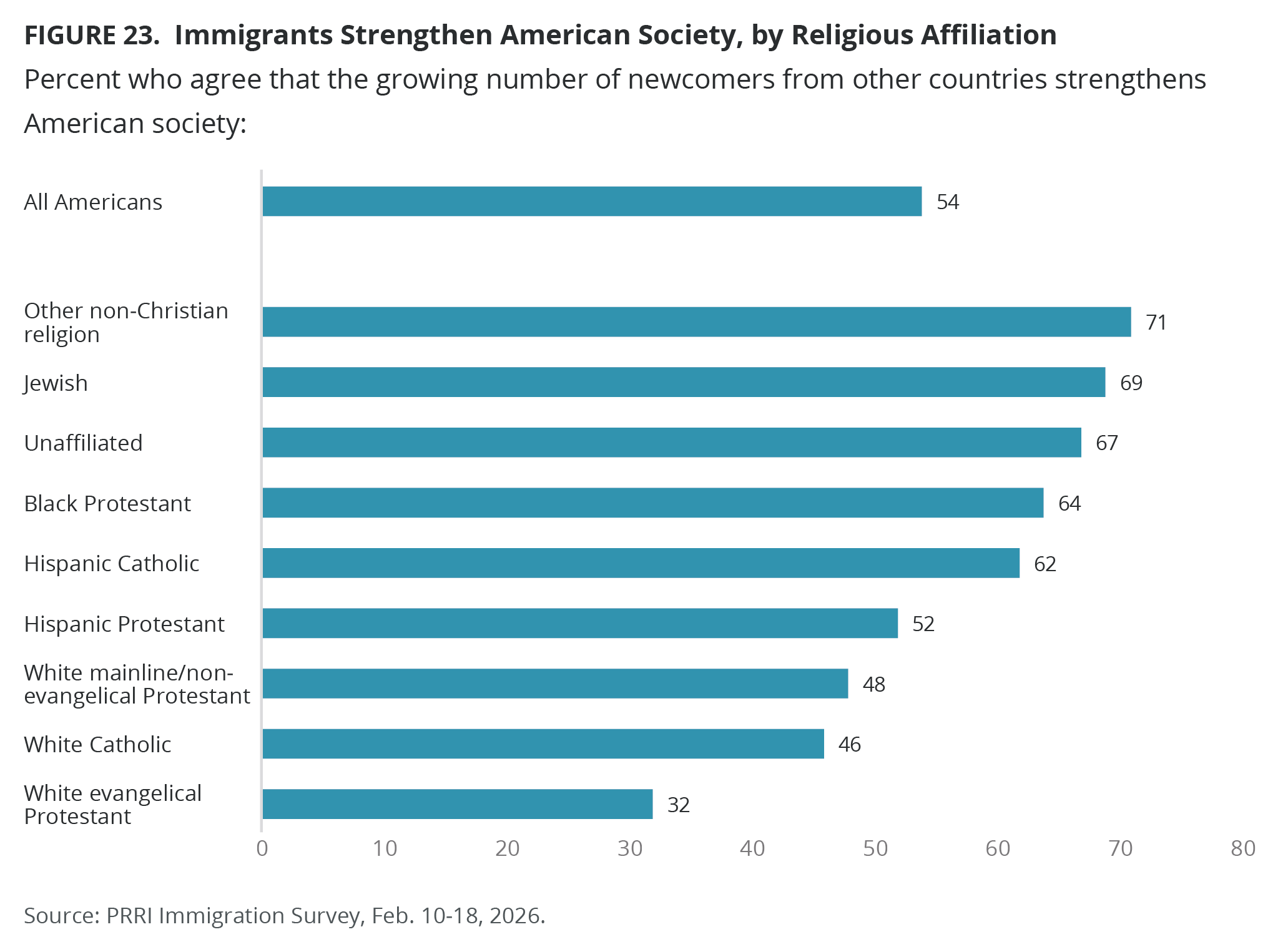
White Christian groups are among the least likely to say immigrants strengthen American society. Only one-third of white evangelical Protestants (32%) agree, while white mainline/non-evangelical Protestants (48% agree vs. 48% disagree) and white Catholics (46% agree vs. 52% disagree) are roughly split. Hispanic Protestants are also split (52% agree and 46% disagree). By contrast, majorities of other non-Christians (71%), Jewish Americans (69%), religiously unaffiliated Americans (67%), Black Protestants (64%), and Hispanic Catholics (62%) agree.
Most Christian nationalism Rejecters (82%) and Skeptics (57%) agree that immigrants strengthen American society, compared with 35% of Sympathizers and 29% of Adherents.
While there are no differences by gender, white Americans, older Americans, and those without a college education are less likely than Americans of color, younger Americans, and college graduates to agree that immigrants strengthen American society.
Immigrants Should Have Due Process Regardless of Legal Status
About six in ten Americans (61%) agree with the idea that “immigrants, regardless of legal status, should have the right to challenge their deportation in court,” while 36% disagree. Most Democrats (88%) and independents (63%) agree, compared with just one-third of Republicans (32%). Independents have become slightly less likely to agree, from 67% since September 2025 when PRRI first asked this question, while Republicans and Democrats have remained largely unchanged.
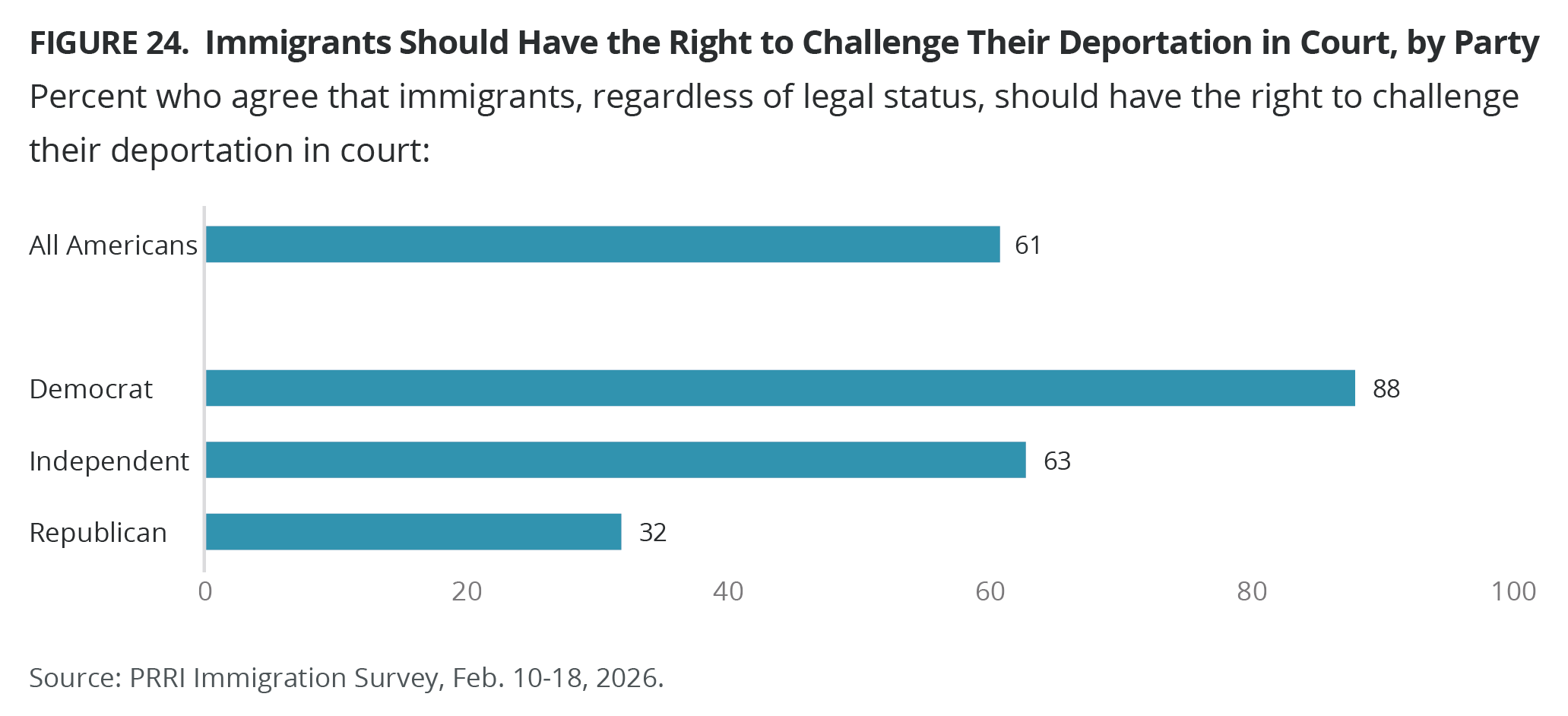
Except for white Christian groups, solid majorities across all other religions agree that immigrants should have basic rights — including due process — regardless of legal status. By contrast, agreement is lower among white Christians: 54% of white mainline/non-evangelical Protestants, half of white Catholics (48%), and just 35% of white evangelical Protestants agree.
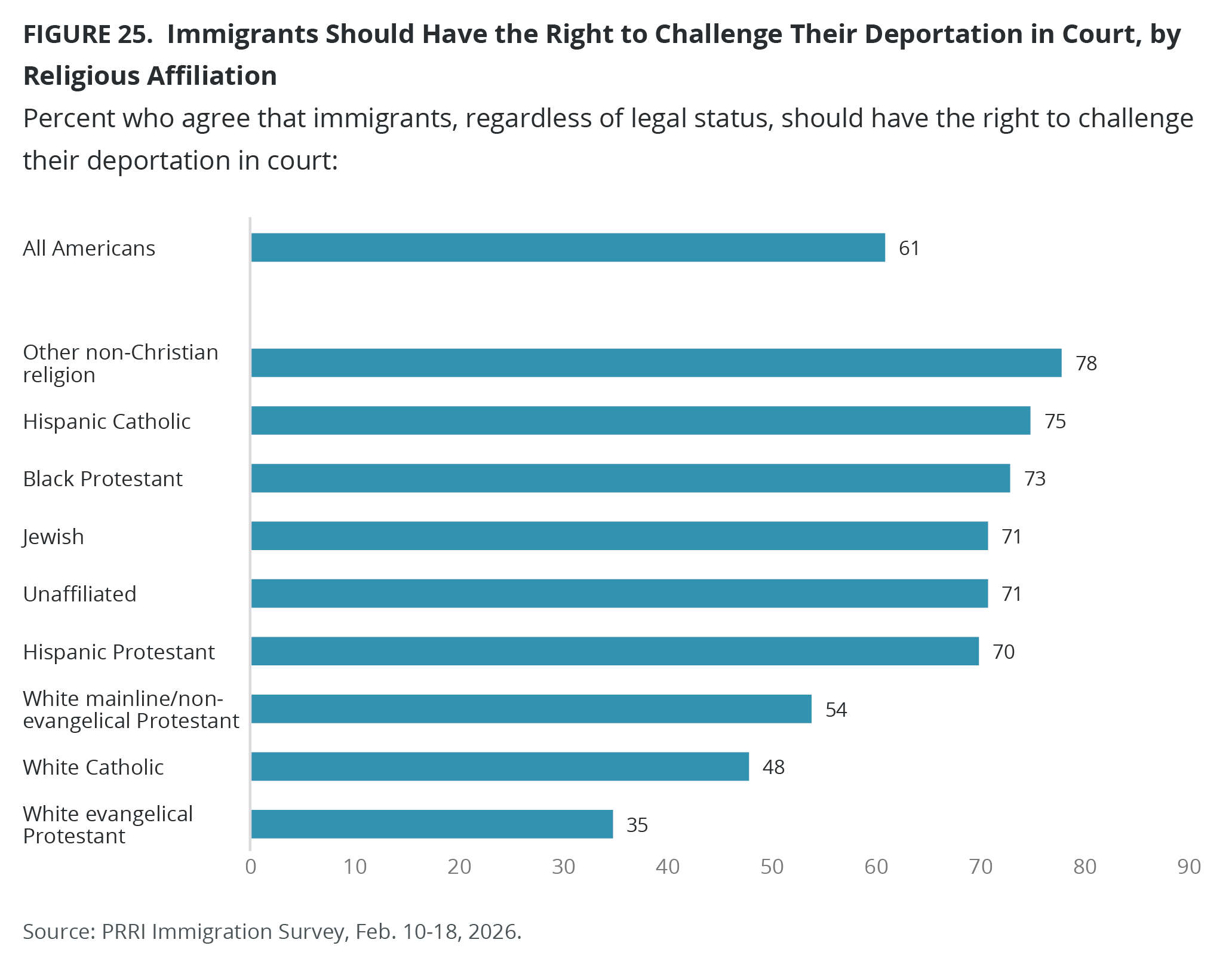
Most Christian nationalism Rejecters (86%) and Skeptics (62%) favor immigrants’ basic rights regardless of legal status, compared with 45% of Sympathizers and 35% of Adherents.
Solid majorities of all racial and age groups agree that immigrants should have basic rights and protections regardless of legal status. However, white Americans (52%) are less likely than Americans of color to agree, as are older than younger Americans. Women and Americans with a four-year college degree or higher are more likely than men and those without a four-year degree to agree.
Free Speech, Government Criticism, and Citizenship
Concerns Over Declining Protection of the Right to Criticize the Government
Two-thirds of Americans (67%) agree that “the ability of Americans to freely criticize the government without fear of punishment is a right that seems less protected than in previous years,” compared with 30% of those who disagree. Concerns over declining protection of the right to criticize the government have dropped among Republicans since September 2025, from 54% to 41%, and slightly declined among independents, from 73% to 70%. However, among Democrats, concerns over free speech protections increased from 86% to 90%.
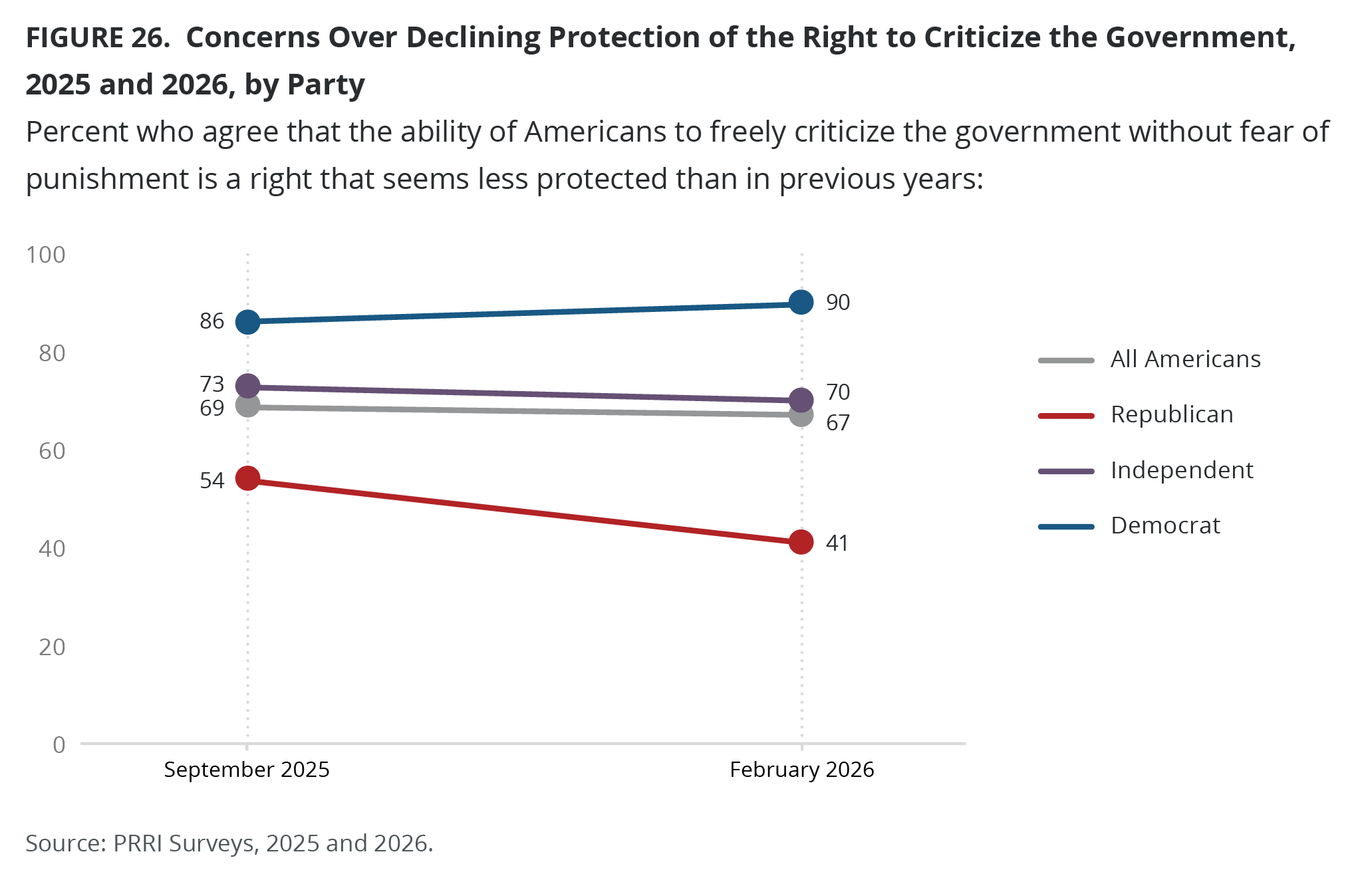
Large majorities of Black Protestants (82%), Jewish Americans (79%), the religiously unaffiliated (77%), other non-Christian groups (76%), Hispanic Catholics (75%), and Hispanic Protestants (70%) agree that the American ability to criticize the government seems less protected now than in previous years. White religious groups are less likely to agree, including 62% of white mainline/non-evangelical Protestants, 56% of white Catholics, and 44% of white evangelical Protestants. White evangelical Protestants are the only religious group without majority agreement.
Roughly half of Christian nationalism Adherents and Sympathizers (both 49%) agree that government criticism is less protected now than in previous years while overwhelming majorities of Skeptics (69%) and Rejecters (91%) feel the same.
Majorities across racial groups, age groups, gender, and education levels agree that the ability of Americans to freely criticize the government without fear of punishment is a right that seems less protected than in previous years.
Strong Opposition to Government Surveillance of Americans Who Protest
Most Americans (81%) oppose “allowing the U.S. government to collect personal data and build a database of Americans who protest government actions,” while just 16% are in favor. Most Democrats (93%), independents (86%), and Republicans (65%) oppose government surveillance.
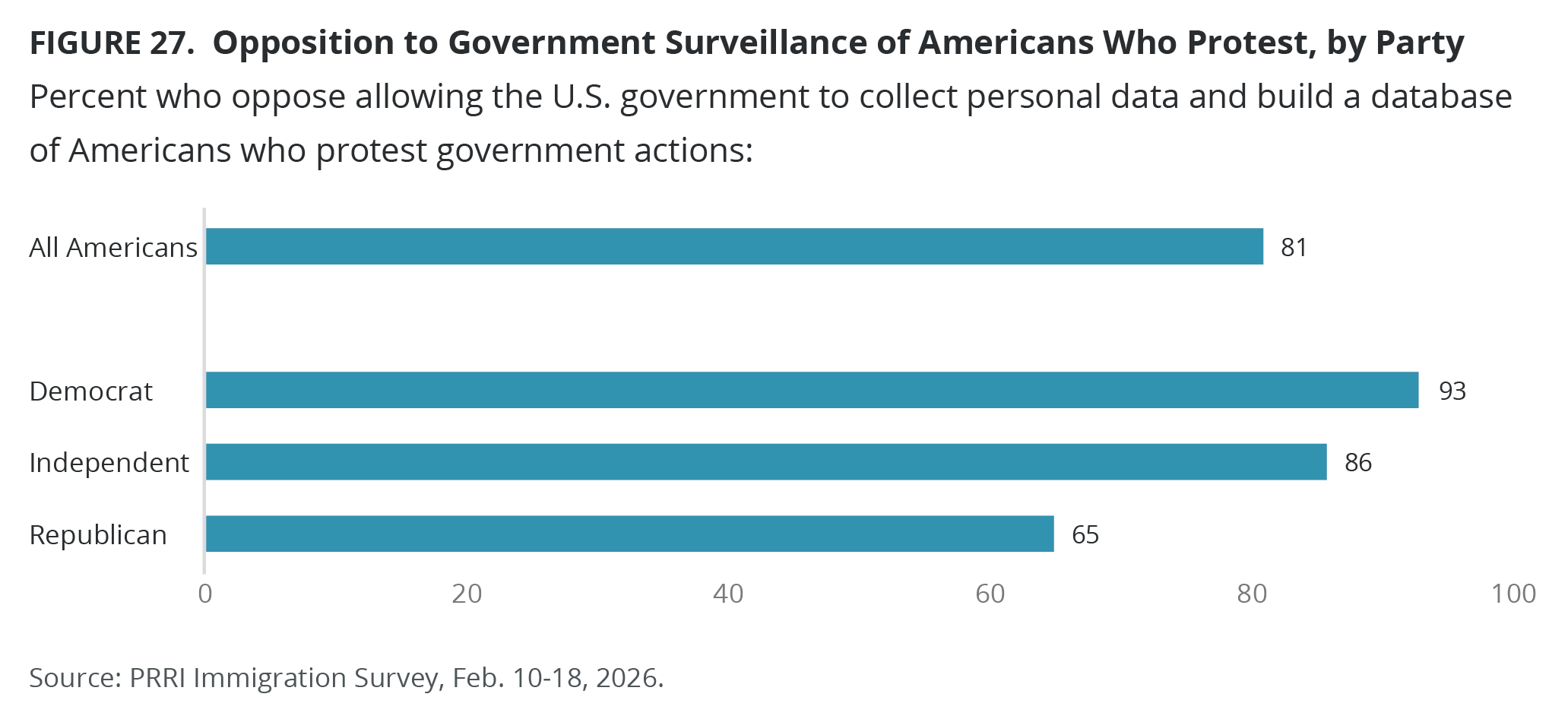
Solid majorities across religious affiliation, Christian nationalism groups, race, education, age, and gender oppose government surveillance of Americans who protest.
Stripping Citizenship and Deporting U.S. Citizens Deemed a Threat to the Country
Roughly one-third of Americans (35%) favor “stripping U.S. citizens of their citizenship and deporting them if they are determined to be a threat to the country,” while 61% oppose this policy. Support has declined since the last time PRRI asked this question in December 2025, when 41% were in favor. Support has also decreased across all partisan groups, from 60% to 55% among Republicans, 38% to 31% among independents, and 27% to 20% among Democrats.
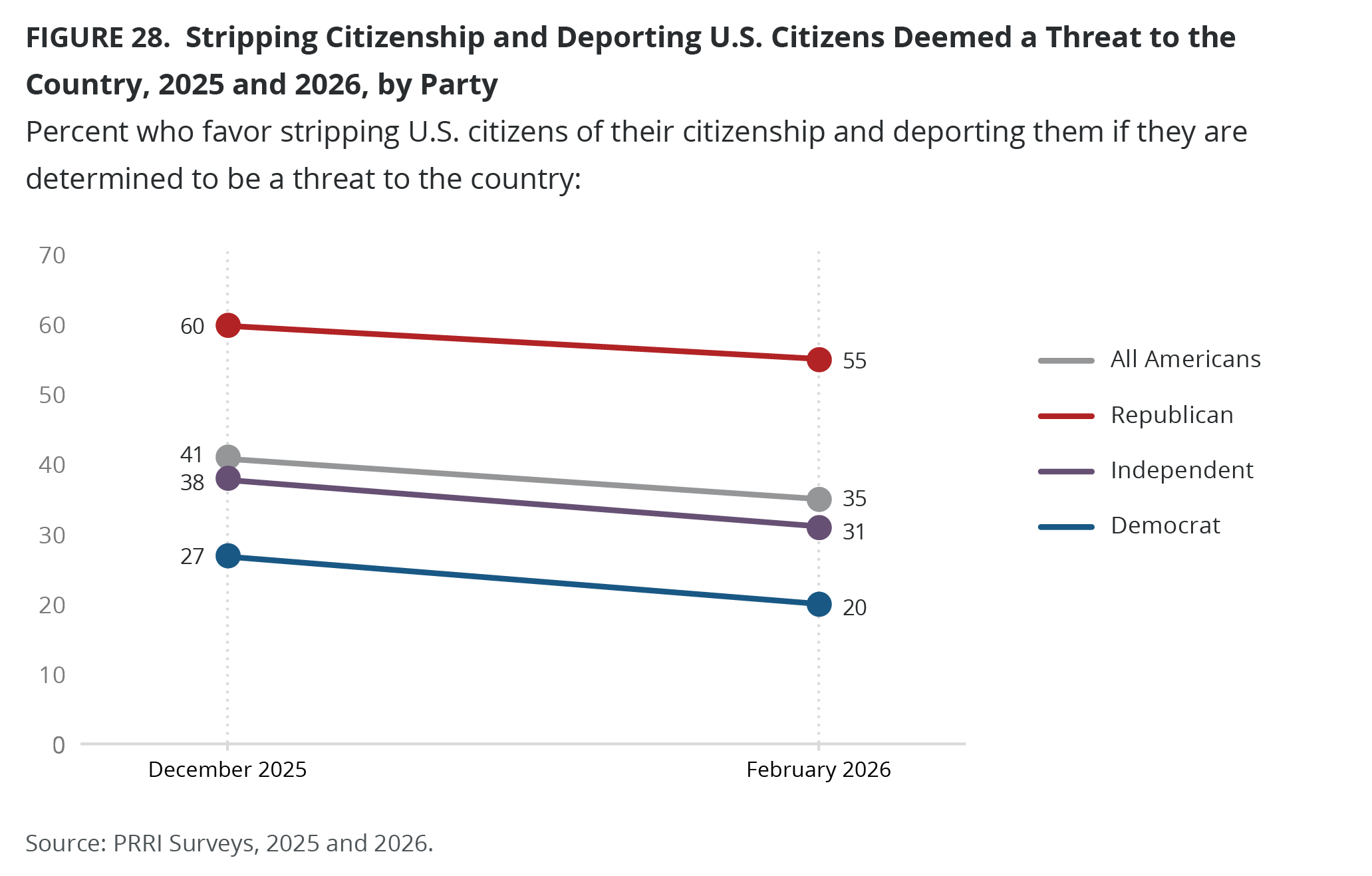
White evangelical Protestants (48%) are the most likely to favor this policy, followed by white Catholics (42%), white mainline/non-evangelical Protestants and Hispanic Protestants (both 38%), Black Protestants (37%), Hispanic Catholics (33%), Jewish Americans and other non-Christians (both 29%), and the religiously unaffiliated (28%).
Majorities of Christian nationalism Adherents (58%) and Sympathizers (51%) are in favor of stripping U.S. citizens of their citizenship and deporting them if they are deemed a threat, compared with 35% of Skeptics and 15% of Rejecters.
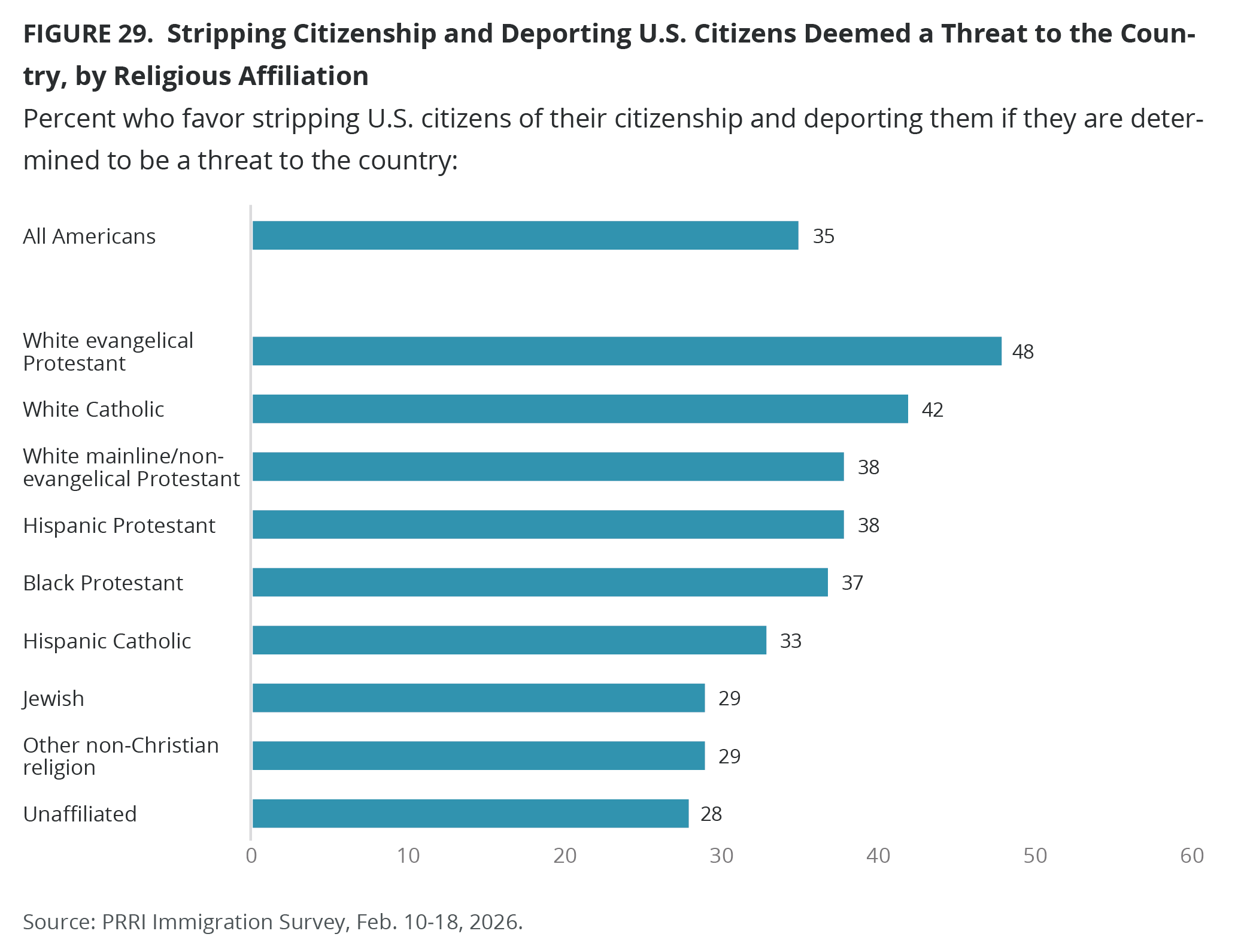
Americans of color, younger Americans, and college graduates are less likely than white Americans, older Americans, and non-college graduates to favor stripping U.S. citizens of their citizenship.
How Do Americans Perceive the Term “Christian Nationalism”?
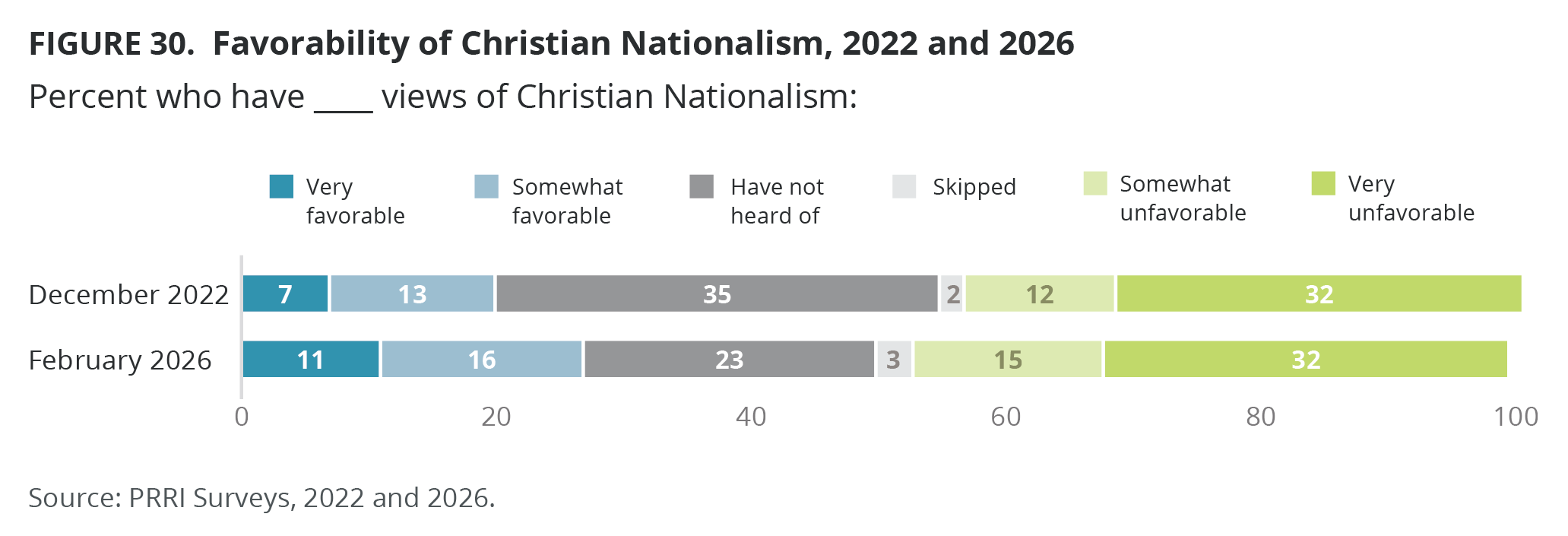
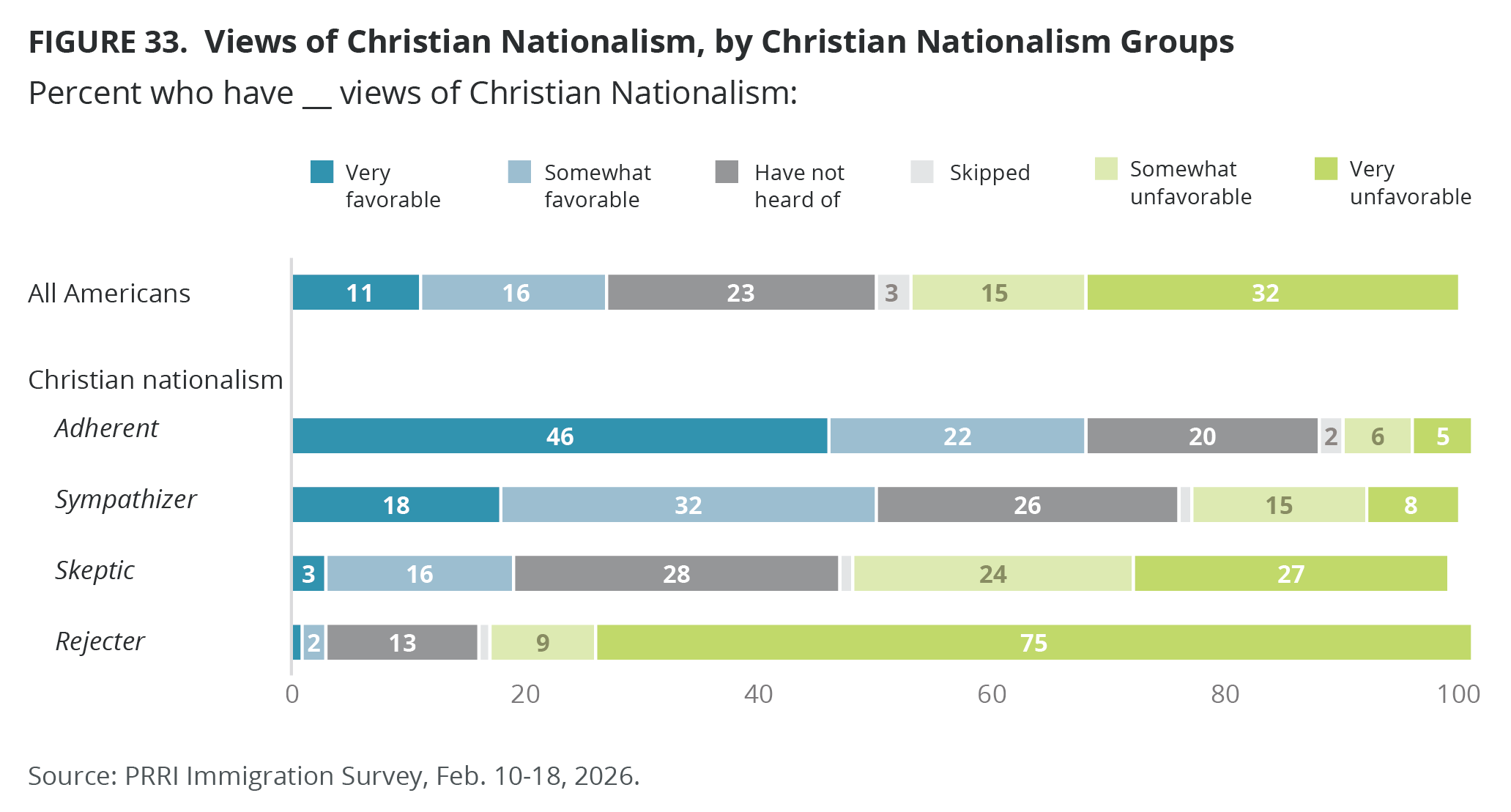
Just 27% of Americans hold favorable views of the term “Christian nationalism,” compared with 47% who hold unfavorable views. In addition, nearly one in four Americans (23%) have not heard of this term. Compared to 2022, the percentage of Americans who hold favorable views of the term is up 7 points from 20%, and the percentage who hold unfavorable views is up only 3 points from 44%. The number of Americans who say they have not heard of the term has dropped significantly, from 35% to 23%.
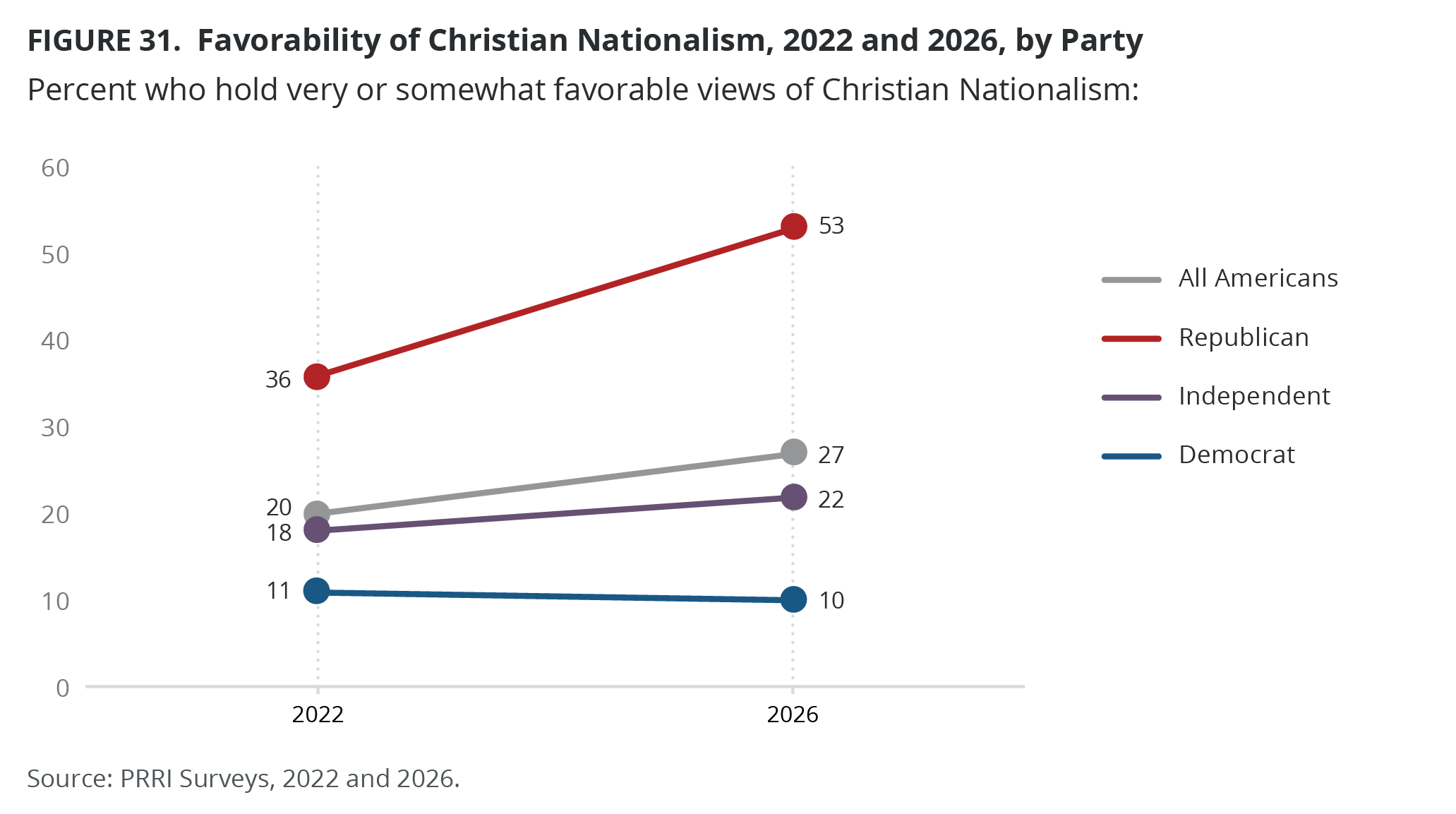
Partisan divides remain stark: A majority of Republicans (53%) view Christian nationalism favorably, compared with 22% of independents and only 10% of Democrats. While support among independents and Democrats has remained relatively stable since 2022, Republicans are increasingly embracing the term, with favorable views rising 17 points, from 36% to 53%.
A majority of white evangelical Protestants (54%) hold favorable views of the term “Christian nationalism,” followed by 44% of Hispanic Protestants. Christian nationalism favorability declines among white Catholics (35%), white mainline/non-evangelical Protestants (31%), and Black Protestants (27%), and is much lower among Hispanic Catholics (20%), members of other non-Christian religions (16%), Jewish Americans (14%), and religiously unaffiliated Americans (10%). Hispanic Catholics are the most likely to say they haven’t heard of the term (30%).
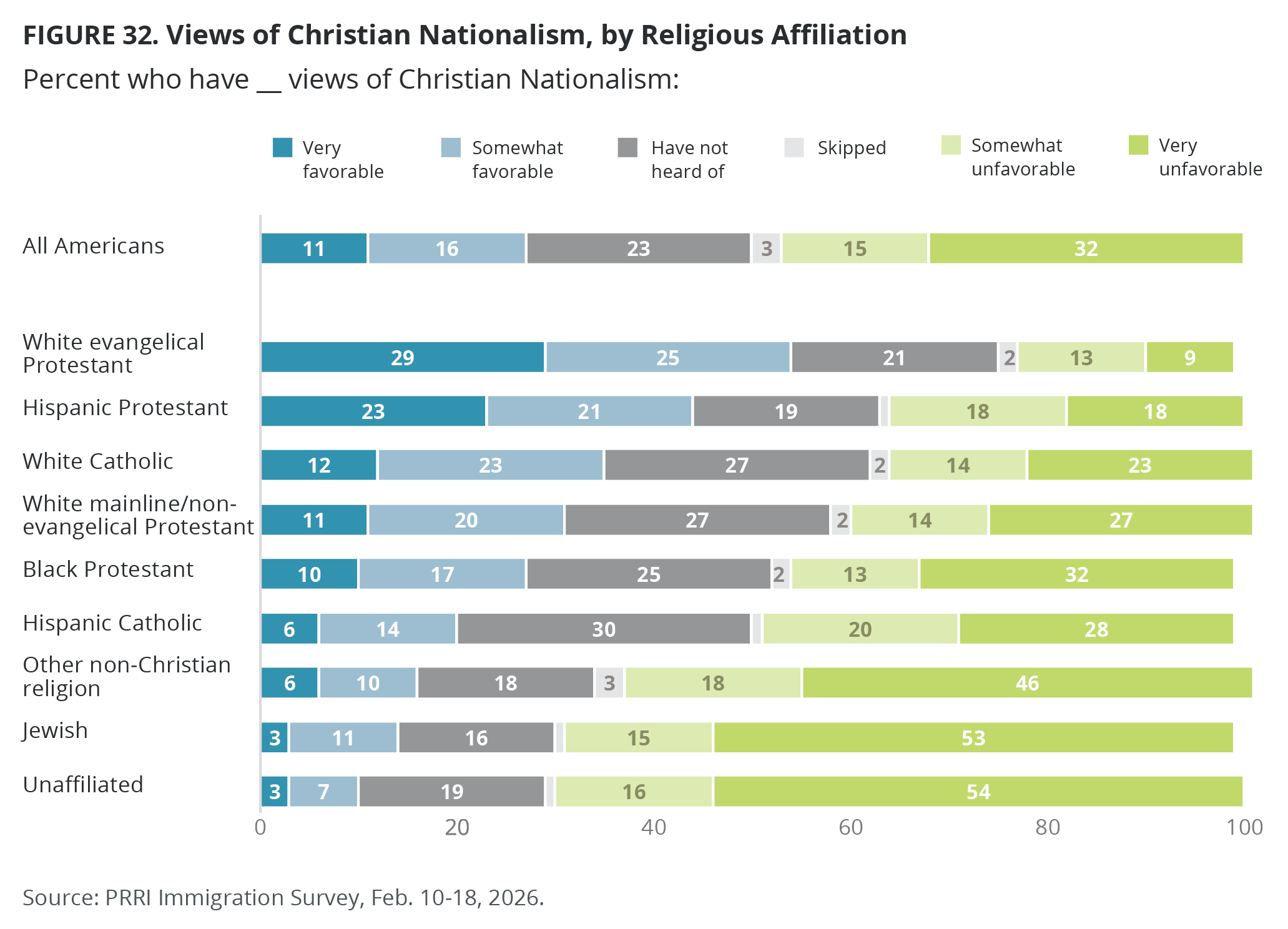
Notably, Americans who qualify as Christian nationalists using independent criteria are more likely than others to hold favorable views of the term. Two-thirds of Christian nationalism Adherents (68%), as well as half of Sympathizers (50%), hold favorable views of the term “Christian nationalism.” By contrast, Christian nationalism Skeptics (19%) and Rejecters (3%) are far less likely to hold favorable views. Notably, Skeptics (28%) and Sympathizers (26%) are more likely than Adherents (20%) to say they have not heard of the term, while Rejecters are the least likely to report this (13%).
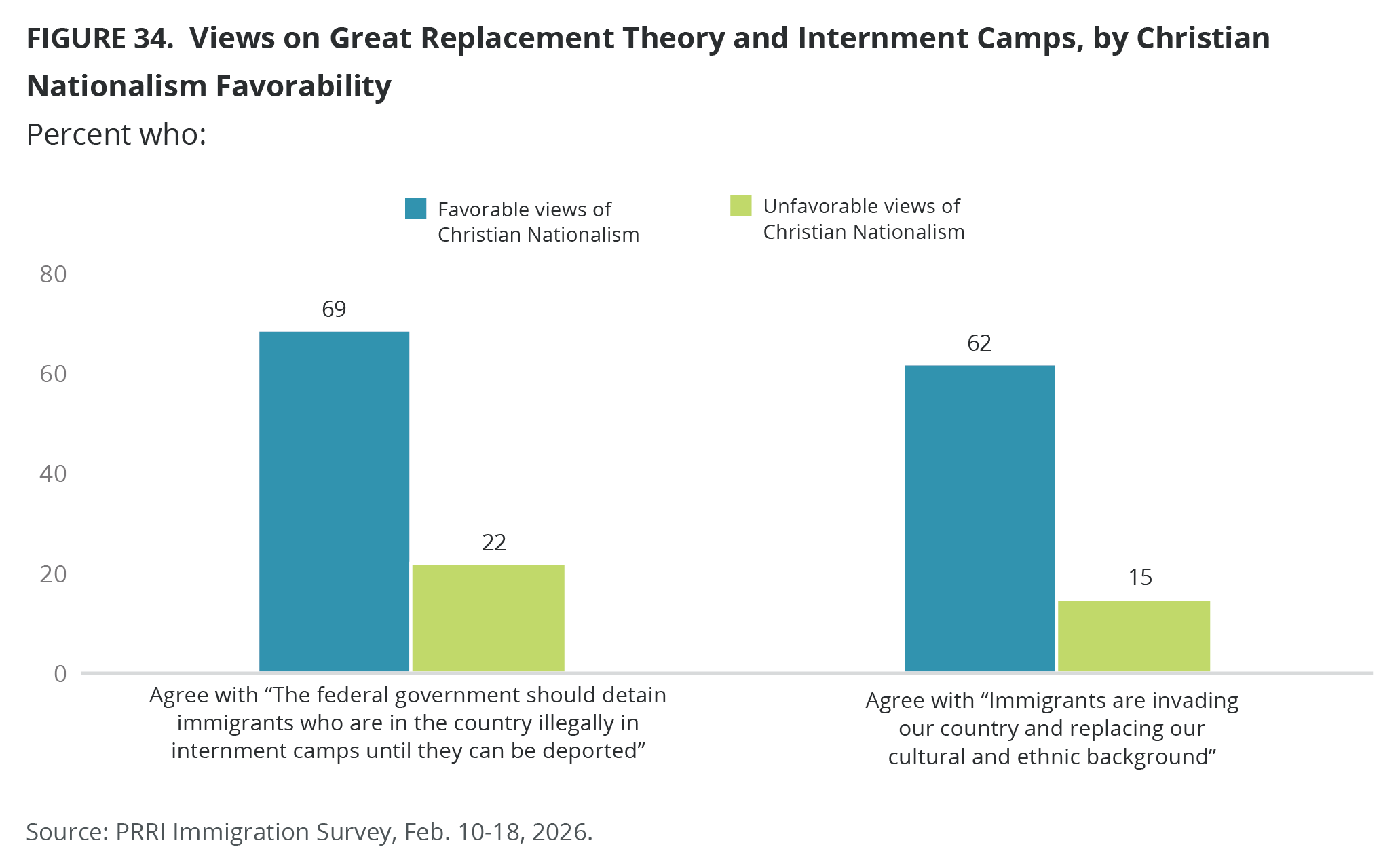
Holding a favorable view of the term “Christian nationalism” is strongly correlated with holding harsh views about immigrants and immigration policy. Among those with very or somewhat favorable views of Christian nationalism, 69% agree that the federal government should detain immigrants who are in the country illegally in internment camps until they are deported, compared with 22% of those who hold very or somewhat unfavorable views of this term.
Similarly, among those with very or somewhat favorable views of the term “Christian nationalism,” 62% agree that immigrants are invading our country and replacing our cultural and ethnic background, compared with 15% of those who hold very or somewhat unfavorable views.
Survey Methodology
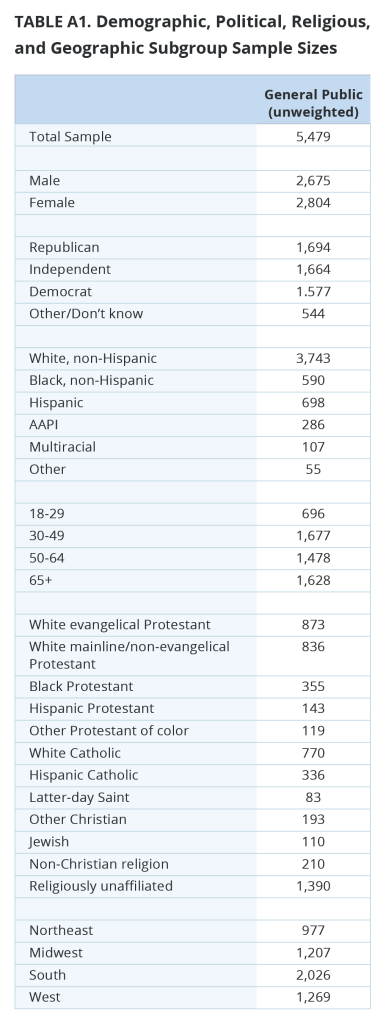
The survey was designed and conducted by PRRI. The survey was made possible through the generous support of the Carnegie Corporation of New York, the William and Flora Hewlett Foundation, and the Unitarian Universalist Veatch Program at Shelter Rock. The survey was conducted among a representative sample of 5,479 adults (age 18 and up) living in all 50 states in the United States. Among those, 5,143 are part of Ipsos’s KnowledgePanel and an additional 336 were recruited by Ipsos using opt-in survey panels to increase the sample sizes in smaller states. Interviews were conducted online between February 10–18, 2026.
Respondents are recruited to the KnowledgePanel using an addressed-based sampling methodology from the Delivery Sequence File of the USPS – a database with full coverage of all delivery addresses in the U.S. As such, it covers all households regardless of their phone status, providing a representative online sample. Unlike opt-in panels, households are not permitted to “self-select” into the panel; and are generally limited to how many surveys they can take within a given time period.
The initial sample drawn from the KnowledgePanel was adjusted using pre-stratification weights so that it approximates the adult U.S. population. Next, a probability proportional to size (PPS) sampling scheme was used to select a representative sample.
To reduce the effects of any non-response bias, a post-stratification adjustment was applied. The needed benchmarks were obtained from the latest 2025 March supplement of the Current Population Survey (CPS), except language proficiency, which is not available from CPS, and was obtained from the 2023 American Community Survey (ACS). Additionally, the 2024 vote choice benchmark was obtained from the Associated Press Tabulation of Certified Results. The post-stratification weight rebalanced the sample based on the following benchmarks: gender by age, race/ethnicity, education, income, language proficiency, Census region by metropolitan status, and 2024 presidential vote choice. Additionally, we included individual states (50 states plus D.C.) to account for the oversampling of some states.
The margin of error for the national survey is +/- 1.49 percentage points at the 95% level of confidence, including the design effect for the survey of 1.3. In addition to sampling error, surveys may also be subject to error or bias due to question wording, context, and order effects. Additional details about the KnowledgePanel can be found on the Ipsos website: https://www.ipsos.com/en-us/solution/knowledgepanel
[1] For more information on Trump favorability, see: https://prri.org/spotlight/trump-favorability-declines-among-republicans-some-religious-groups/
[2] In March 2025, this question was asked as “Do you approve or disapprove of the job President Trump is doing handling immigration?”
[3] In September 2025, this question asked about favorable views of “the police.”