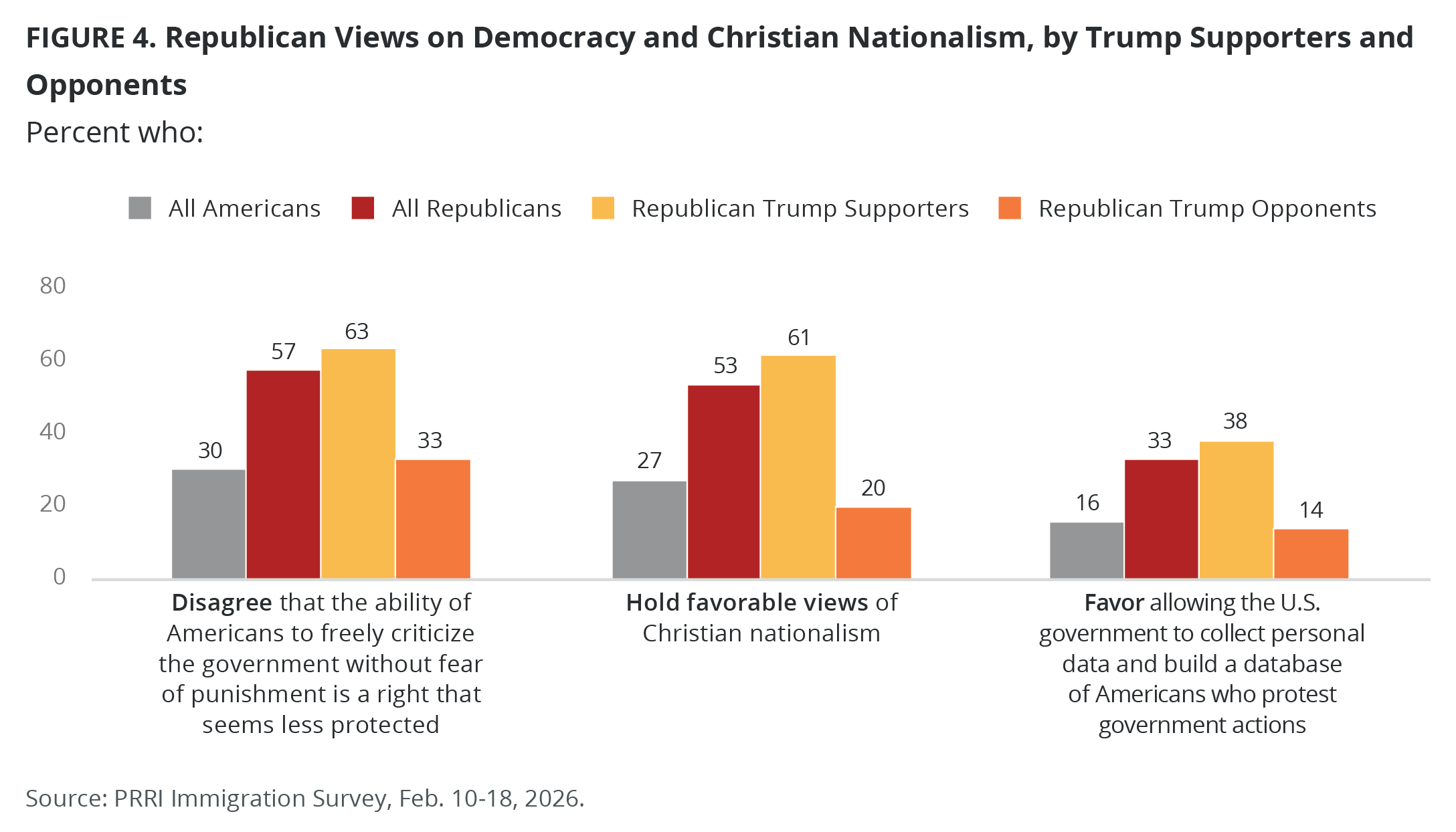

PRRI data collected in February 2026 finds that 81% of Republicans view President Donald Trump favorably, while 18% view Trump unfavorably. This Spotlight Analysis profiles Republicans who view Trump favorably alongside those who view him unfavorably, comparing their views on Christian nationalism, immigration, and democracy.
Profiles of Trump’s Republican Supporters and Opponents
Ideology, Religion, and Christian Nationalism Groups
While three-quarters of Republicans identify as conservative (75%), those who view Trump favorably are far more likely to do so than those who view him unfavorably (81% vs. 52%). Conversely, Republicans with unfavorable views of Trump are more than twice as likely to identify as moderate (40% vs. 17%). Just 2% of all Republicans identify as liberal.
Republican Trump supporters are more likely than opponents to identify as white Christian (70% vs. 57%). Notably, Republican Trump supporters are almost twice as likely to be white evangelical Protestants than Trump opponents (31% vs. 19%). By contrast, Republican Trump opponents are more likely to identify as Christians of color: around one in ten are Hispanic Protestant (9%) or Hispanic Catholic (8%). Only 4% of Republican Trump supporters identify as either.
Republican Trump supporters are more than three times as likely as Republican Trump opponents to qualify as Christian nationalism Adherents (28% vs. 8%) and 12 points more likely to qualify as Christian nationalism Sympathizers (38% vs. 26%).
Race, Age, and Education
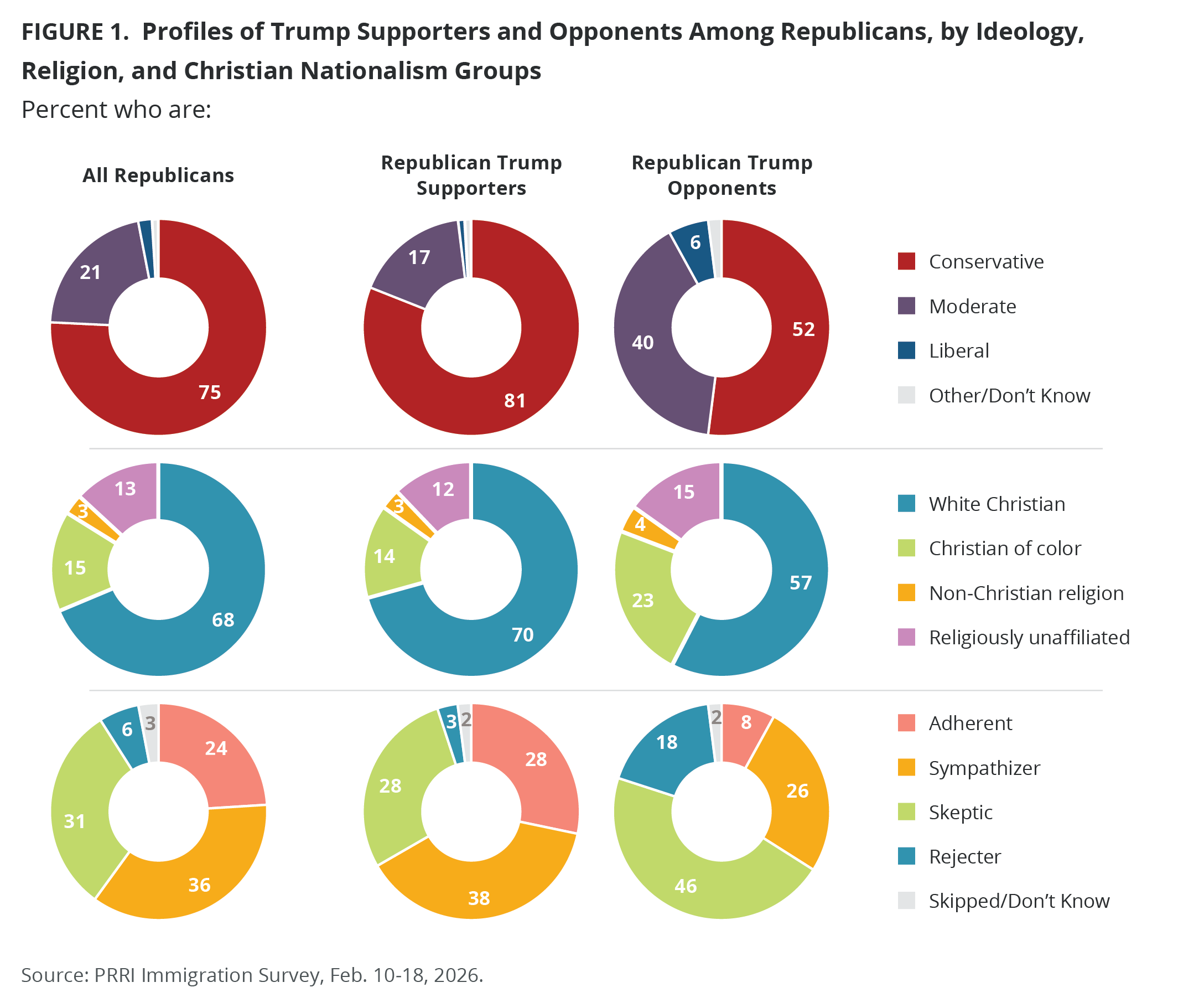
The racial breakdown of Republican Trump supporters closely mirrors that of all Republicans, with nearly eight in ten identifying as white. In contrast, Republican Trump opponents are less likely to identify as white (68% vs. 82%) and more likely to identify as Hispanic (19% vs. 10%).
Republicans, overall, skew older, however, Republicans who view Trump unfavorably tend to be younger than those who view him favorably: 22% of Republican Trump opponents are ages 18–29 compared with 14% of Republican Trump supporters, and 35% are ages 30–49 compared with 26%.
While only one-third of Republicans hold a four-year degree or higher (35%), those who view Trump unfavorably are over 10 percentage points more likely to hold a four-year degree or higher than those who view him favorably (44% vs. 33%, respectively).
Differences in Pro-Trump and Anti-Trump Republicans’ Views on Immigration
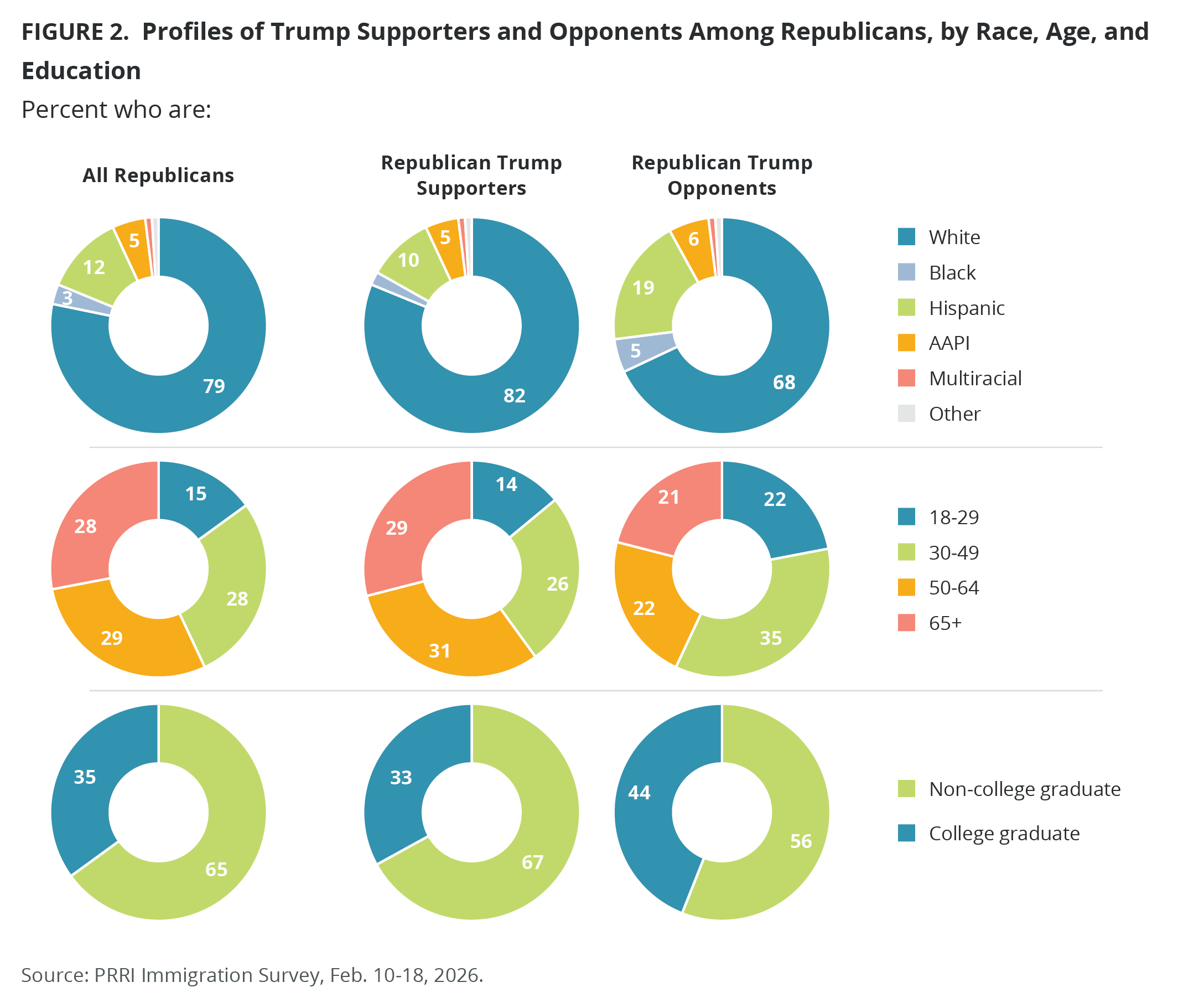
According to PRRI’s 2026 Immigration Survey, two-thirds of Republicans (66%) agree with the statement “Immigrants are invading our country and replacing our cultural and ethnic background,” a concept known as the “Great Replacement Theory,” while less than one-third disagree (31%). Republican Trump supporters are twice as likely as Republican Trump opponents to agree with the Great Replacement Theory (74% vs. 37%).
A slim majority of Republicans (55%) favor stripping U.S. citizens of their citizenship and deporting them if they are deemed a threat to the country, while 43% oppose it. Republicans who view Trump favorably are nearly twice as likely as those who view him unfavorably to support this policy (60% vs. 31%).
Republican Trump Supporters and Opponents on Democracy and Christian Nationalism
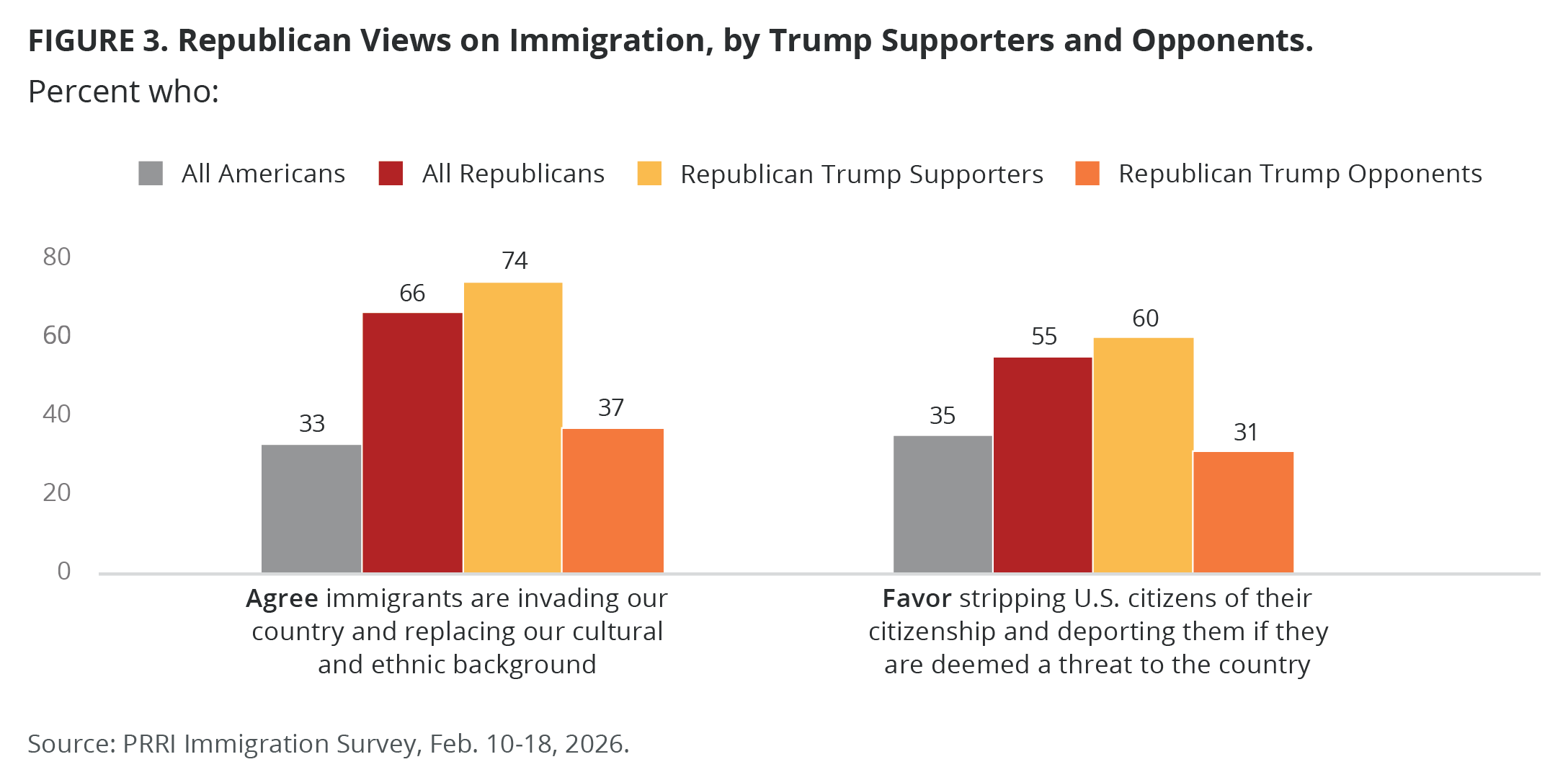
Nearly six in ten Republicans (57%) disagree that “the ability of Americans to freely criticize the government without fear of punishment is a right that seems less protected than in previous years;” 41% agree. Republican Trump supporters are about twice as likely as opponents to disagree with this idea (63% vs. 33%).
While most Republicans (65%) oppose allowing the U.S. government to build a database of Americans who protest government actions, 38% of Republicans who view Trump favorably favor this policy, compared with just 14% of those who view Trump unfavorably.
A slim majority of Republicans (53%) hold somewhat or very favorable views of the term “Christian nationalism,” compared with 19% who hold unfavorable views; around one-quarter of Republicans (27%) have not heard of the term. Republican Trump supporters are three times as likely as Republican Trump opponents to hold favorable views of Christian nationalism (61% vs. 20%).