
Dr. Anne Whitesell is a 2025-2026 PRRI Public Fellow focusing on reproductive health and rights. She is also an associate professor of political science at Miami University in Oxford, Ohio.
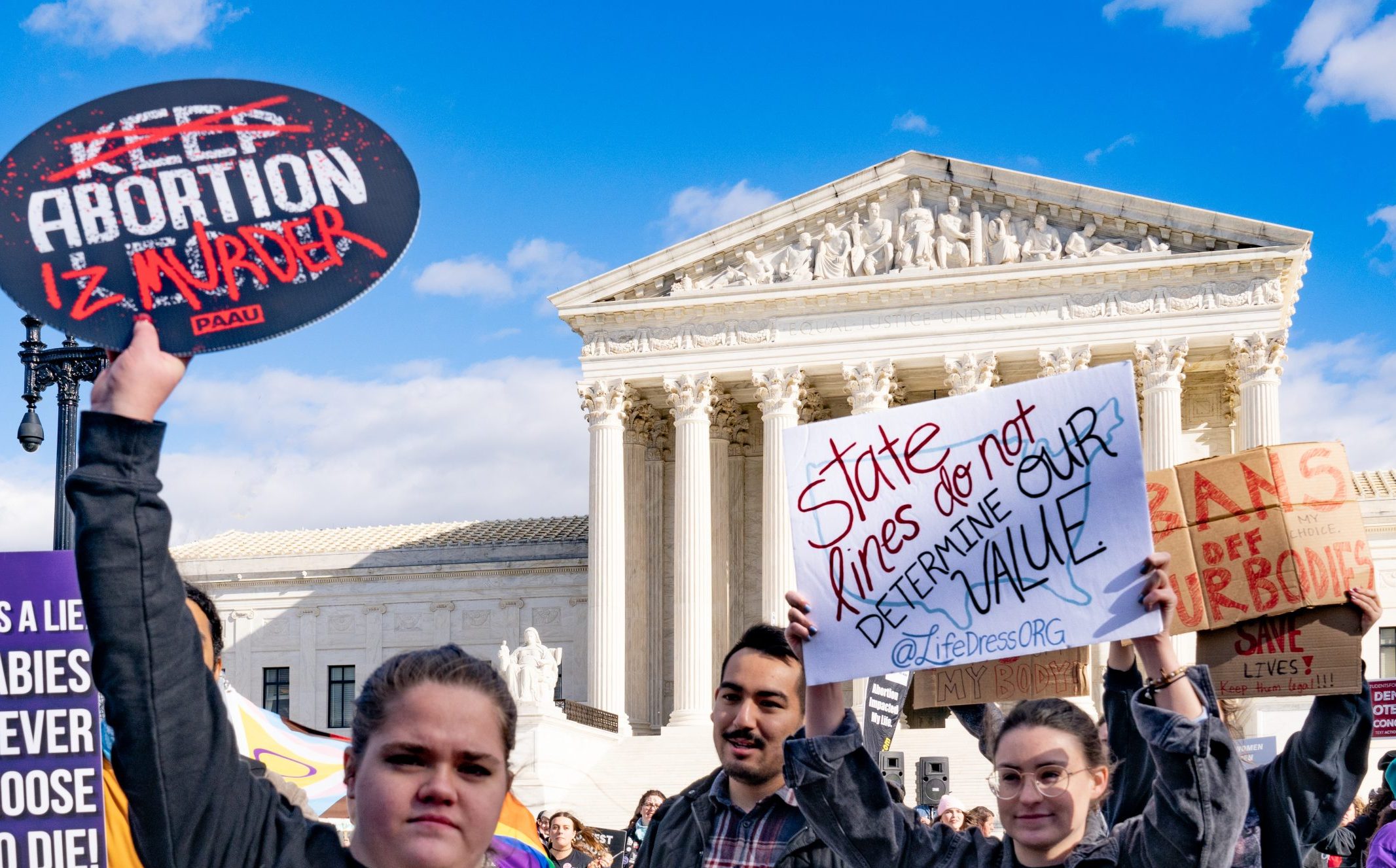
Every January, thousands of Americans descend on Washington, D.C., for the National March for Life, an event first held to remember the anniversary of Roe v. Wade. While the event, and associated organizations, are most well-known for their opposition to abortion, the March for Life frames its work as “celebrat[ing] life from the moment of conception to the moment of natural death, and every moment in between.” However, my research on the policy priorities of “pro-life” organizations finds that protecting life does not often include supporting policies related to “every moment in between.” While some “pro-life” organizations, particularly those following a consistent life ethic, may take positions on a number of policies related to protecting human life, most focus on beginning and end-of-life issues. This Spotlight Analysis examines American public opinion on some of the most prominent “pro-life” positions: opposition to abortion, capital punishment, and assisted suicide.
According to PRRI’s 2024 American Values Survey, most Americans do not support these positions. Around six in ten Americans believe abortion should be legal in all or most cases (62%), capital punishment should be legal in all or most cases (61%), and assisted suicide should be legal in all or most cases (59%).
Notably, opposition to these policies does not align with the positions of either Democrats or Republicans. Democrats reaffirmed their support for legalized abortion in the party’s 2024 platform, and PRRI data shows that 86% of Democrats believe abortion should be legal in all or most cases. The Democratic Party’s position on the death penalty is less clear. The official party platform does not mention the issue, but the Justice Department under President Joe Biden issued a moratorium on federal death sentences. A slim majority of Democrats (51%), meanwhile, support the death penalty.
The Republican Party’s position on these issues is even less clear. The party’s 2024 platform opposes late-term abortion, but its stance is softer than in past years. On his first day in office, President Donald Trump reinstated the federal death penalty paused under Biden. PRRI finds that 59% of Republicans believe abortion should be illegal in all or most cases, but only 18% believe capital punishment should be illegal in all or most cases.
Republicans are nearly evenly split on whether assisted suicide should be legal; 49% believe it should be illegal in all or most cases. However, Republicans are more likely than Democrats (26%) or independents (36%) to hold the “pro-life” position when it comes to assisted suicide.
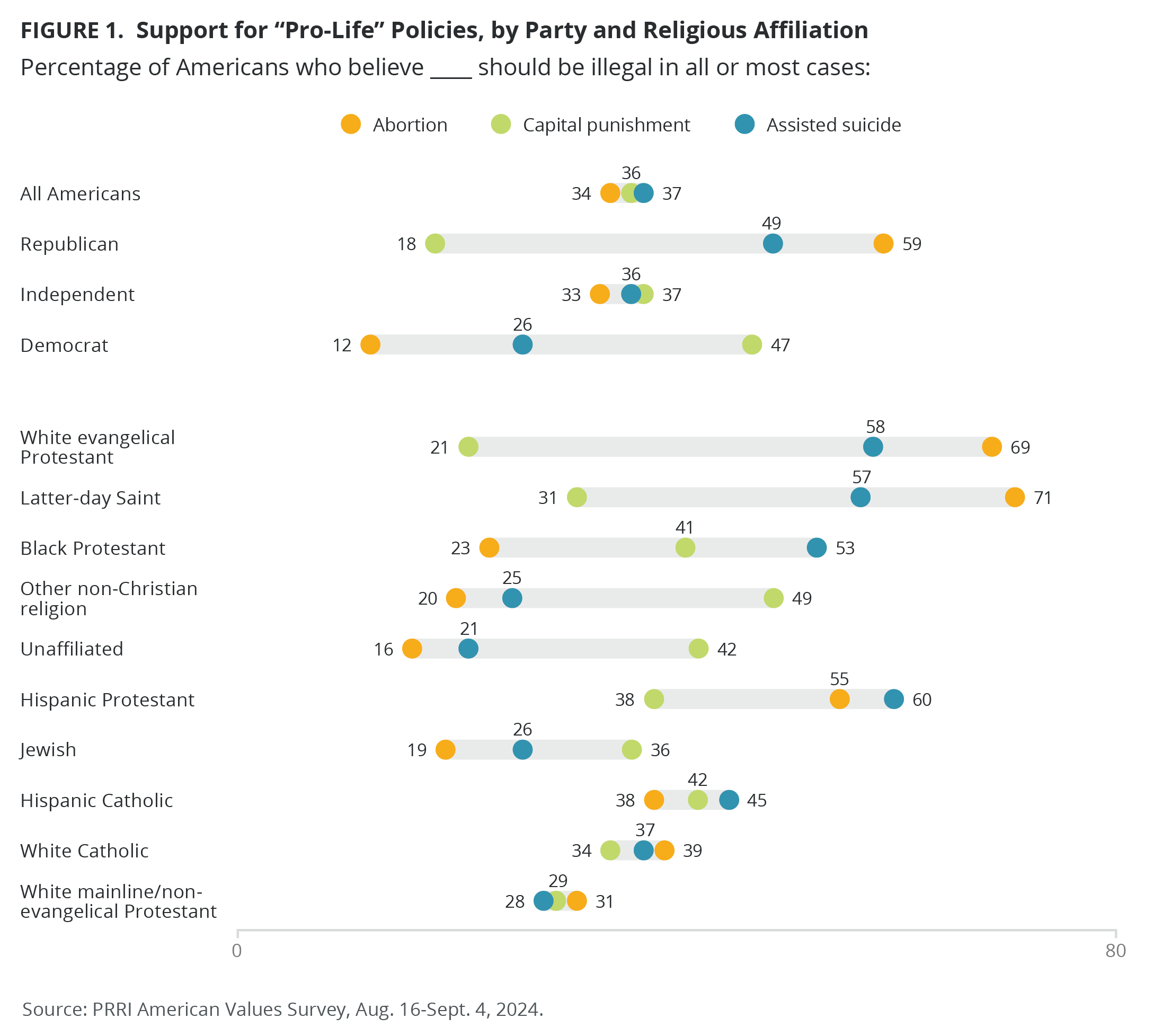
Given that consistent support for “pro-life” positions is not related to party affiliation in the United States, we might expect it to be driven by religious affiliation. PRRI data shows this to be true, to an extent. The Southern Baptist Convention, which represents about one-fifth of all U.S. evangelical Protestants, has passed resolutions opposing both abortion and assisted suicide, but supports capital punishment “applied as justly and fairly as possible.” According to PRRI data, while 69% of white evangelical Protestants oppose abortion and 58% believe assisted suicide should be illegal in all or most cases, only 21% believe capital punishment should be illegal in all or most cases. A majority of Hispanic Protestants also oppose abortion and assisted suicide, but only 38% oppose capital punishment.
Similarly, the Church of Jesus Christ of Latter-day Saints opposes assisted suicide and “elective abortion for personal or social convenience,” but neither opposes nor supports capital punishment. Most members of the church oppose abortion (71%) and assisted suicide (57%), while 31% oppose capital punishment.
There is variation within the Jewish tradition on these issues. The Union for Reform Judaism, for example, opposes capital punishment and assisted suicide but supports increased abortion access. Orthodox Jews, however, take a more conservative approach to abortion; the Orthodox Union Advocacy Center stated it could neither “mourn nor celebrate” the Dobbs v. Jackson Women’s Health Organization decision. PRRI data shows that 36% of Jewish respondents oppose capital punishment and 26% oppose assisted suicide, while 79% support legalized abortion.
In all of these faith traditions, those affiliated largely align with the official position of faith leadership. In contrast, American Catholics and the church hierarchy diverge in their views. The U.S. Conference of Catholic Bishops opposes abortion, capital punishment, and assisted suicide. Yet, majorities of both white and Hispanic Catholics support legalized abortion, capital punishment, and assisted suicide.
Overall, there are few Americans who consistently support all three “pro-life” policies. Among Americans who believe abortion should be illegal in all or most cases, two-thirds believe physician-assisted suicide should also be illegal (67%) and one-third believe capital punishment should be illegal (33%). The correlation between these views is likely driven by a mix of political and religious affiliation.