

Will McCorkle, Ph.D., (he/him) is an Associate Professor of Teacher Education at the College of Charleston and a 2025-2026 PRRI Public Fellow.
Last September, at the height of the anti-immigrant rhetoric of the presidential campaign, PRRI’s 2024 American Values Survey asked Americans about their views on “rounding up and deporting immigrants who are in the country illegally, even if it takes setting up encampments guarded by the U.S. military.” Nearly half of Americans (47%) agreed with the idea, including 22% of Democrats, 47% of independents, and 79% of Republicans.
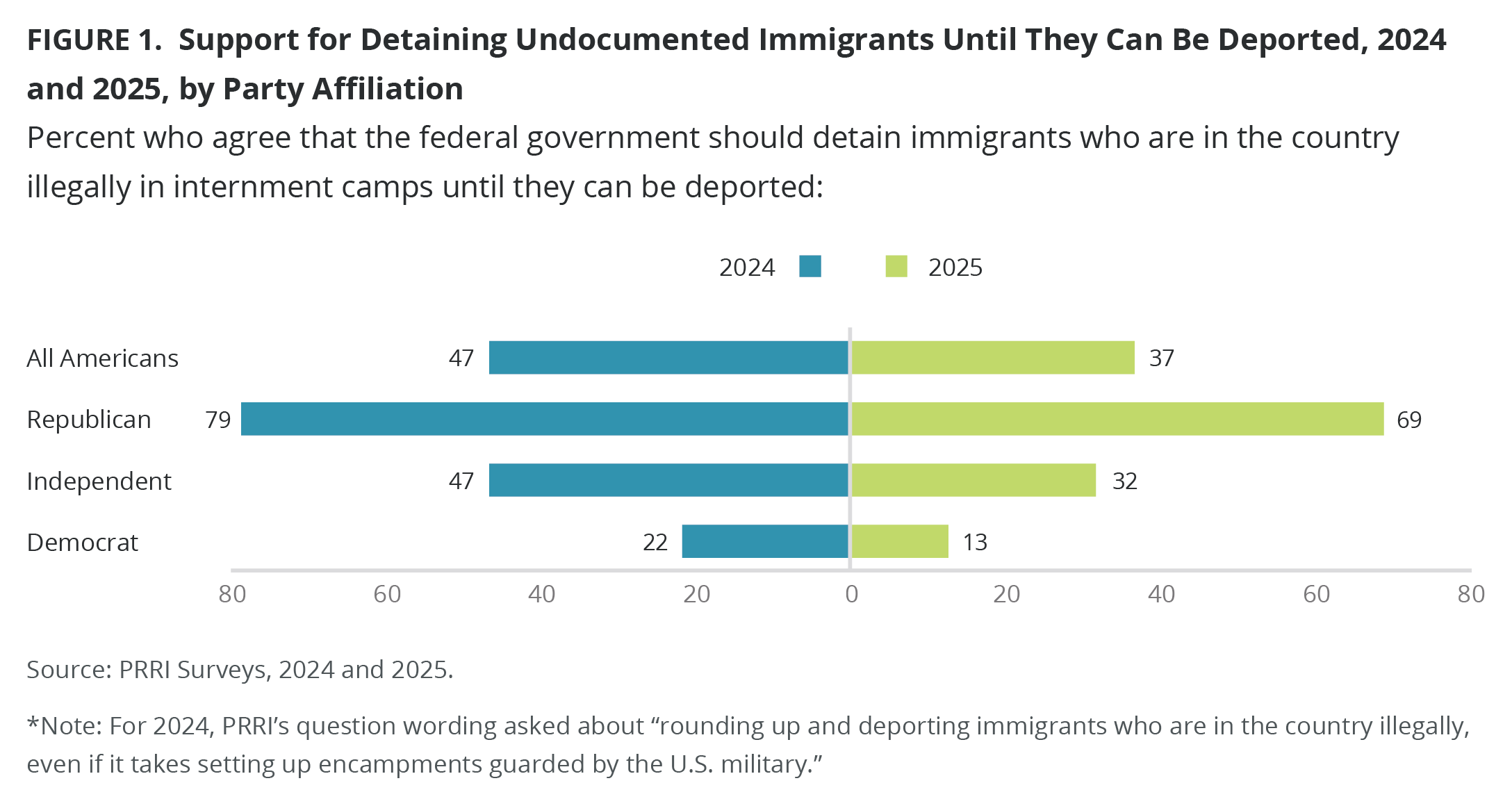
Just a year later in September 2025, PRRI asked a similar question about whether “the federal government should detain immigrants who are in the country illegally in internment camps until they can be deported.” Here, PRRI found that support for detaining and deporting immigrants dropped among Americans, with 37% agreeing. Importantly, the drop in support may be partially a function of a change in question wording but could also be an indicator that Trump’s handling of immigration policy and more draconian approach to immigration enforcement is making many Americans reconsider their views on deportation. PRRI’s 2025 American Values Survey found that just 33% of Americans approve of the job that President Donald Trump is doing handling immigration, compared with 37% from an earlier PRRI survey conducted in March 2025.
Notably, the decline in support for detaining and deporting immigrants spans party and religion. The 2025 PRRI American Values Survey finds that 69% of Republicans agree that the federal government should detain immigrants who are in the country illegally in internment camps until they can be deported, compared with 32% of independents and 13% of Democrats. Bearing in mind the change in question wording, support for the deportation and detention of undocumented immigrants dropped 9 percentage points among Democrats, 10 percentage points among Republicans, and 15 percentage points among independents.
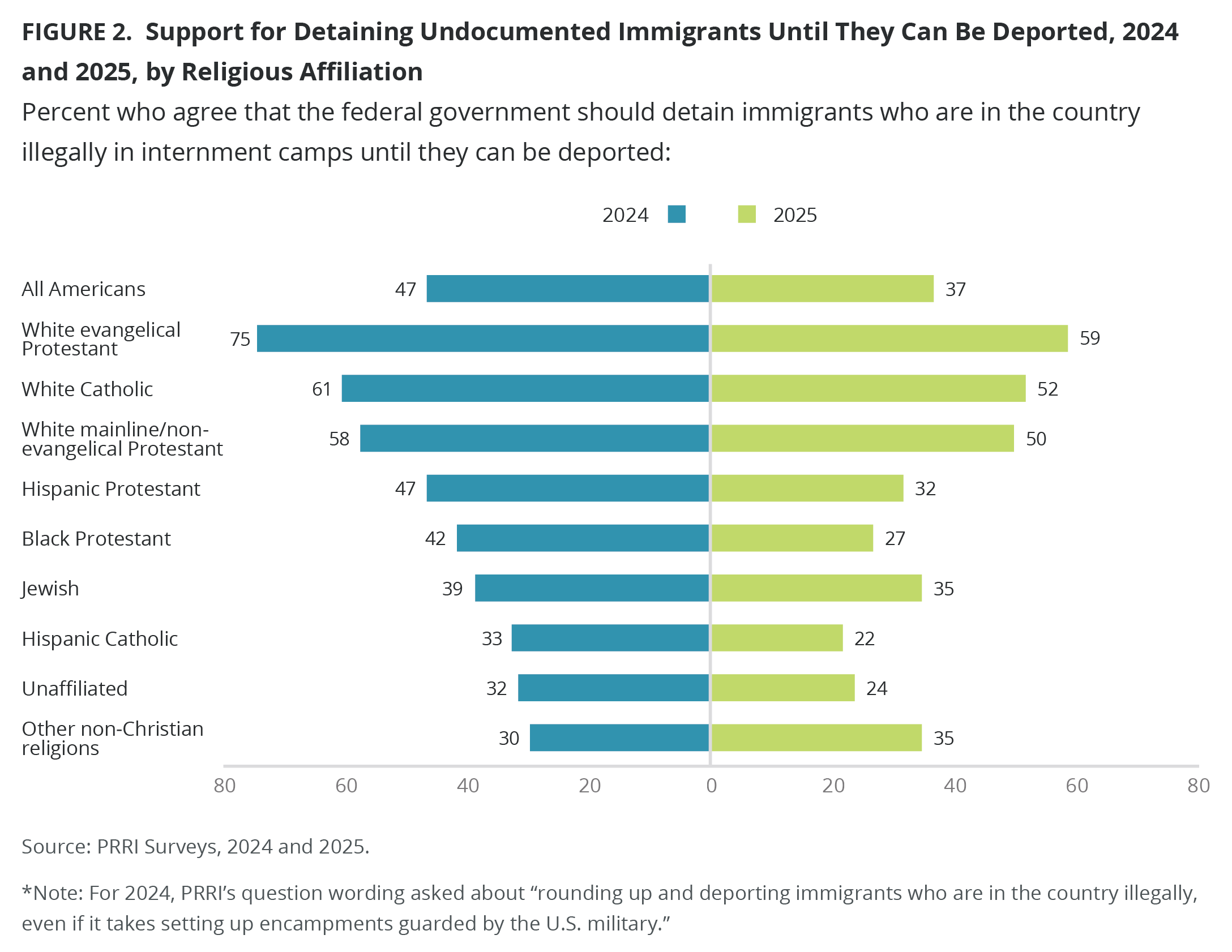
There was also a decline in support for detention and deportation among virtually all religious groups, but it was particularly pronounced among white evangelicals, with a 16-percentage-point drop. Support dropped 15 percentage points among Hispanic Protestants, 9 percentage points among white Catholics, and 11 percentage points among Hispanic Catholics. We do see a small increase in support for Trump’s detention and deportation policies among individuals from other non-Christian religions, but that increase is not statistically significant.
All racial groups — except for AAPI, which remains unchanged — saw a decline in support for detention and deportation. The largest drops were among Hispanic (12 points) and multiracial Americans (13 points).
Although the consolidation of Democratic supporters opposed to Trump’s detention and deportation policies should be expected, the loss of some Republican supporters and those from more conservative religious groups is somewhat surprising. Though there is a strong core that will support Trump’s policies without question, there appears to be some pushback or at least questioning on the edges of Trump’s immigration policies. As a story from NPR highlighted this year, in some aspects the issue of immigration in particular may be more complex among evangelicals. Though it may not play a large role, the reduction in attendance among Hispanic worshipers due to fear of ICE raids could be troubling to at least some conservative respondents.
While it appears that the pendulum is now starting to swing back in the other direction, with increasing numbers of Americans rejecting many of the Trump administration’s immigration tactics, it is too late for many immigrant families and communities. This moment should draw the attention of Republican leaders that the immigration attitudes are starting to shift, not just among progressives but with some of their own voters. Some Americans like anti-immigrant policies in theory, but when they see policies negatively impacting their own communities, it is a different dynamic. For Democrats, it could be the moment to make an affirmative case for immigration, rather than taking a defensive approach as they have over the last several years.