
Dr. Lauren Horn Griffin is a 2025-2026 PRRI Public Fellow focusing on racial justice and white supremacy. She is also an Assistant Professor in the Department of Philosophy & Religious Studies and the Department of History at Louisiana State University.
In the first tumultuous months of 2026, journalists and pundits have struggled to make sense of this administration’s meme-laden messaging, especially regarding the attacks on Venezuela and Iran. Across its social media accounts, the White House has been focused on performing hypermasculinity. These images of destruction and domination reveal not only a preoccupation with masculinity as a social issue, but a broader shift in the symbolic language through which politics itself is articulated. Across speeches and policy posts, questions of strength, dominance, softness, humiliation, and revenge increasingly structure conservative political discourse. This Spotlight Analysis explores how religious identification — which is closely intertwined with racial identities — is related to views on masculinity.
Strength and Authoritarianism
Across racial and ethnic groups, Christian attitudes toward topics from bathroom bills to governing style reflect preferences for strength, domination, and traditional gender roles. More than a culture war issue alone, the data on authoritarianism, gender, and sexuality can shed light on how the image of a hypermasculine strongman serves as a unifying concept across racial and religious lines.
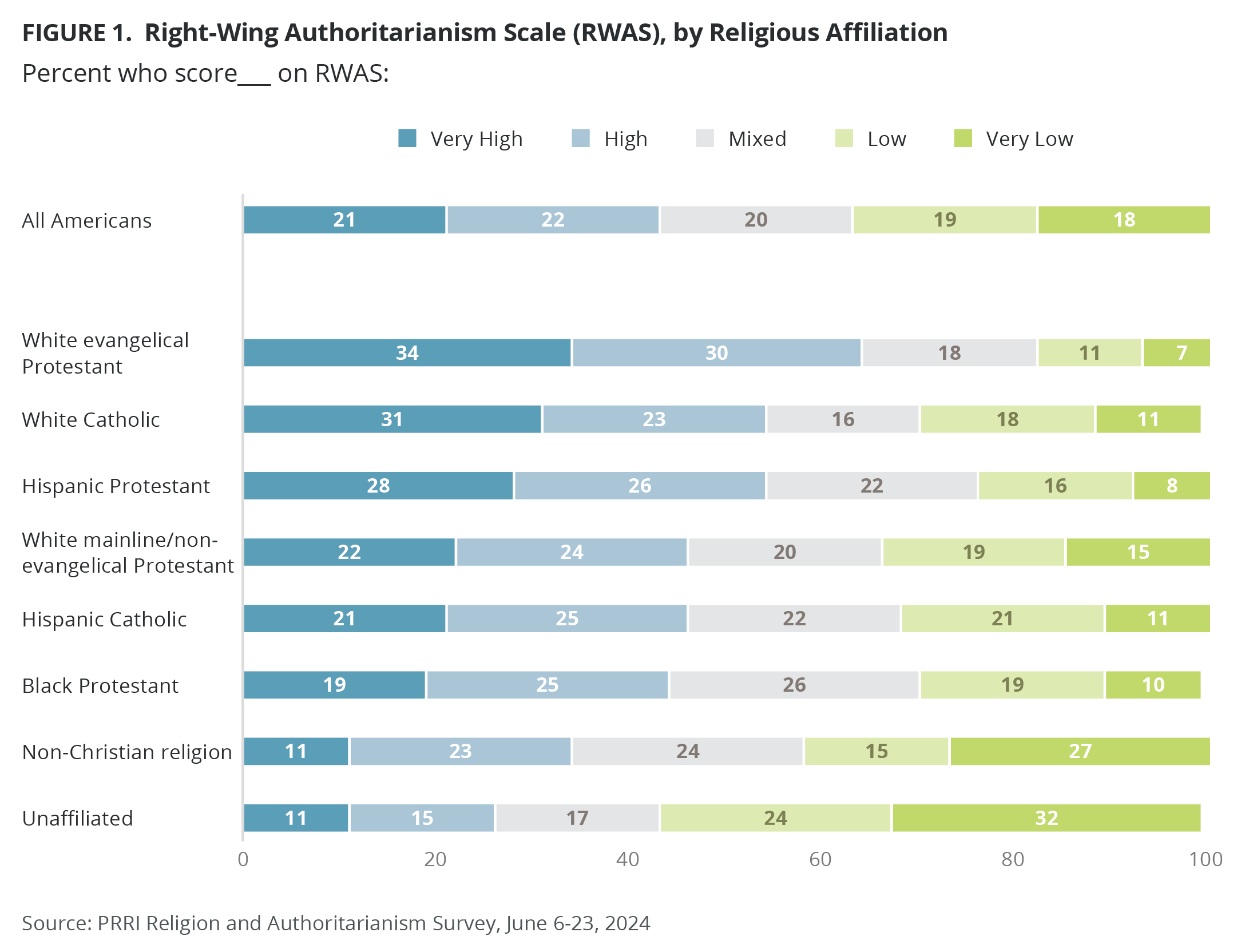
For example, PRRI’s 2024 Religion and Authoritarianism survey shows that a majority of Protestants across racial and ethnic groups score high on the Right-Wing Authoritarianism Scale (RWAS), including white evangelical Protestants (64%) and Hispanic Protestants (54%).
Moreover, in a 2025 Spotlight analysis, former PRRI fellow Michael Fisher Jr., Ph.D., finds that Black Christians who score high on the Christian nationalism scale also scored higher on authoritarianism metrics even though they lean more liberal in their other views.
While there are likely many explanations for this — and Fisher offers a few — analyzing additional PRRI data reveals the emergence of masculinity as a broader organizing framework.
The Role of Patriarchy in Society
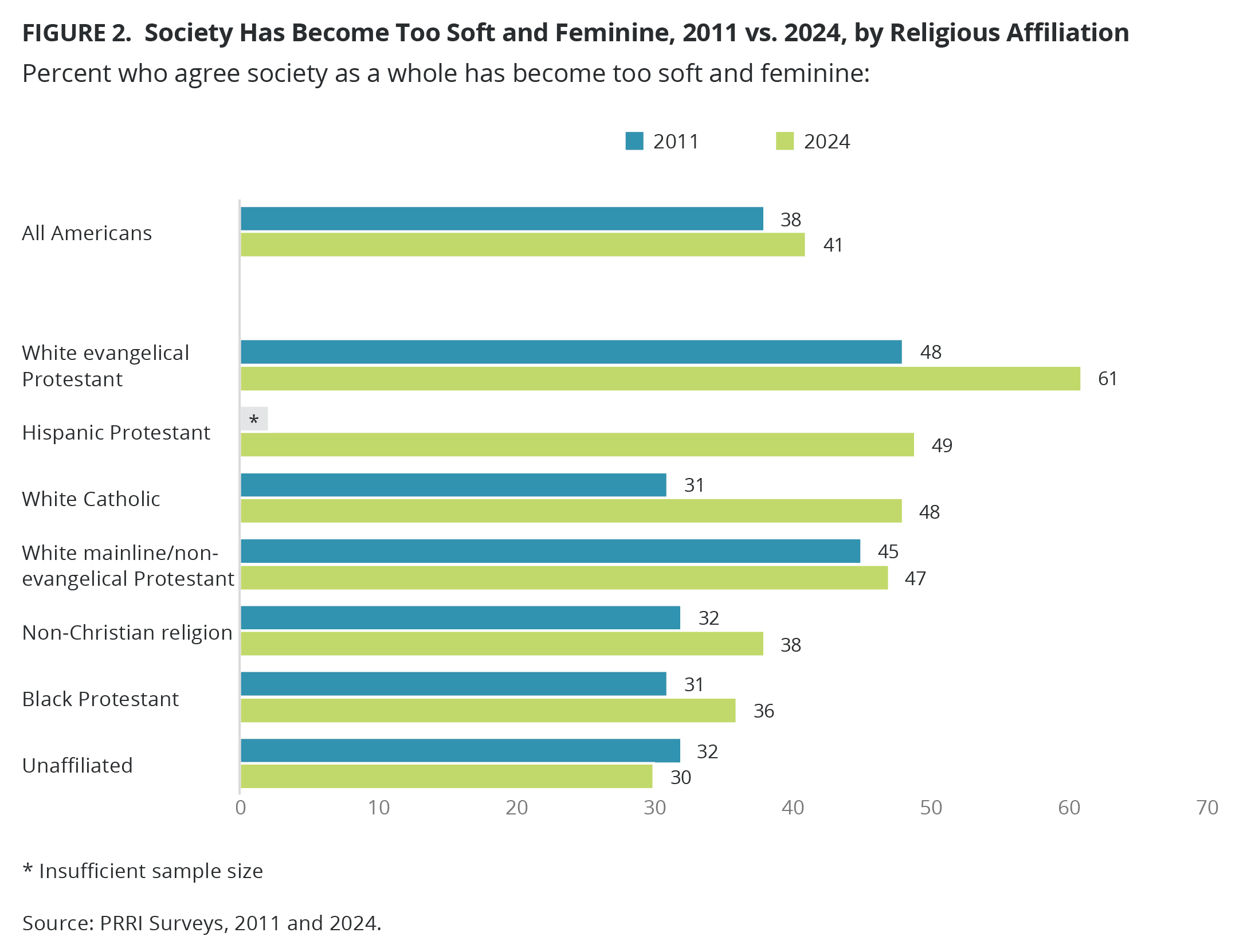
Agreement with the statement that “society as a whole has become too soft and feminine” has gone up among Christians since PRRI originally asked the question (notably from 48% in 2011 to 61% in 2024 among white evangelical Protestants and from 31% to 48% among white Catholics).
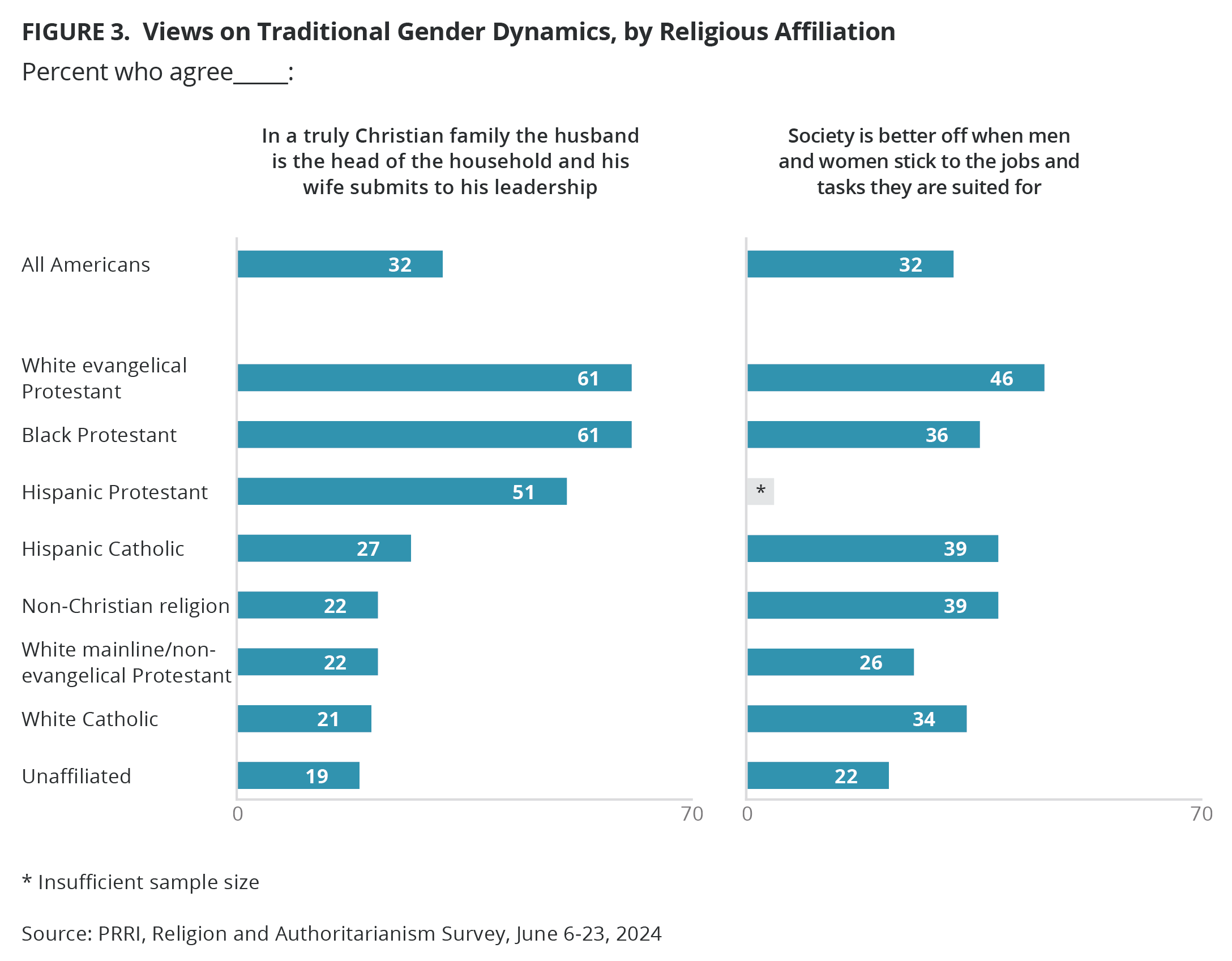
Moreover, majorities of white evangelical Protestants (61%), Black Protestants (61%), and Hispanic Protestants (51%) also agree with the statement that “in a truly Christian family, the husband is the head of the household and his wife submits to his leadership.” In addition, white evangelical Protestants (46%) are the most likely to agree that “society is better off when men and women should stick to the jobs and tasks they are naturally suited for.”
Decreasing Support for LGBTQ Rights
According to PRRI’s 2025 American Values Atlas, 56% of Americans favor “laws that require transgender individuals to use bathrooms that correspond to their sex at birth rather than their current gender identity,” a more than 20-percentage-point increase from 35% in 2016.
Looking at religious groups, white evangelical Protestants and Hispanic Protestants are most likely to favor laws that require transgender individuals to use bathrooms that correspond to their sex at birth (78% and 70%, respectively), followed by 62% of white Catholics, 60% of both white mainline/non-evangelical Protestants and Black Protestants, and 59% of Hispanic Catholics. Unaffiliated (38%) Americans are far less likely to favor these laws.
Some scholars have argued that discourses around trans people has led to a “trans panic,” which shapes understandings of masculinity and gender by positioning transgender bodies as sites of perceived threat and instability. In doing so, attitudes toward transgender people reinforce rigid boundaries around gender, social order, and authority.
When taken together, these seemingly disparate data points show how questions of gender and sexuality, which threaten hypermasculinity, have moved to the center of public discourse. This has resulted not only in new laws and policies, but in a broader turn to authoritative masculinity as an affective image and religio-political identity marker. Rather than fragmenting along religious or racial lines, we see diverse groups converging around shared commitments to strength, authority, and patriarchal order, even when their broader political views diverge. More research is needed to understand how the image of a hypermasculine strongman became more than a culture war issue, but a unifying concept across racial and religious lines.