
Dr. Michal Raucher is a 2025-2026 PRRI Public Fellow focusing on reproductive health and rights. She is also an Associate Professor of Jewish Studies at Rutgers University.
In January 2026, Playboy magazine published an article featuring four men whose wives needed abortions and faced legal challenges and dire health circumstances: Josh Zurawski and his wife, Amanda, who almost died when she could not get an abortion; Hollie and Cody Cunningham, who spent over $10,000 traveling out of state to get an abortion; Hope Ngumezi, whose wife, Porsha Ngumezi, died after being denied medical care for a miscarriage in Texas; and Marcus and Ashley Brandt, who also had to travel out of state for abortion care. Playboy magazine introduced these stories by challenging the assumption that abortion is a women’s issue. Instead, they argue, “Abortion is, crucially, also a men’s issue.” These stories feature men who did not understand reproductive health care and did not appreciate the harm caused by new laws restricting access to abortion until their wives needed this care. By sharing their stories, Playboy hopes that more men get involved in advocating for reproductive justice.
To better understand how gender affects Americans’ views on abortion legality and how important these views are to their votes, this Spotlight compares American men’s and women’s positions on these questions. The analysis reveals that, when polled the year after the U.S. Supreme Court’s Dobbs v. Jackson Women’s Health Organization decision, a candidate’s position on abortion legality was a “litmus test” issue for more American women than men, though the gender gap differed depending on one’s position on abortion legality.
PRRI’s 2023 American Values Atlas reveals just a small gender gap when it comes to men and women’s opinions about abortion legality. Over six in ten men (62%) and 66% of women said that abortion should be legal in all or most cases. Overall, among Democratic voters, there was no gender gap, with 86% of both men and women supporting the legality of abortion.
These values, however, do not translate into votes equally.
In 2023, abortion legality was a significant issue in determining how Americans vote. More Americans said they would only vote for a candidate who shared their views on abortion (36%) than for one who shared their views on climate change (27%), immigration (30%), and LGBTQ rights (30%). About the same percentage of Americans said they would only vote for a candidate who shared their views on access to guns (37%).
Whether one is supportive of or opposed to abortion did not seem to matter much, with 38% of those who favor the legality of abortion and 36% of those who oppose its legality saying that they would only vote for a candidate who shares their views.
Yet, among those who say abortion should be legal in all or most cases, there was a significant gender gap in the voting booth. Nearly half of women who said abortion should be legal also said they would only vote for a candidate who shared their views (43%), compared with 32% of men. Across all generations, more women who support the legality of abortion said they would only vote for a candidate who shared their views. This includes about half of Gen Z women (52%) and millennial women (48%) as opposed to just 36% of Gen Z men and 35% of millennial men. Gender gaps remained significant for Gen Xers (39% of women vs. 29% of men) and baby boomers (37% of women vs. 30% of men) and were smaller — though still notable — for women (33%) and men (28%) of the Silent Generation.
The gender gap was less significant among those who are opposed to the legality of abortion: 38% of women and 34% of men who said abortion should be illegal also said they would only vote for a candidate who shared their views. In this group, Gen Z had the largest gender gap, with 49% of women and 38% of men saying they would only vote for a candidate who shared their position, but the gap is cut in half for the rest of the generations.
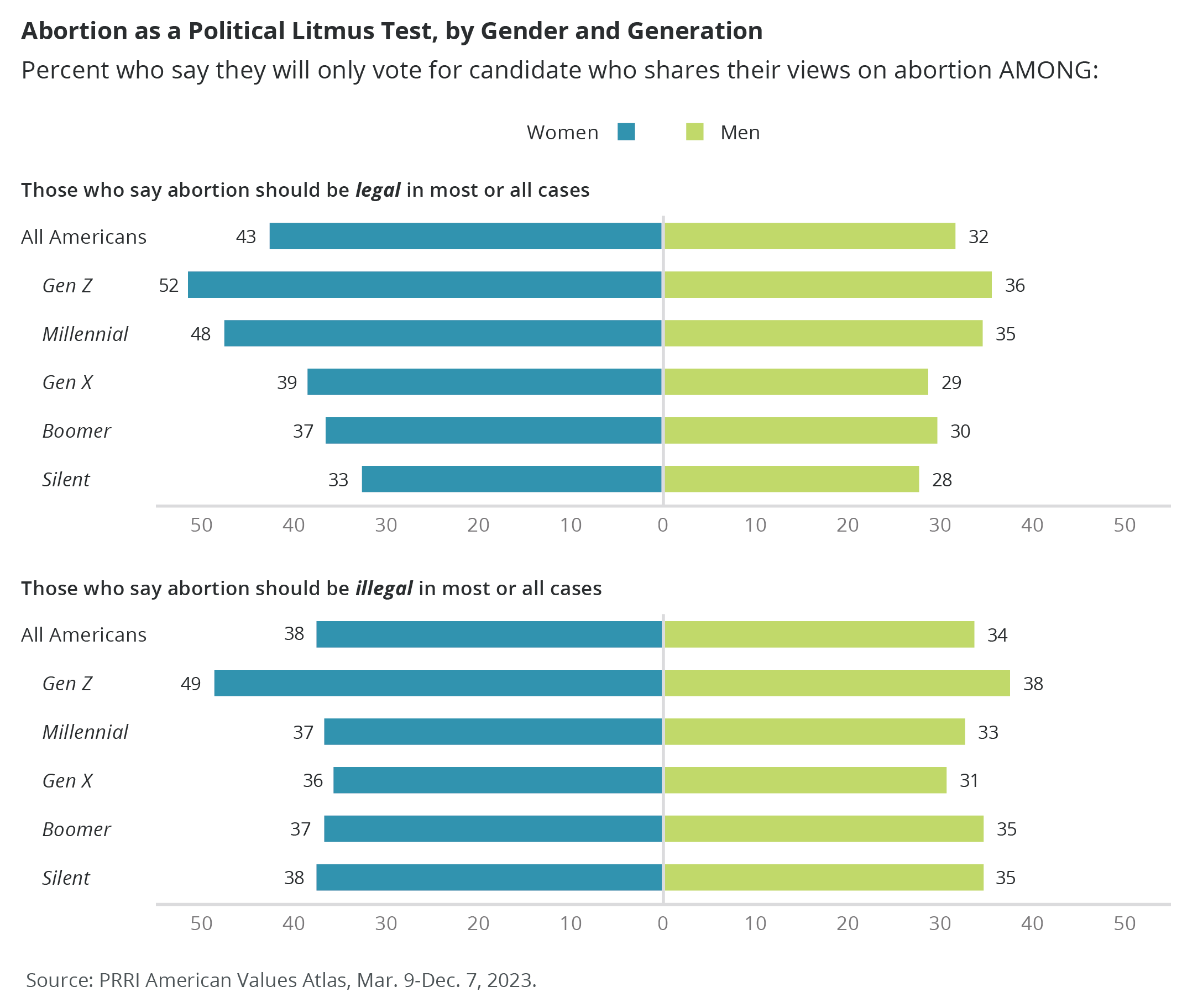
It is important to note that while men are less likely than women to say they would only vote for a candidate who supports the legality of abortion, across all generations, we see that men do consider a candidate’s position on this issue as “one of many” other important issues.
Playboy magazine’s assertion that abortion is a men’s issue is aspirational right now as the data shows that men have not historically cared as much about abortion as women when it comes to how they vote. Yet, there is some indication that the personal stories that Playboy shared could move the needle. Abortion in America, an advocacy group, found that personal abortion testimonies affected how Gen Z men thought about voting on abortion. Additional studies have found that personal experiences with an issue often increase political engagement. If men think that abortion bans will affect them, they might be more likely to vote against those bans and for candidates who support abortion.