

Hispanic Americans are far from a monolith with respect to religion, and these religious differences shape their partisanship and attitudes about a variety of political issues, including their views toward President Donald Trump. This Spotlight takes a closer look at Hispanic Americans’ views of the second Trump administration and the extent to which they are shaped by religious affiliation, party identification, ideology, and other factors, including their views on Trump’s unprecedented immigration policies.
Trump Favorability Among Hispanic Americans Doubled Over a Decade, but Recently Dropped
Since PRRI first started asking, Donald Trump’s favorability among Hispanic Americans has more than doubled (from 16% in 2015 to 39% in 2024). However, as of September 2025, his favorability among Hispanic Americans had decreased significantly to 30%.
When we look at Hispanic Americans by religion, Hispanic Protestants consistently report the highest Trump favorability. Their support for Trump has noticeably grown over time, from 25% in 2015 to a peak of 51% in September 2024, followed by a brief decline to 32% in March 2025, before rising again to 48% today.
Trump favorability among Hispanic Catholics, by contrast, displays a more modest but consistent pattern of growth. In 2015, just 12% of Hispanic Catholics held favorable views of Trump. In 2024, that percentage rose to the low-to-mid 30s, before declining again to 25% in 2025.
The religiously unaffiliated Hispanic American population reflects the most changes, however. In 2018, when PRRI was able to collect enough data on unaffiliated Hispanic Americans, only 6% favored Trump. The percentage of unaffiliated Hispanic Americans who hold favorable views of Trump increased significantly since then, reaching a high of 30% in early 2023 and again in 2024, before declining to 25% in September 2025.[1]
Hispanic Americans Show Lower Approval of Trump Overall, but Hispanic Protestants Stand Out With Higher Approval
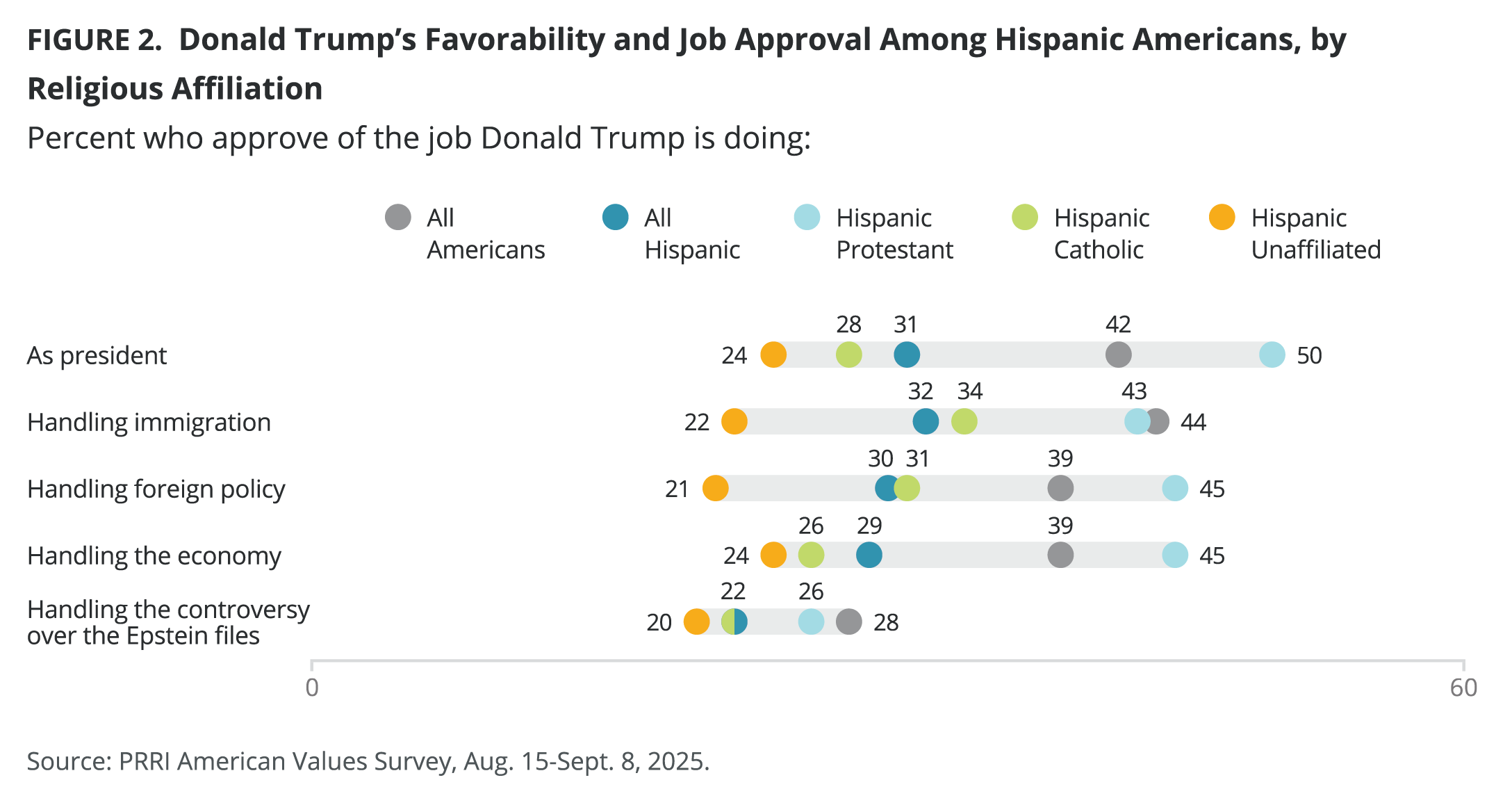
Hispanic Americans are 10 percentage points less likely to approve of the job Trump is doing as president than all Americans (31% vs. 42%), but this differs significantly by religion. The percentage of Hispanic Protestants who approve of the job Trump is doing as president falls above the national average (50%), while Hispanic Catholics (28%) and the Hispanic unaffiliated (24%) fall below it. Comparing March 2025 with September 2025, Hispanic Americans have remained consistent in their overall approval of Trump as president, including among Hispanic Catholics and Hispanic unaffiliated. However, Hispanic Protestants stand out, showing a notable increase in approval, from 34% in March 2025 to 50% in September.
About three in ten Hispanic Americans approve of the job Trump is doing handling immigration (32%), foreign policy (30%), and the economy (29%). Just 22% approve of the job Trump is doing handling the controversy over the Epstein files. Again, Hispanic Protestants are far more likely than Hispanic Catholics and Hispanic unaffiliated to support Trump’s handling of immigration (43% vs. 34% and 22%, respectively), foreign policy (45% vs. 31% and 21%, respectively), and the economy (45% vs. 26% and 24%, respectively).[2] However, they do not differ significantly when it comes to the president’s handling of the controversy over the Epstein files (26%, 22%, 20%, respectively).
Most Hispanic Americans View Immigration Policy as Headed in the Wrong Direction and Lack Confidence in Immigration and Customs Enforcement (ICE)
On the question of immigration specifically, most Hispanic Americans (73%) say that the way the federal government is dealing with undocumented immigrants is generally going in the wrong direction, including strong majorities of unaffiliated (83%), Catholic (76%), and Protestant (60%) Hispanic Americans. While most Hispanic Americans have little or no confidence in U.S. Immigration and Customs Enforcement (ICE) (68%), unaffiliated Hispanic Americans are over 10 percentage points more likely to lack confidence in ICE (78%) than Hispanic Catholics (66%) and Hispanic Protestants (64%).
There are few differences among Hispanic Americans (70%) by religious affiliation over their agreement with the idea that “Immigration and Customs Enforcement officers should not be allowed to conceal their identity with masks or use unmarked vehicles when arresting people,” including Hispanic Protestants (67%), unaffiliated (68%), and Catholics (74%).
Across Religious Traditions, Hispanic Americans Broadly Oppose Punitive Immigration Policies and Support Legalization Pathways
When examining Hispanic Americans’ views on specific immigration policies, there are few differences by religious affiliation as well. More than seven in ten Hispanic Americans disagree with the idea of “arresting and detaining undocumented immigrants who have resided in the United States with no criminal record” (78%) and “The U.S. government deporting undocumented immigrants to foreign prisons in El Salvador, Rwanda, or Libya, without allowing them to challenge their deportation in court” (72%).
While most disagree with the idea that “The federal government should detain immigrants who are in the country illegally in internment camps until they can be deported” (75%) and agree that “Immigrants, regardless of legal status, should have basic rights and protections such as the ability to challenge their deportation before a judge in court” (70%), Hispanic Protestants are less likely (65% and 58%) than Hispanic Catholics (76% both), and unaffiliated Hispanic Americans (82% and 73%) to hold these views.

Further, most Hispanic Americans, independent of their religious affiliation, agree with allowing undocumented immigrants a way to become citizens, provided they meet certain requirements (68%) and agree with “allowing immigrants brought illegally to the U.S. as children to gain legal resident status” (71%). Surprisingly, Hispanic Protestants are 20 percentage points less likely to support DACA (55%) than Hispanic unaffiliated (76%) and Hispanic Catholics (78%).
Support for the “Great Replacement Theory” Is Lower Among Hispanic Americans Overall, Though Hispanic Protestants Are More Receptive
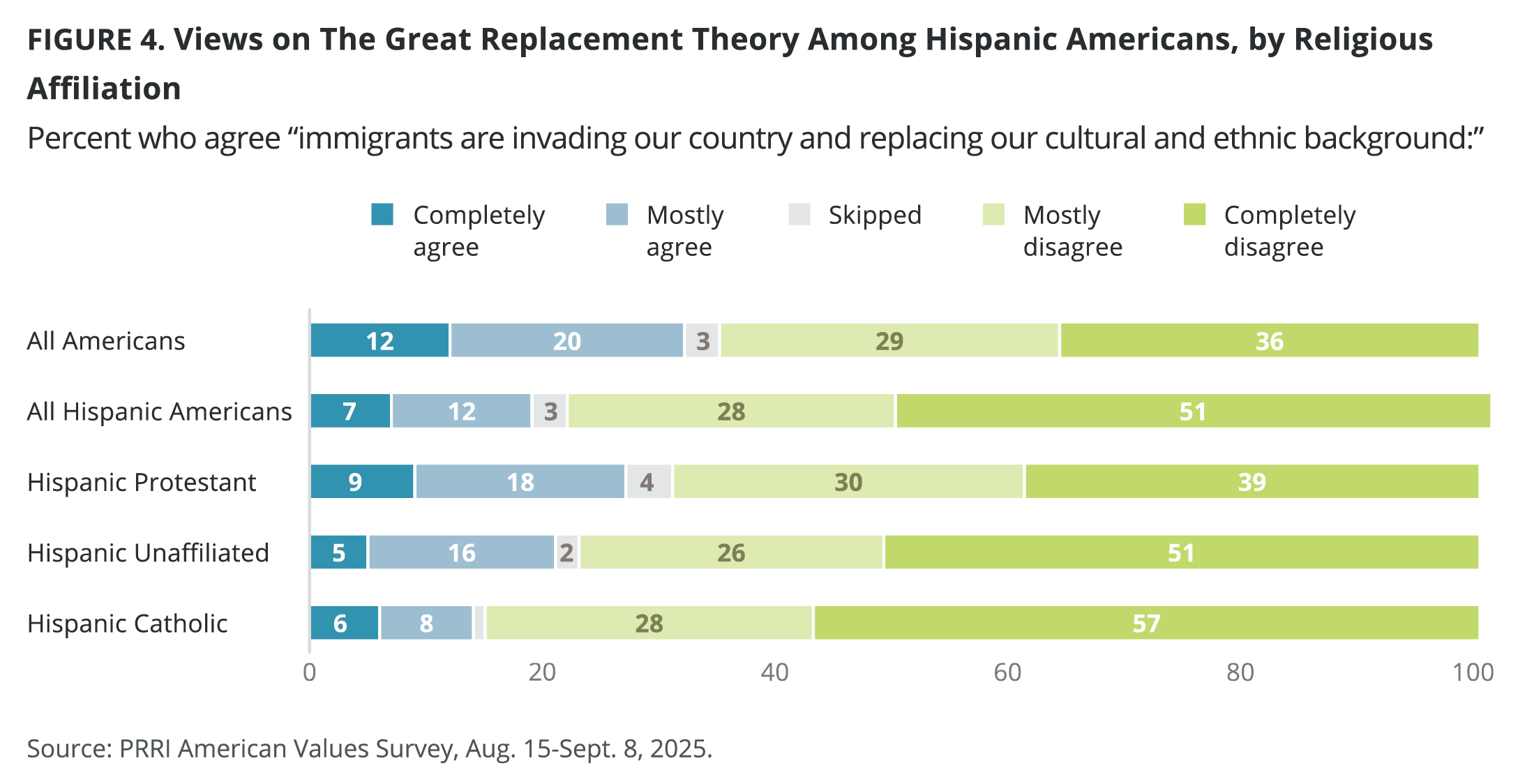
Agreement with the “Great Replacement Theory” (the idea that “Immigrants are invading our country and replacing our cultural and ethnic background”) is lower among Hispanic Americans (19%) than among Americans overall (32%). Hispanic Catholics show the lowest agreement (14% agree vs. 85% disagree), followed by unaffiliated Hispanic Americans (21% agree vs. 77% disagree). Hispanic Protestants are the most receptive to the Great Replacement Theory (27% agree vs. 69% disagree), though they are still less likely to support this idea than Americans overall.
Key Factors Predicting Support for Donald Trump and His Immigration Agenda Among Hispanic Americans
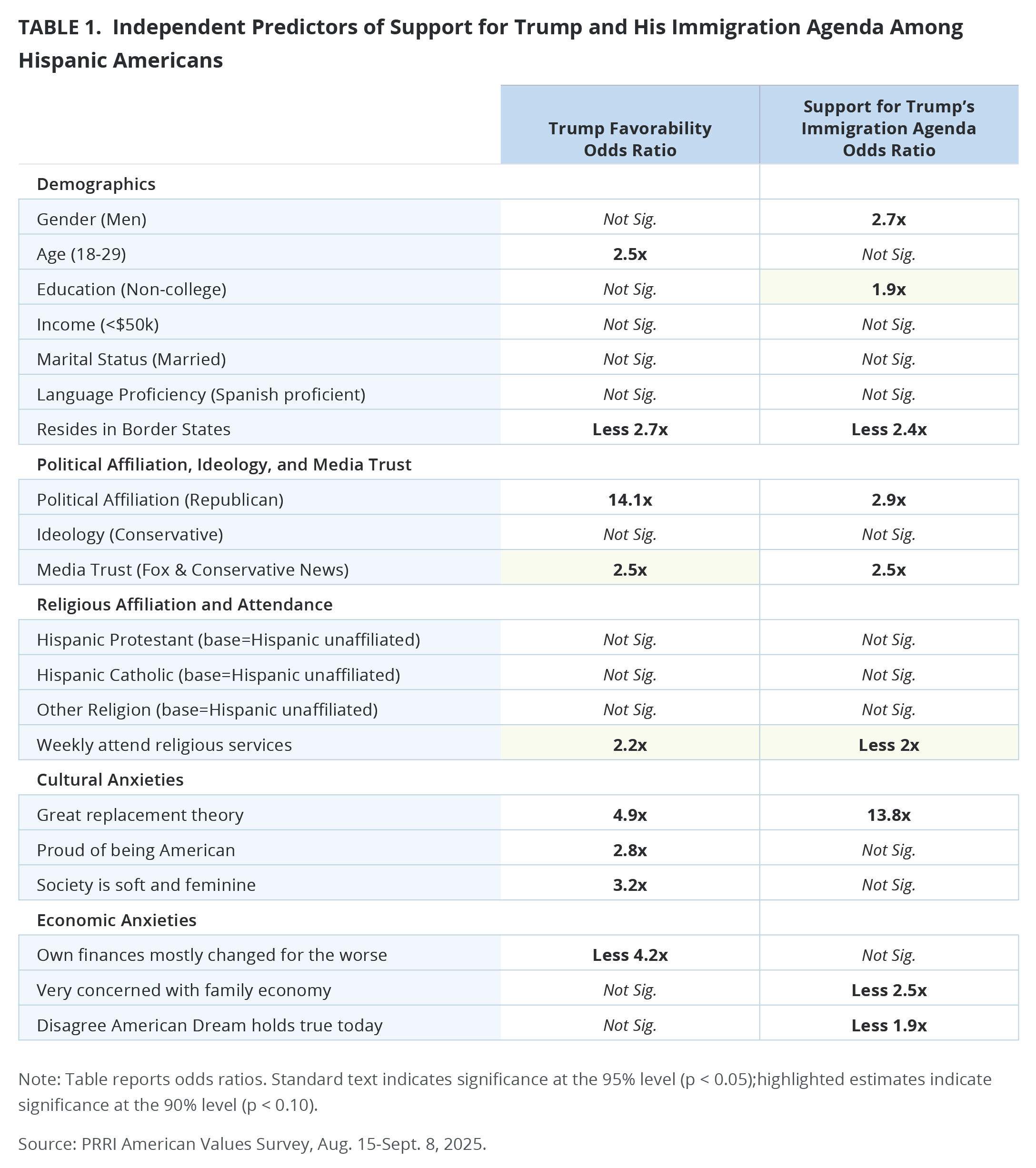
PRRI developed a model to test various factors in predicting support for Trump among Hispanic Americans in 2025, finding that aside from partisanship, views of Trump and the job he is doing on immigration are driven by economic concerns, cultural anxieties, and religiosity. Using data from the 2025 PRRI American Values Survey, we conducted two logistic regression models among Hispanic Americans to determine the roots of Hispanic Americans’ support for Trump, focusing on two key dependent variables: Trump favorability and support for his immigration agenda, based on a recently developed immigration scale published in our latest report.[3]
The models incorporate various demographic characteristics, including gender, age, education, income, marital status, language proficiency, place of residence, media trust, party, ideology, and religious affiliation. Our logistic regression models also control for the frequency of worship attendance (weekly or more) and account for cultural anxiety through indicators such as agreement with the “Great Replacement Theory” (the belief that immigrants are invading the country and replacing its cultural and ethnic identity), attitudes about gender, and pride in being an American. Finally, measures of economic anxiety are included, such as perceptions of a worsening personal economic situation, concerns about meeting family needs, and disagreement with the American Dream.[4]
Demographic Factors, Political Party, and Ideology:
Among Hispanic Americans, identifying as a Republican is strongly predictive of both Trump favorability and support for his immigration agenda. Hispanic Republicans are roughly 14 times more likely than other Hispanic Americans to hold favorable views of Trump and about three times more likely to support his immigration agenda. In addition, Hispanic Americans who most trust Fox news and far-right news for their political information are about three times more likely than Hispanic Americans who trust other media sources or don’t trust any sources to hold favorable views of Trump and support his immigration agenda.
Interestingly, Hispanic young adults ages 18-29 are nearly three times as likely as other Hispanic Americans to hold favorable views of Trump, but do not differ significantly in their support for his immigration agenda. By contrast, Hispanic residents of southern border states are roughly three times less likely than those who live in non-border states to hold favorable views of Trump and support his immigration agenda. Further, Hispanic men and non-college-educated Hispanics are more likely than other Hispanic Americans to support Trump’s immigration policies.[5]
Religious Affiliation and Attendance:
While there are no differences in Hispanic Americans’ religious affiliation and their support for Trump once other factors are taken into account, attending religious services weekly or more is significantly related. Hispanic frequent religious service attenders are nearly three times as likely as other Hispanics to hold favorable views of Trump, but less likely to support his immigration agenda.
Cultural Anxieties and Pride in Being an American:
Hispanic Americans who agree with the “Great Replacement Theory” — the belief that immigrants are invading the country and replacing its cultural and ethnic identity — are significantly more likely than those who disagree to hold favorable views of Trump and support his immigration agenda. Similarly, Hispanics who are proud of being an American are significantly more likely than those who are not proud of being an American to favor Trump, but do not differ significantly from other Hispanic Americans in their support for his immigration agenda.
Support for Patriarchal Views:
Views about gender emerged as a powerful predictor in explaining Trump favorability; Hispanic Americans who agree that society as a whole has become too soft and feminine are about three times as likely as those who disagree to favor Trump, but do not differ significantly from other Hispanic Americans in their support for Trump’s immigration agenda.
Economic Anxieties:
Hispanic Americans who believe that their own economic situation has mostly changed for the worse are four times less likely than those who say it has changed for the better to hold favorable views of Trump. While concerns with meeting family needs and disagreement with the American Dream are not significantly related to Trump’s favorability, they are related to support for Trump’s immigration agenda. Hispanic Americans holding these views are less likely than other Hispanics to support Trump’s immigration policies.
Overall, these models demonstrate that partisanship remains one of the biggest factors in explaining support for Donald Trump and his immigration agenda among Hispanic Americans. Beyond partisanship, however, cultural anxieties also remained strong predictors of Hispanic support, particularly agreement with the “Great Replacement Theory.” At the same time, the models reveal the powerful role of culture and religious practice in shaping Hispanic support for Trump and his immigration agenda. Notably, attitudes about gender and frequency of church attendance also emerged as strong predictors of Trump support among Hispanic Americans.
Finally, several indicators of macro-level economic anxiety are associated with less support for Trump.
[1] Given the small number of Hispanic unaffiliated cases, these findings should be interpreted with caution.
[2] Because the immigration and border approval items were asked on split samples, both responses were combined to maximize sample size and estimate overall Americans’ approval of Trump’s job handling immigration.
[3] It is worth noting, just 16% of Hispanic Americans support Trump’s immigration agenda. For details on the construction of the immigration scale and its indicators, see our most recent report on immigration: https://prri.org/research/the-new-immigration-crackdown-where-americans-stand/.
[4] Because odds ratios can be difficult to interpret, the descriptions of results are simplified to make them more accessible to readers.
[5] According to the 2025 PRRI American Values Survey, 87% of Hispanic Americans identify as white, 6% identify as multiracial, 4% as Black, and 3% as other races. Including white vs. nonwhite identity in the model does not produce significant effects, nor does it alter the overall results. The key findings remain consistent.