

Dr. Risa Cromer is a 2025-2026 PRRI Public Fellow focusing on reproductive health and rights. She is also an Associate Professor of Anthropology at Purdue University.
For decades, conservative Christian organizations and allied legal advocates have worked to expand the legal definition of “person” to include embryos and fetuses. Once incorporated into law through constitutional amendment or statute, embryo personhood reshapes how courts interpret issues from abortion rights to civil and criminal liability. Yet the legal logic of personhood also implicates in vitro fertilization (IVF). IVF in the United States commonly involves creating multiple embryos, transferring some, and freezing others for future use. When embryo personhood is enshrined in law, these routine practices — along with decisions about unused embryos — can create legal liabilities for IVF providers that threaten access to care. This Spotlight Analysis examines Americans’ views on IVF and beliefs about whether human life begins at fertilization, as well as how these views may shape policy debates.
The implications of personhood policy for IVF became visible in 2024 through two developments in reproductive politics. In February, the Alabama Supreme Court ruled in LePage v. Center for Reproductive Medicine that frozen embryos could be treated as children under the state constitution’s personhood clause recognizing the “sanctity of unborn life.” Four months later, the Southern Baptist Convention voted to oppose IVF, citing concerns about the destruction of embryos with “unconditional value and the right to life.”
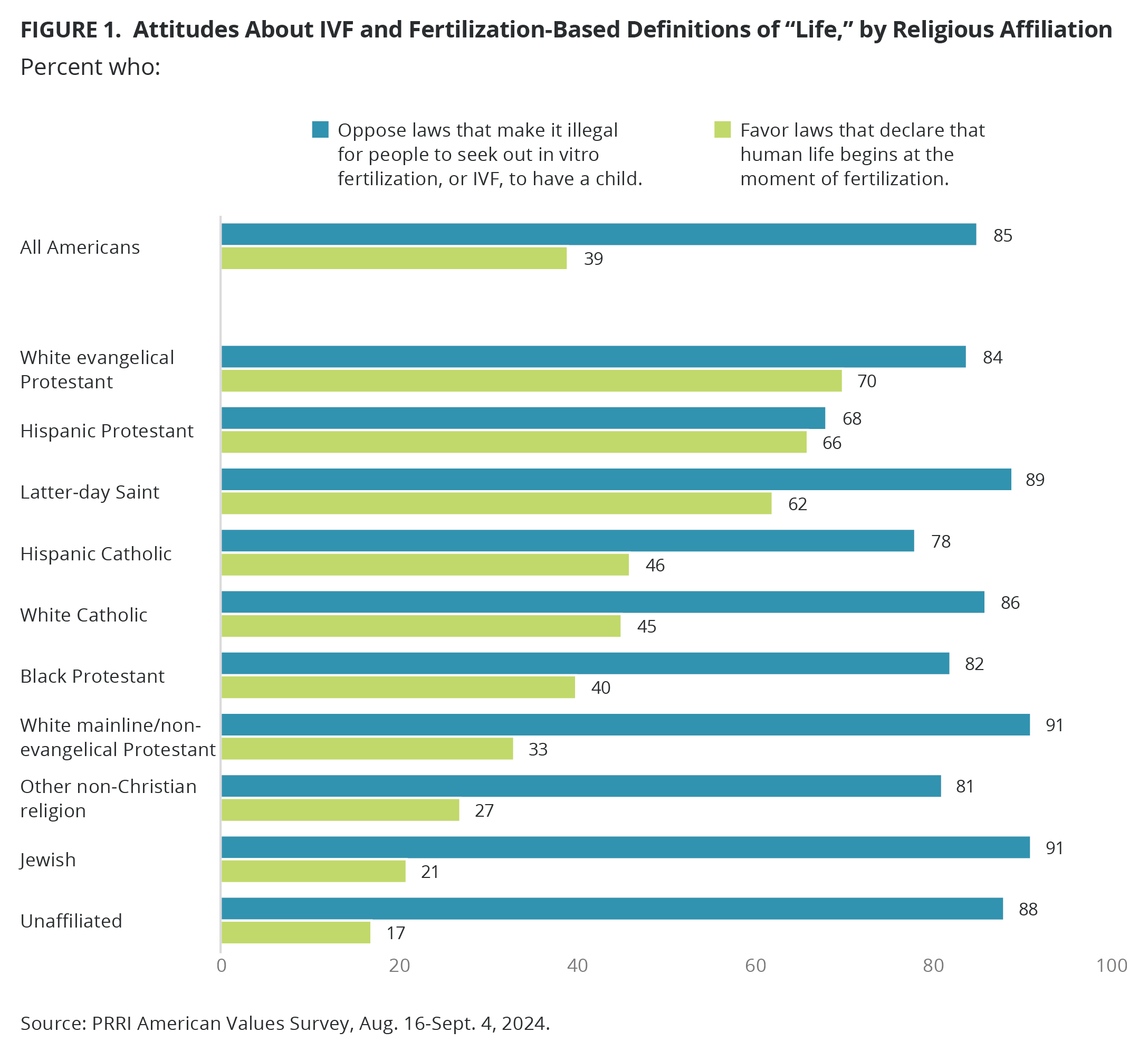
PRRI’s 2024 American Values Survey captures a tension within conservative Christian politics when religious principles become reproductive policy. Nationally, 85% of Americans oppose laws that would make IVF illegal, meaning that significant majorities across nearly every political affiliation, demographic group, and religious tradition support access to IVF. At the same time, a minority of Americans (39%) support laws declaring that “human life begins at fertilization,” the legal cornerstone of embryo and fetal personhood advocacy. Conservative Christians are a notable exception. Majorities of white evangelical Protestants, Hispanic Protestants, and Latter-day Saints both oppose laws that would make IVF illegal and strongly support laws declaring that human life begins at fertilization.
These findings reveal a friction among conservative Christians between affirming IVF as a path to family formation and conferring moral status to human embryos through a legal strategy that puts IVF in jeopardy. As conservative Christian advocates continue to promote embryo personhood proposals in legislatures and courts, this tension may shape how religious constituencies respond to future debates over reproductive policy.
In February 2024, the Alabama Supreme Court demonstrated how embryo personhood policy can implicate IVF when it ruled in LePage v. Center for Reproductive Medicine. The court relied on Alabama’s Amendment 2 — passed by referendum in 2018 codifying the “sanctity of unborn life” — to recognize frozen embryos as children under state law. The ruling had immediate consequences: Fertility clinics halted services and patients’ treatment cycles were disrupted. In response, citizens rallied at the state capitol urging lawmakers to “protect IVF.” State legislators quickly passed a bipartisan bill granting IVF providers civil and criminal immunity, but the law left the constitution’s personhood language unchanged. How personhood policy will ultimately affect IVF in Alabama, therefore, remains unresolved.
As Alabama demonstrates, the view that “life begins at fertilization” has direct consequences for assisted reproduction when it becomes law. In this way, personhood policies threaten IVF by effect rather than explicit ban. Criminalizing IVF, which most Americans oppose, does not require new legislation. It only requires courts to interpret embryo personhood laws to include “extrauterine embryos.” Alabama is not an outlier; many other states have enacted personhood laws or constitutional provisions that could invite similar interpretations. IVF may be at risk wherever personhood policies prevail.
The response to the Alabama ruling underscores that conservative Christians are far from unified on how personhood beliefs should shape public policy. Consider Rodney and Mary Leah Miller, pro-life Christians who built their family through embryo adoption — a practice that affirms embryo personhood yet depends on the reproductive technologies these policies threaten. In the wake of LePage, Rodney told reporters that the ruling is “very life-affirming…on paper” but the consequences are not: “This is not a win [for the Christian right]… It’s the classic case of you won the battle but lost the war. Fewer children will be born because of this unless things change.”
Conservative Christians themselves are debating how far personhood principles should extend in law. The Millers represent one position within the ongoing political tension among conservative Christians. At the other end, the Southern Baptist Convention’s June 2024 resolution — passed just months after the Alabama ruling — urged members to oppose IVF, calling the creation and destruction of embryos inconsistent with the “dignity of human life.” The resolution represents a faction willing to accept the implications of embryo personhood policy for reproductive technologies, but responses to the vote and PRRI’s survey findings suggest that many evangelical Protestants hold more ambivalent views.
Conservative Christian legal advocacy built the legal framework of embryo personhood from convictions about the sanctity of life. But that framework is colliding with a reproductive technology that many within the same communities rely on to build families. Alabama marked the first major conflict between personhood policy and IVF, though it is unlikely to be the last. As embryo personhood provisions spread, the question is no longer whether the religious principle will shape reproductive policy, but how far its consequences will reach.