

To view a PDF of slides presented during PRRI’s February 17, 2026, webinar on this report, please click here. To view a replay of the webinar, please click here.
Executive Summary
Around three in ten Americans qualify as Christian nationalism Adherents or Sympathizers.
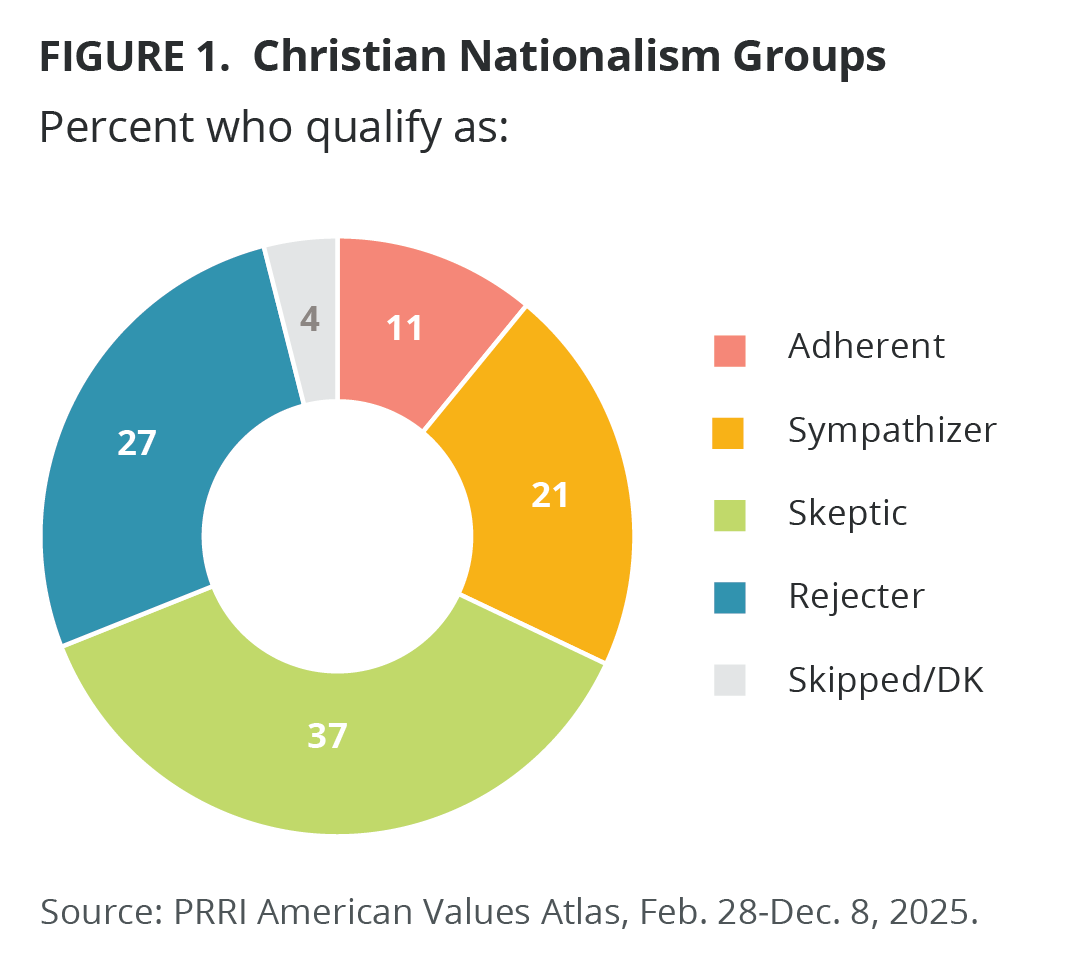
- One-third of Americans qualify as Christian nationalism Adherents (11%) or Sympathizers (21%), compared with two-thirds who qualify as Skeptics (37%) or Rejecters (27%).
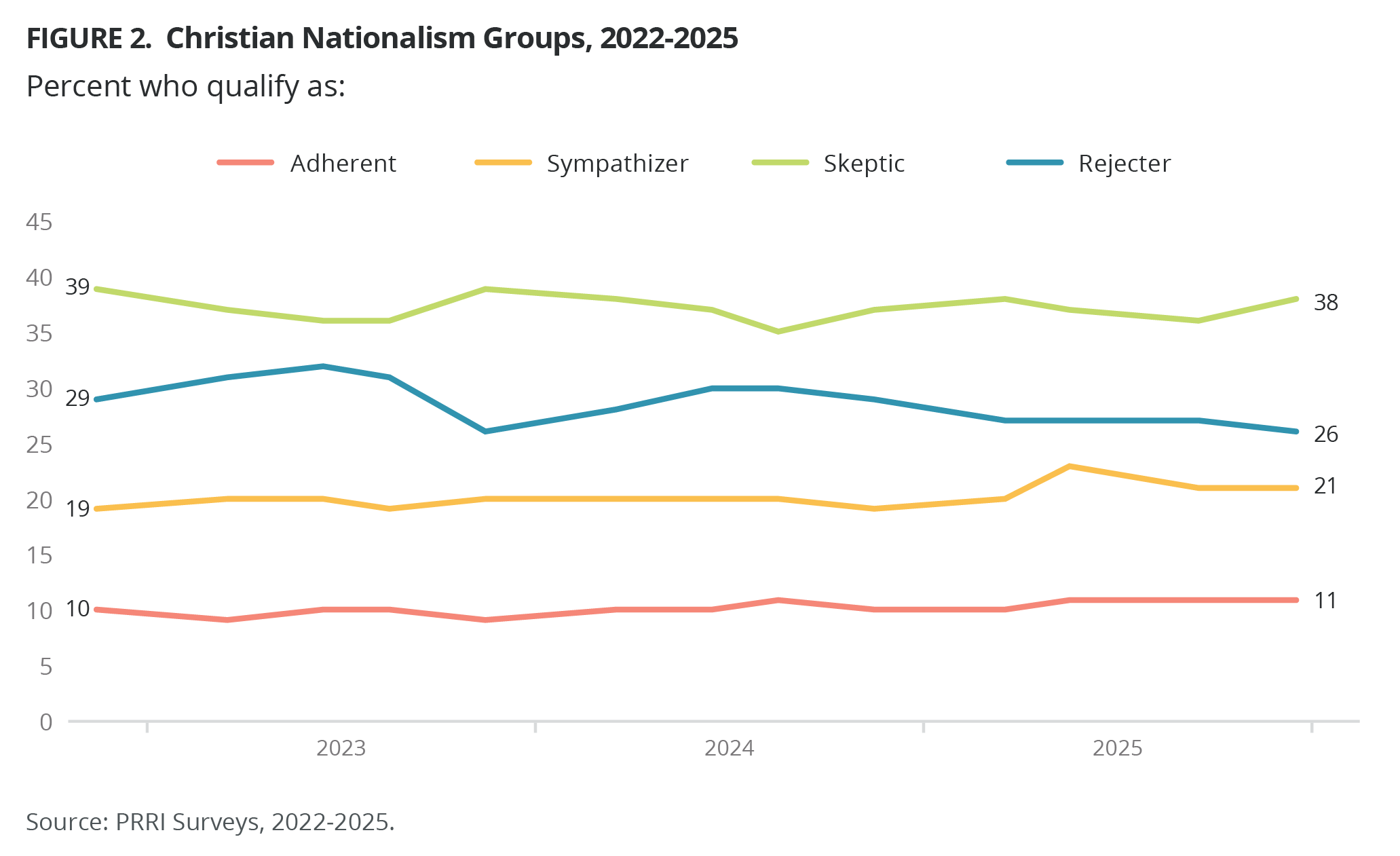
- These percentages have remained stable since PRRI first asked these questions in late 2022, with a slight decline among Americans who qualify as Christian nationalism Rejecters, who peaked at 32% in June 2023 and declined to 26% by the end of 2025.
White evangelical Protestants and Hispanic Protestants are most likely to hold Christian nationalist beliefs; Americans who frequently attend religious services, especially those who are white, are more likely to be Christian nationalists.
- White Christians (46%) are more likely than Christians of color (39%), non-Christians (13%), and religiously unaffiliated Americans (10%) to qualify as Christian nationalism Adherents and Sympathizers. White evangelical Protestants (67%) and Hispanic Protestants (54%) are the only major religious groups among whom a majority hold Christian nationalist beliefs.
- The majority of those who attend religious services weekly or more qualify as Christian nationalism Adherents or Sympathizers (54%), compared with 39% of those who attend at least a few times a year and 20% of those who seldom or never attend services. This correlation holds among those who pray outside of religious services and those who read religious texts.
- White Americans who attend religious services, pray, or read the Bible or other religious texts frequently are more likely than their Black and Hispanic counterparts to qualify as Christian nationalism Adherents and Sympathizers.
Christian nationalism support is also strongly linked to party, media habits, age, education, and race.
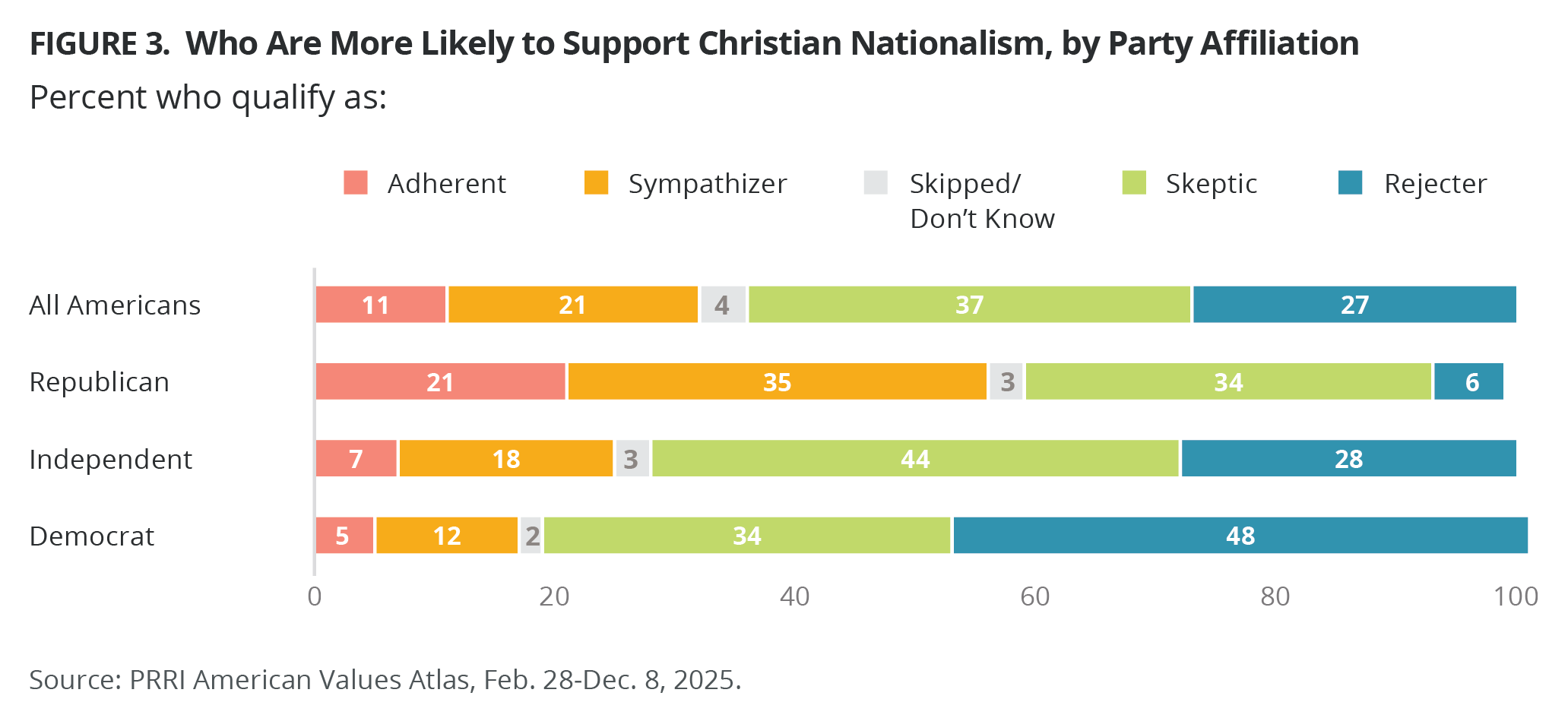
- A majority of Republicans qualify as either Christian nationalism Adherents (21%) or Sympathizers (35%), compared with one-quarter of independents (7% Adherents and 18% Sympathizers) and less than one in five Democrats (5% Adherents and 12% Sympathizers).
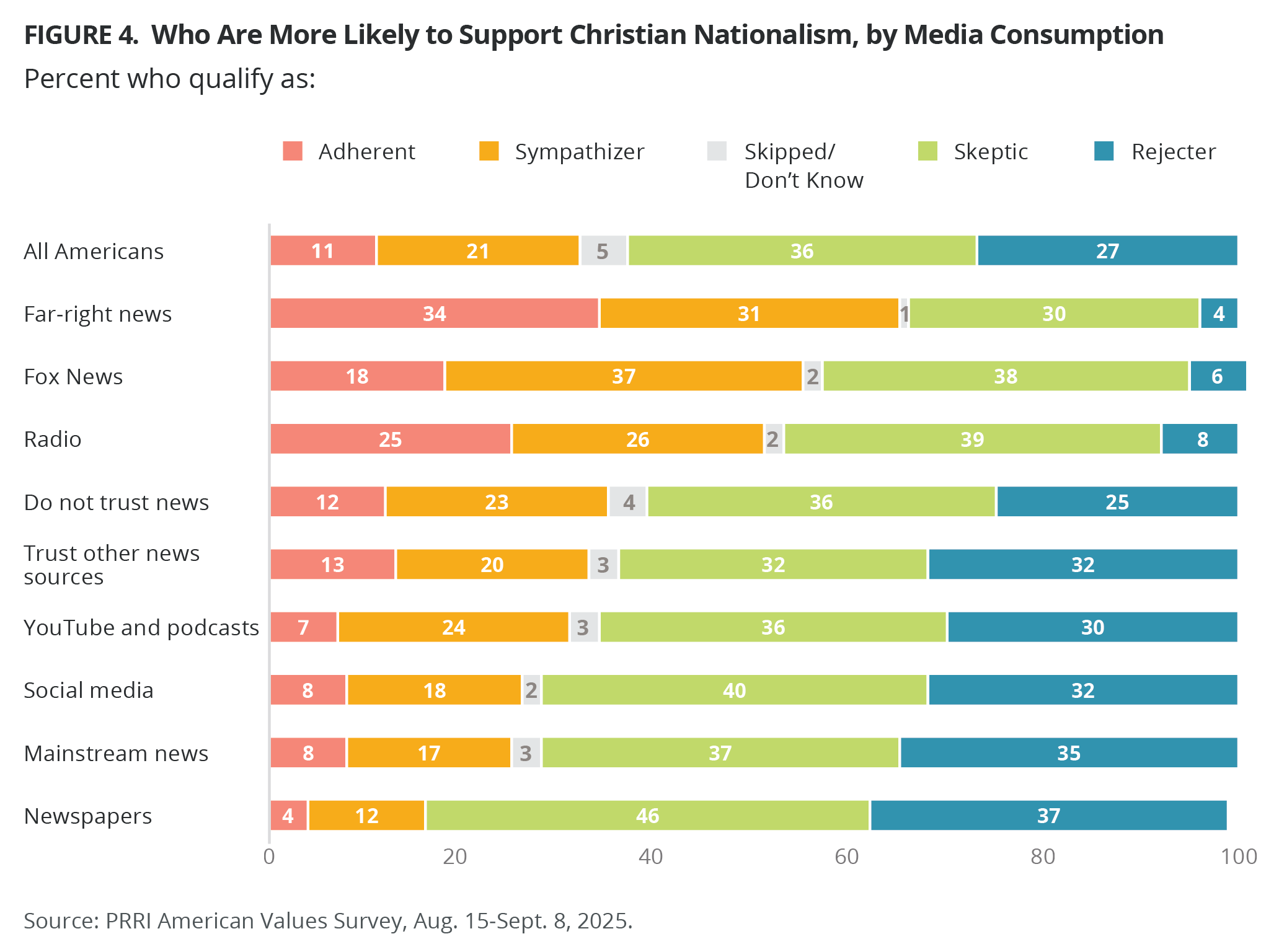
- Two-thirds of Americans who most trust far-right news sources qualify as Christian nationalism Adherents (34%) or Sympathizers (31%), as do a majority of those who most trust Fox News (18% Adherents and 37% Sympathizers).
- Support for Christian nationalism is positively associated with lower education levels and older age; AAPI Americans are far less likely to be Christian nationalists than other Americans.
Christian nationalist views predominate in the South and Midwest; support for Christian nationalism is strongly correlated in all 50 states with favorable views of President Donald Trump and the proportion of Republican representation in state legislatures.
- The states with the highest levels of support for Christian nationalism — which includes about half of their residents — are Arkansas (54%), Mississippi (52%), West Virginia (51%), Oklahoma (49%), and Wyoming (46%).
- Three states emerge with more than half of their white, non-Hispanic residents supporting Christian nationalism: Arkansas (59%), Mississippi (54%), and West Virginia (53%).
- The higher state residents scored on the Christian nationalism scale, the more likely they are to hold favorable views of Trump and the larger the proportion of Republican elected officials in their state legislatures.
Christian nationalists are more likely than other Americans to support political violence and score high on PRRI’s Right-Wing Authoritarianism Scale.
- Three in ten Christian nationalism Adherents (30%) and one-quarter of Sympathizers (23%) agree that “because things have gotten so far off track, true American patriots may have to resort to violence to save the country,” compared with only 14% of Skeptics and 11% of Rejecters.
- Support for political violence among Christian nationalism Adherents was higher under President Joe Biden and declined after Trump’s reelection.
- Christian nationalism Adherents and Sympathizers score high on PRRI’s Right-Wing Authoritarianism Scale; scores for Skeptics are mixed, while Rejecters score low.
- Christian nationalism Adherents and Sympathizers overwhelmingly view Trump as a strong leader, while Skeptics and Rejecters overwhelmingly view him as a dangerous dictator.
Christian nationalists also hold more extreme views about immigrants and are more likely to say mandatory vaccines for children should be illegal.
- Majorities of Christian nationalism Adherents (67%) and Sympathizers (53%) believe that “immigrants are invading our country and replacing our cultural and ethnic background.”
- Majorities of Christian nationalism Adherents (61%) and Sympathizers (54%) agree with “the U.S. government deporting undocumented immigrants to foreign prisons without due process.”
- While at least half of Christian nationalism Adherents and Sympathizers support birthright citizenship, majorities agree with “stripping U.S. citizens of their citizenship and deporting them if they are determined to be a threat to the country” (66% and 56%).
- Over four in ten Christian nationalism Adherents (44%) and one-third of Sympathizers (34%) say that mandatory vaccines for children should be illegal in all or most cases, compared with one-quarter of Skeptics and one in ten Rejecters.
Introduction
In 2022, PRRI developed a comprehensive measurement of Christian nationalist ideology, allowing us to track its prevalence nationally and in all 50 states. This report draws upon 22,000 interviews from the 2025 American Values Atlas to update this work, including new analysis examining the correlation between Christian nationalist views and Republican legislative representation.
Measuring Christian Nationalism
To measure Christian nationalism, PRRI uses a battery of five questions about the relationship between Christianity, American identity, and the U.S. government.[1] Over the course of 2025, around 11% qualified as Christian nationalism Adherents, 21% as Sympathizers, 37% as Skeptics, and 27% as Rejecters.
The proportion of Americans identifying as Christian nationalism Adherents or Sympathizers has remained stable since late 2022: Approximately one in ten Americans are Christian nationalism Adherents, and an additional one in five are Sympathizers. The percentage of Americans who are Christian nationalism Skeptics has remained relatively stable, hovering around 38% since PRRI has collected this data. Since 2022, there has been a slight decline among Americans who are Christian nationalism Rejecters, who peaked at 32% in June 2023 and declined to 26% by the end of 2025.
Which Americans Are Most Likely to Adhere to Christian Nationalist Ideology?
Party Affiliation and Media Trust
A majority of Republicans qualify as either Christian nationalism Adherents (21%) or Sympathizers (35%), compared with one-quarter of independents (7% Adherents and 18% Sympathizers) and less than two in ten Democrats (5% Adherents and 12% Sympathizers).
PRRI’s 2025 American Values Survey asked which news sources Americans trust most to provide accurate information about politics and current events. Nearly two-thirds of Americans who most trust far-right news outlets qualify as Christian nationalism Adherents (34%) or Sympathizers (31%), as do a majority of those who most trust Fox News (18% of Adherents and 37% of Sympathizers) and about half of those who most trust radio news sources (25% of Adherents and 26% of Sympathizers). By contrast, about one-third or fewer Americans who do not trust news sources qualify as Adherents (12%) or Sympathizers (23%), followed by those who most trust other news sources (13% of Adherents and 20% of Sympathizers), YouTube or podcasts (7% of Adherents and 24% of Sympathizers), social media (8% of Adherents and 18% of Sympathizers), and mainstream media outlets (8% of Adherents and 17% of Sympathizers). Just 16% of those who trust most newspapers qualify as Adherents (4%) or Sympathizers (12%).
Religious Affiliation
Around half of white Christians (16% Adherents and 30% Sympathizers) and four in ten Christians of color (14% Adherents and 25% Sympathizers) qualify as Christian nationalists, compared with around one in ten non-Christians (3% Adherents and 10% Sympathizers) and unaffiliated Americans (2% Adherents and 8% Sympathizers).
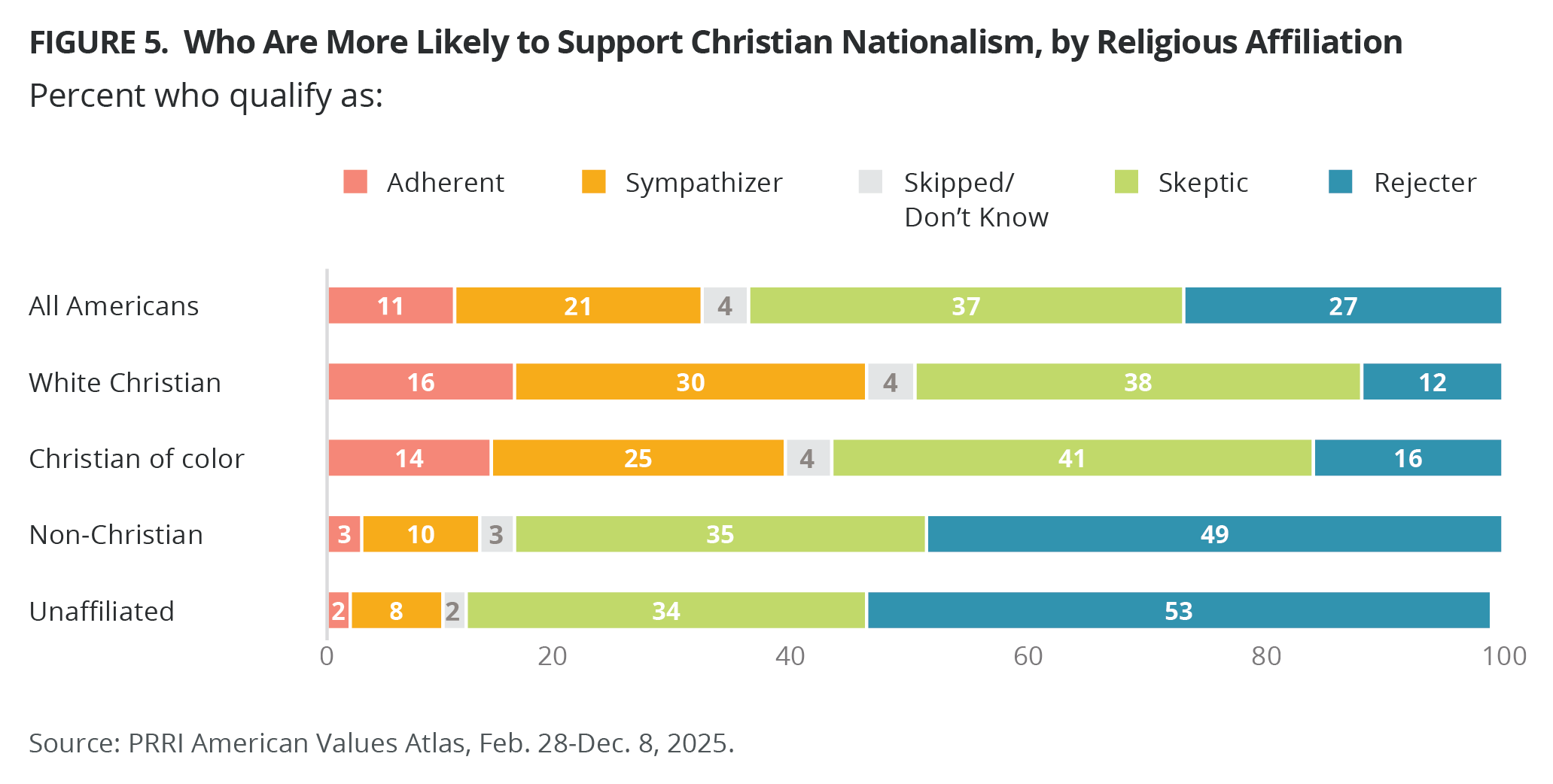
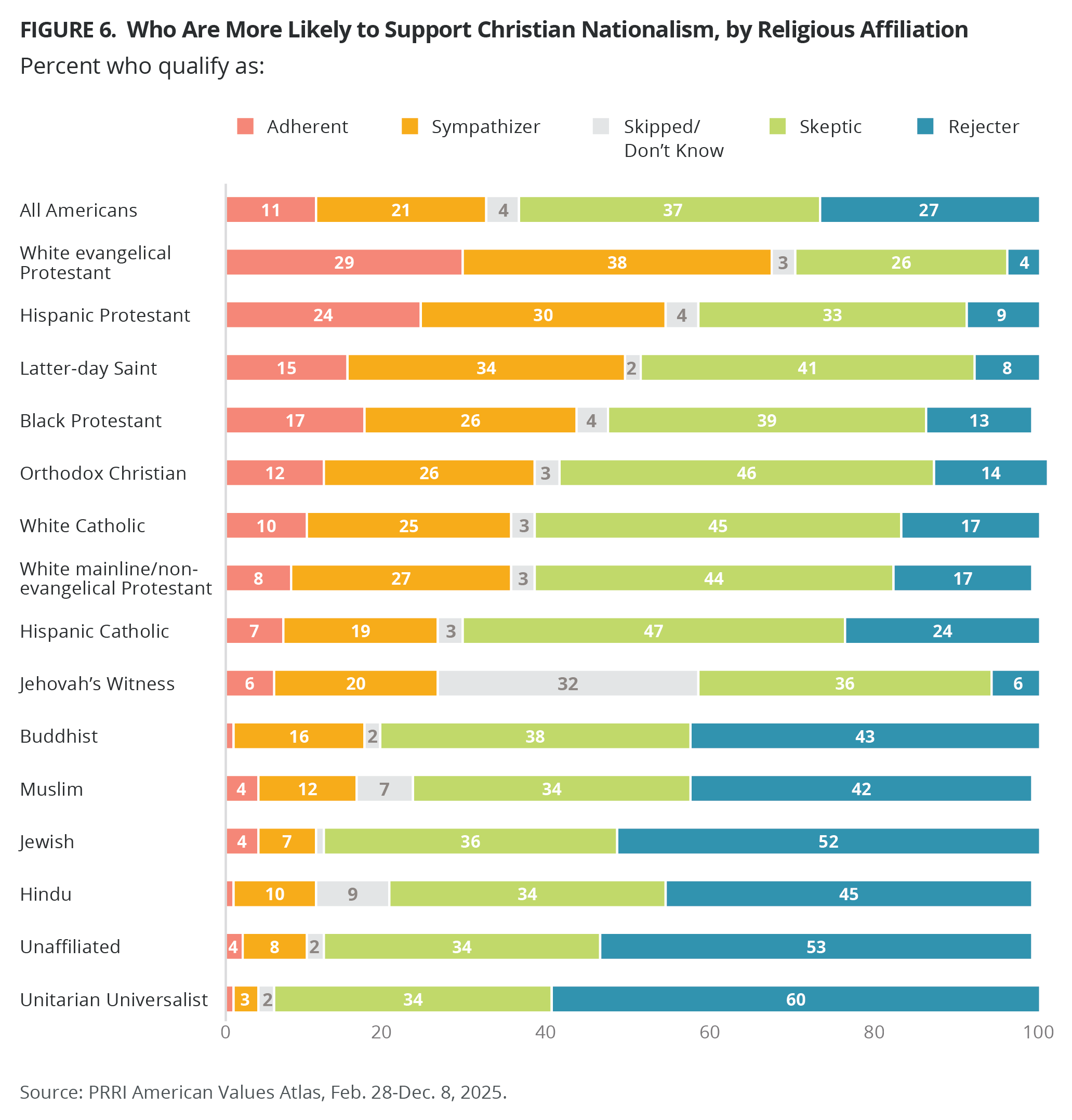
Looking deeper within these broader religious categories, PRRI finds distinct differences. White evangelical Protestants (29% Adherents and 38% Sympathizers) and Hispanic Protestants (24% Adherents and 30% Sympathizers) stand out as the only groups with majority support for Christian nationalist views. Latter-day Saints are divided, with 49% qualifying as Christian nationalism Adherents or Sympathizers and 49% qualifying as Skeptics and Rejecters.
Significantly less than half the members of all other religious groups support Christian nationalism. About four in ten Black Protestants (17% Adherents and 26% Sympathizers) and Orthodox Christians (12% Adherents and 26% Sympathizers) support Christian nationalism. About one-third of white Catholics (10% Adherents and 25% Sympathizers) and white mainline/non-evangelical Protestants (8% Adherents and 27% Sympathizers), as well as one-quarter of Hispanic Catholics (7% Adherents and 19% Sympathizers) and Jehovah’s Witnesses (6% Adherents and 20% Sympathizers), also adhere to these beliefs. Significantly fewer members of non-Christian religions or unaffiliated Americans are Christian nationalism Adherents or Sympathizers, including Buddhists (1% Adherents and 16% Sympathizers), Muslims (4% Adherents and 12% Sympathizers), Jewish Americans (4% Adherents and 7% Sympathizers), Hindus (1% Adherents and 10% Sympathizers), religiously unaffiliated Americans (2% Adherents and 8% Sympathizers), and Unitarians (1% Adherents and 3% Sympathizers).
Religious Practices
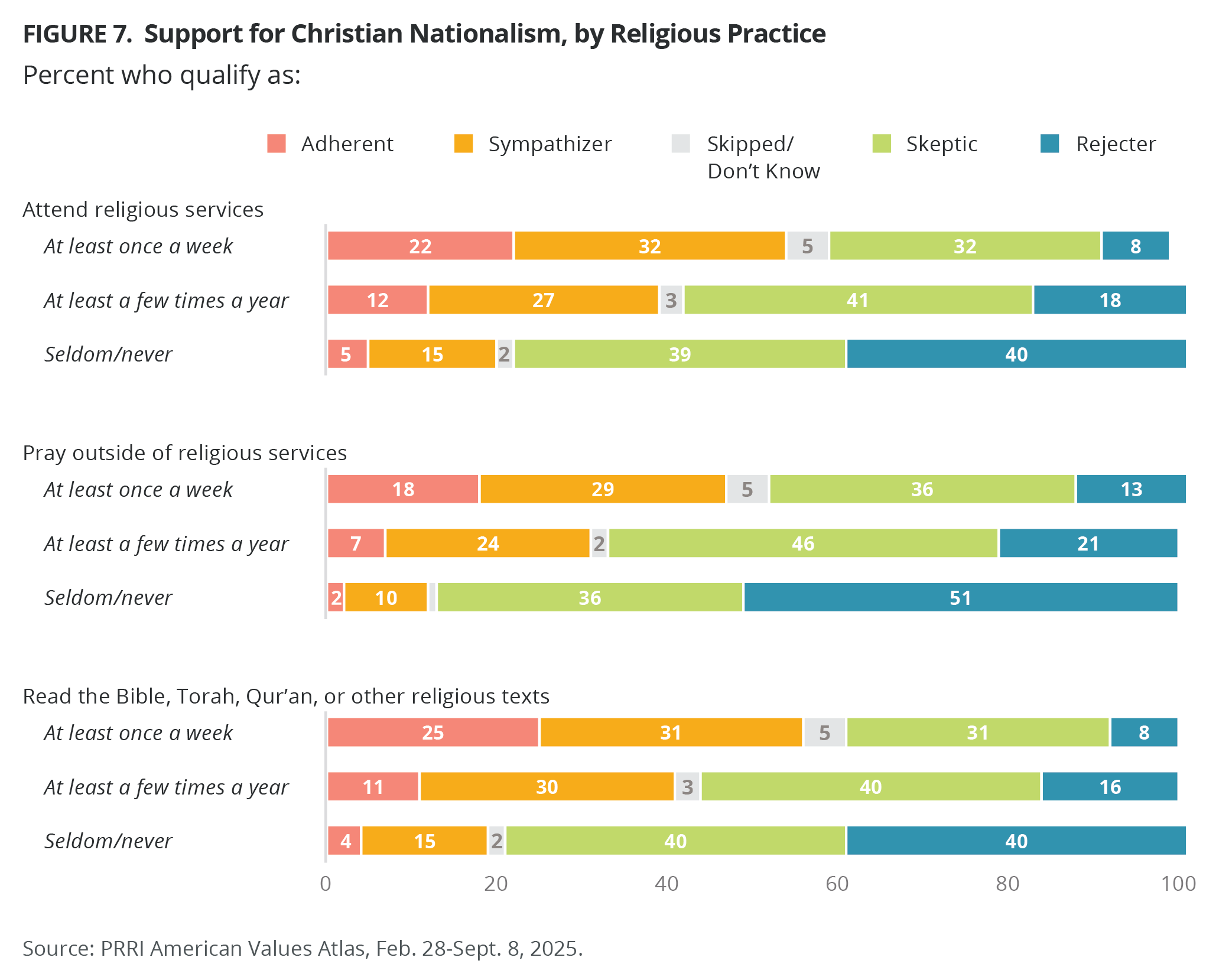
Christian nationalist views are more prevalent among Americans who frequently participate in various religious practices. A majority of Americans who attend religious services weekly or more qualify as Christian nationalism Adherents (22%) or Sympathizers (32%), compared with four in ten of those who attend at least a few times a year (12% Adherents and 27% Sympathizers), and two in ten of those who seldom or never attend services (5% Adherents and 15% Sympathizers). Among Christians, the pattern is similar. Most Christians who attend religious services weekly or more qualify as Christian nationalism Adherents (23%) or Sympathizers (33%), compared with over four in ten Christians who attend at least a few times a year (13% Adherents and 30% Sympathizers) and around one-third of Christians who never attend (9% Adherents and 23% Sympathizers). This positive correlation between frequency of religious practice and support for Christian nationalism also holds for the practices of prayer and the reading of the Bible or other religious texts.
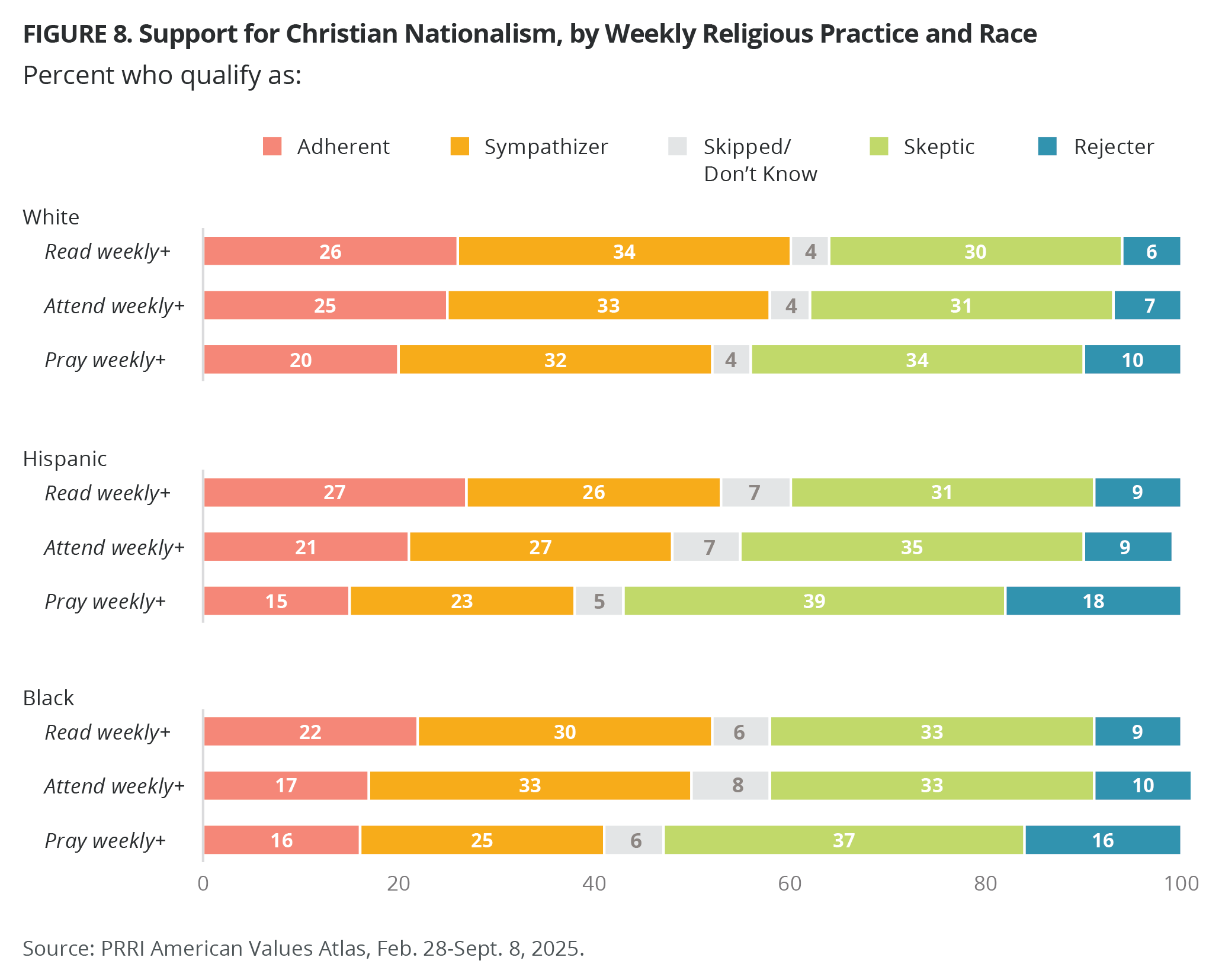
While weekly religious practices are closely associated with Christian nationalism, important differences emerge among racial groups. Nearly six in ten white weekly church attenders qualify as Adherents or Sympathizers (58%), compared with half of Black (50%) and Hispanic weekly church attenders (48%). More than half of white Americans who pray weekly (52%) are Christian nationalism Adherents and Sympathizers, compared with 41% of Black Americans and 38% of Hispanic Americans. Similar patterns emerge with respect to weekly scripture reading, with 60% of white Americans who read the Bible or religious texts frequently qualifying as Christian nationalism Adherents or Sympathizers, compared with 53% of Hispanic Americans and 52% of Black Americans with similar practices.
Demographic Attributes
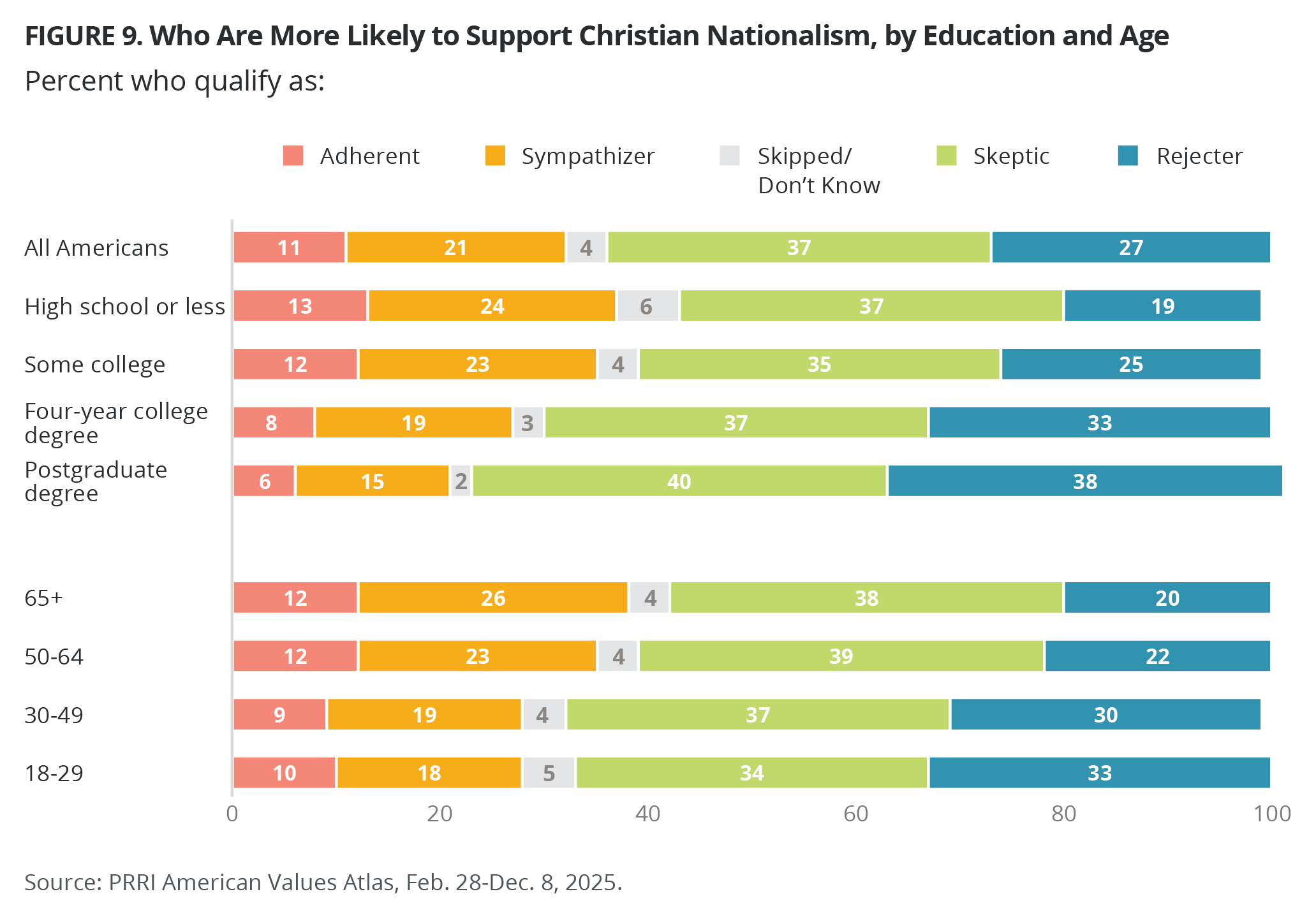
PRRI’s 2025 American Values Atlas also finds that Christian nationalism is positively correlated with lower levels of education and older age. Americans with a high school education or less (37%) or some college (35%) are more likely to be Christian nationalism Adherents or Sympathizers, compared with 27% of Americans with a college degree and 21% of Americans with a postgraduate degree. Similarly, Americans aged 50 or higher are more likely to hold Christian nationalist views, compared with those under 50.
Race
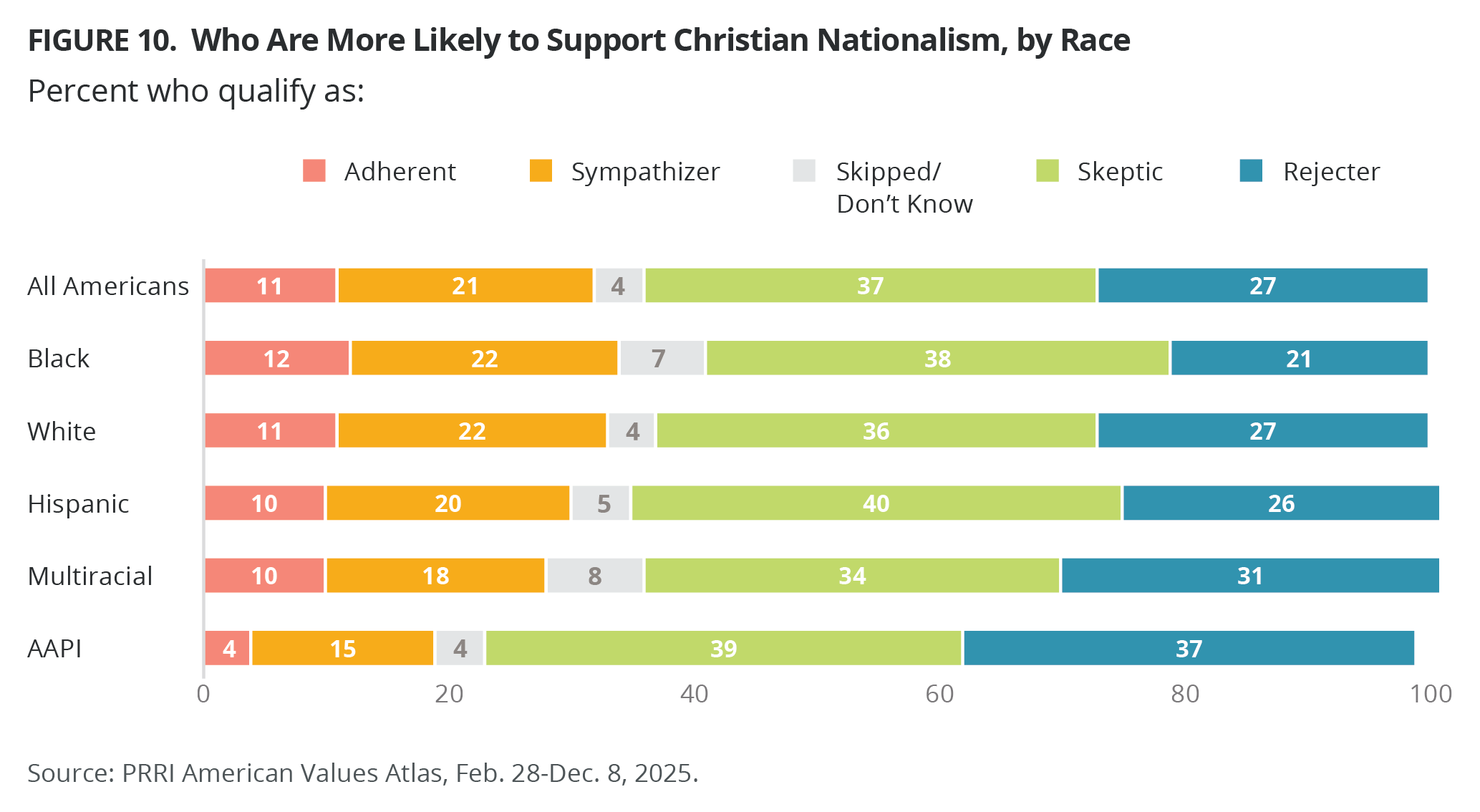
There is less support for Christian nationalism among AAPI Americans, who are less likely than the general population to identify as Christian, but fewer differences among other racial and ethnic groups.
Previous analysis by PRRI finds that while there is little variation by race or ethnicity when it comes to support for Christian nationalist identity, Christian nationalist beliefs, as refracted through racial and ethnic identity, produce divergent political outcomes among white, Hispanic, and Black Americans.[2] Among white and Hispanic Americans — but not Black Americans — holding Christian nationalist beliefs is strongly correlated with Republican Party identity and support for Trump. White Christian nationalists are also far more likely than Hispanic and Black Christian nationalists to prioritize the issue of immigration.
State-Level Patterns in Christian Nationalism
Christian Nationalism at the State Level
The proportion of Americans who qualify as Adherents and Sympathizers differs considerably across states, ranging from a low of 15% in Massachusetts to a high of 54% in Arkansas (see Appendix A for a table of Christian nationalism groups in all 50 states).
Figure 11 shows that states with the highest levels of support for Christian nationalism are red states primarily located in the South and Midwest: Arkansas (54%), Mississippi (52%), West Virginia (51%), Oklahoma (49%), and Wyoming (46%). By contrast, the states with the lowest shares of Christian nationalism Adherents and Sympathizers are blue, located primarily on the coasts: California (22%), New Jersey (22%), New York (21%), Washington (18%), and Massachusetts (15%). Swing states fall in between, with roughly one-third of residents qualifying as Adherents or Sympathizers: North Carolina (36%), Pennsylvania (34%), Michigan (33%), Wisconsin (32%), and Arizona (30%). Residents in Georgia (42%) are significantly more likely than Nevadans (25%) to adhere to Christian nationalism beliefs.[3]
Figure 12 shows that three states have majorities of white, non-Hispanic residents who support Christian nationalism: Arkansas (59%), Mississippi (54%), and West Virginia (53%). Additionally, nearly half of white residents in Louisiana (49%), Oklahoma (49%), and Missouri (45%) also qualify as Christian nationalism Adherents or Sympathizers.
Christian Nationalism and Favorable Views of Trump
Favorable views of President Donald Trump are highly correlated with Christian nationalism views at the state level.[4] For example, Figure 13 shows that Arkansas and Mississippi have average scores of 0.52 and 0.51, respectively, on the Christian nationalism scale, with 53% and 50% of residents showing favorable views toward Trump. Similarly, Georgia and Texas have average scores of 0.42 and 0.40, respectively, on the Christian nationalism scale, with 37% and 39% of their residents showing favorable views of Trump. In comparison, Massachusetts and Washington, with average scores of 0.23 and 0.24, respectively, have only 30% and 31% of residents showing favorable views of Trump.
Christian Nationalism and Republican Representation in State Legislatures
The 50-state map shows that Christian nationalist ideologies predominate in the South and Midwest in states with larger majorities of Republican elected officials in their state legislatures. Figure 14 shows a strong positive correlation between the proportion of Republicans in a state’s legislature and support for Christian nationalism.[5] For example, Arkansas and Oklahoma have an average score of 0.52 and 0.48, respectively, on the Christian nationalism scale, with Republicans representing 81.5% and 79.9% of their state legislatures. Similarly, Georgia and Texas have comparable average scores on the Christian nationalism scale (0.42 and 0.40, respectively), with Republican lawmakers representing 55.9% and 59.7% of the state legislatures. In comparison, Massachusetts, with an average Christian nationalism score of 0.23, has only 15% of its state legislative seats held by Republicans.
The Link Between Christian Nationalism, Political Violence, and Authoritarianism
Christian Nationalism and Political Violence
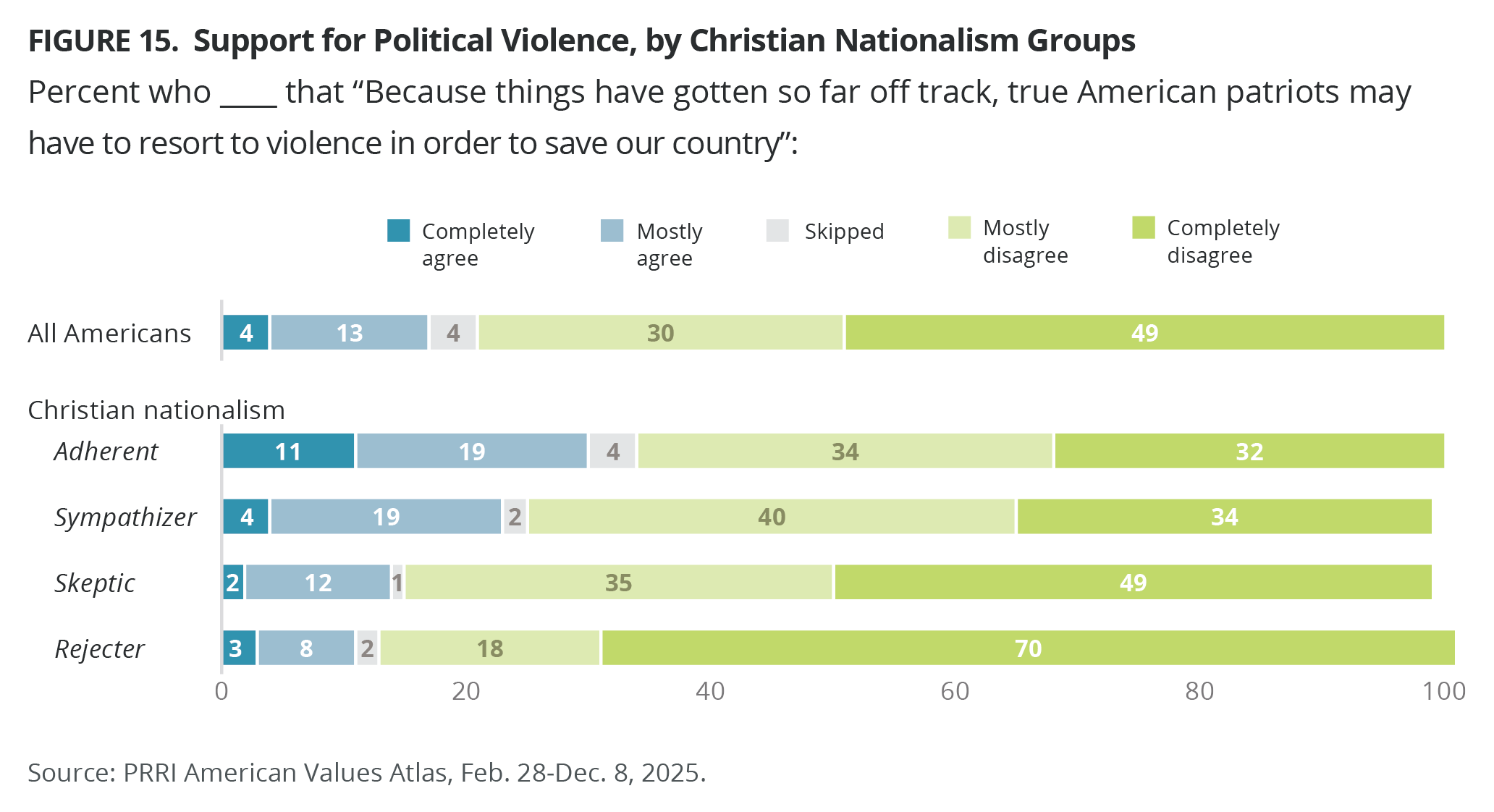
Over the course of 2025, only 17% of Americans agreed that “because things have gotten too far off track, true American patriots may have to resort to violence in order to save our country,” while the vast majority disagree (79%). Even most Americans who qualify as Christian nationalism Adherents (66%) and Sympathizers (74%) disagree. However, Christian nationalism Adherents (30%) are more likely than Sympathizers (23%), Skeptics (14%), and Rejecters (11%) to support political violence.
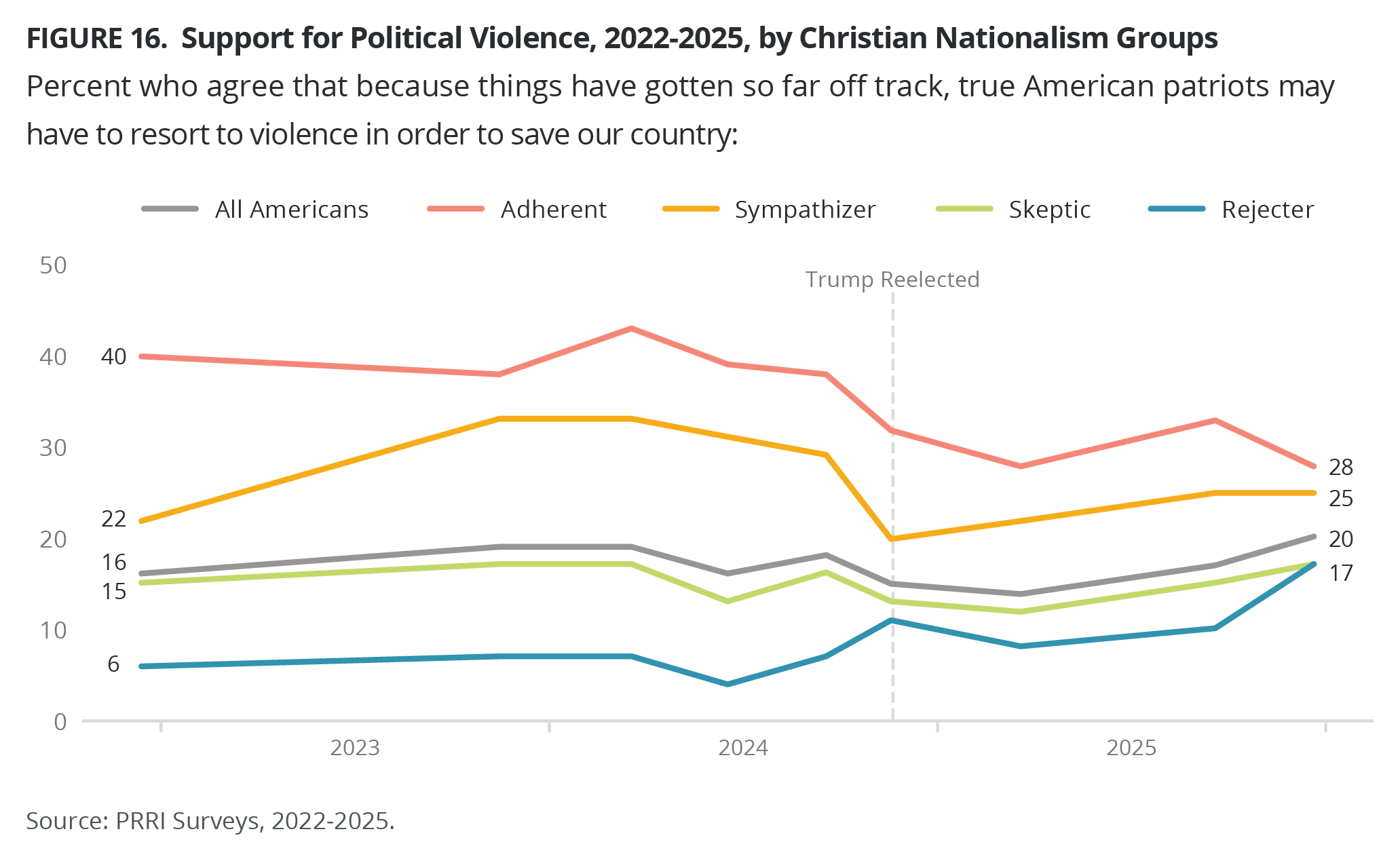
Support for political violence among Christian nationalism Adherents was notably higher during President Joe Biden’s administration, fluctuating between 43% and 38%, before dropping to 32% after Trump was reelected. Among Sympathizers and Skeptics, support for resorting to political violence has remained relatively stable, with somewhat higher support among Sympathizers during Biden’s administration. Rejecters, meanwhile, had consistently lower levels of support for political violence than Christian nationalists, though support has increased since Trump’s reelection.
Christian Nationalism and Right-Wing Authoritarianism
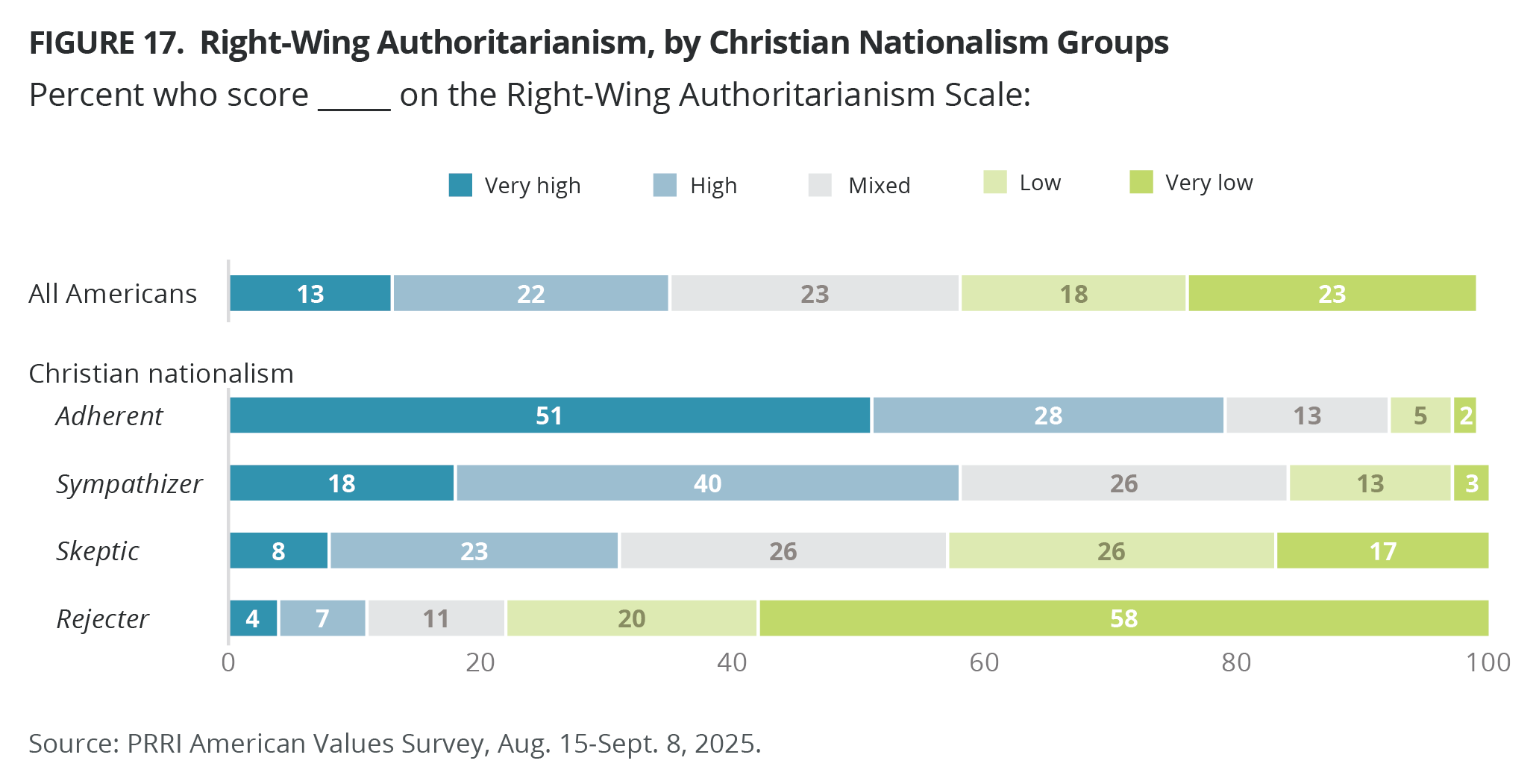
PRRI’s American Values Survey finds a positive correlation between holding Christian nationalist views and supporting authoritarianism. Nationally, 41% of Americans score low or very low on the RWAS, 23% fall in the mixed category, and 35% score high or very high. Christian nationalism Adherents stand out as the most authoritarian group: 79% score high or very high, while only 7% score low or very low. Sympathizers also lean heavily toward authoritarianism, with 58% scoring high and just 16% scoring low. By contrast, Skeptics are more evenly divided. Nearly half score low on the RWAS (43%), while 31% score high. Rejecters are the least authoritarian group overall: 78% score low on the RWAS, compared with just 11% who score high. [6]
Christian Nationalism and Trump as a Dictator
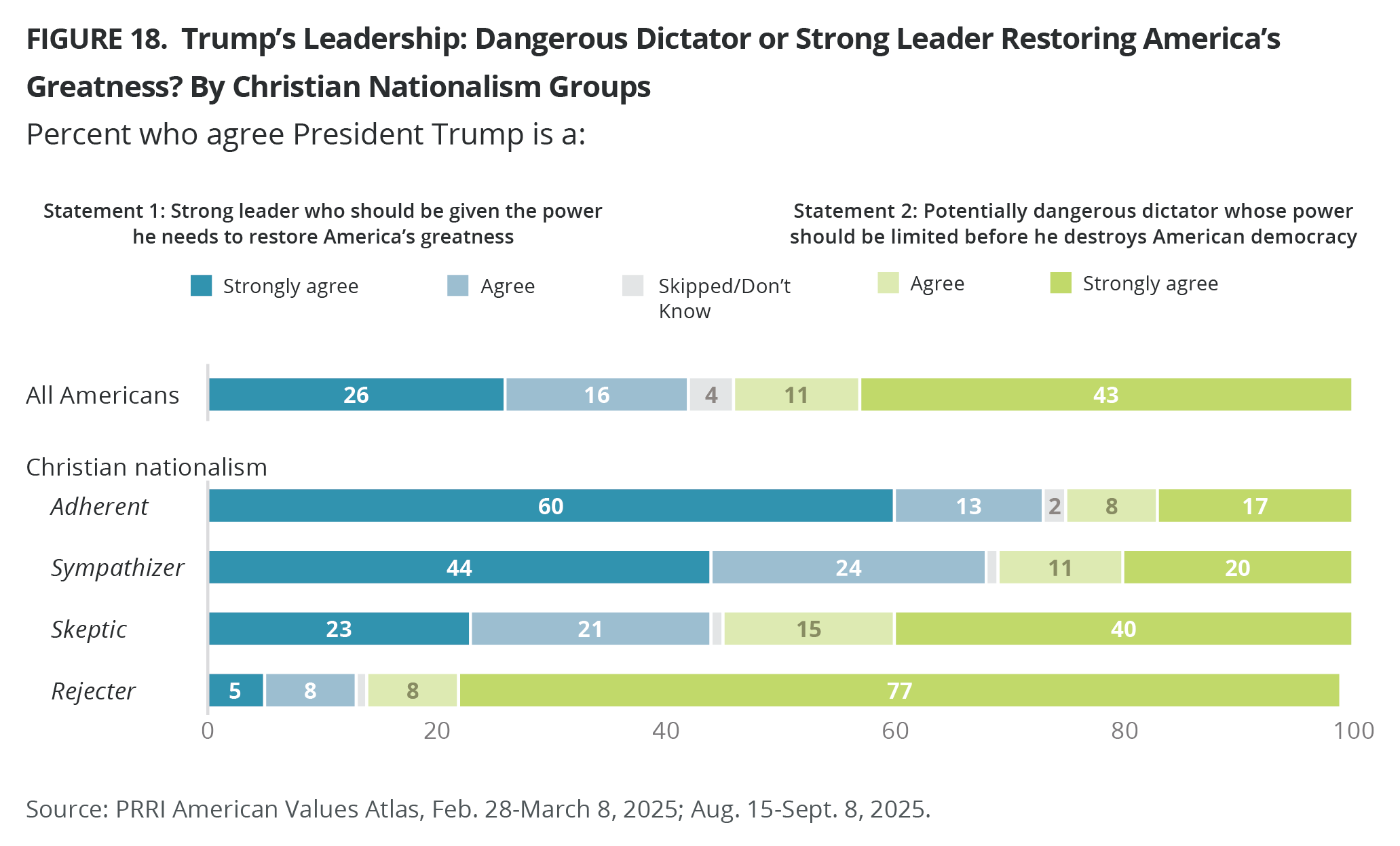
Americans were asked how much they agree with two statements: “President Trump is a strong leader who should be given the power he needs to restore America’s greatness,” and “President Trump is a dangerous dictator whose power should be limited before he destroys American democracy.” A majority of Americans agree that Trump is a dangerous dictator (54%), compared with 42% who say he is a strong leader.
Views differ sharply across Christian nationalism groups. Adherents overwhelmingly view Trump as a strong leader, with 73% agreeing — including 60% who strongly agree — and just 25% seeing him as a dangerous dictator. Two-thirds of Sympathizers also agree that he is a strong leader (68%), compared with 31% who say he is a dangerous dictator. By contrast, majorities of Skeptics (55%) and Rejecters (85%) view Trump as a dangerous dictator rather than a strong leader (44% and 13% respectively).
Christian Nationalism, Immigration, and Vaccinations
The Great Replacement Theory and Support for Deportations Without Due Process
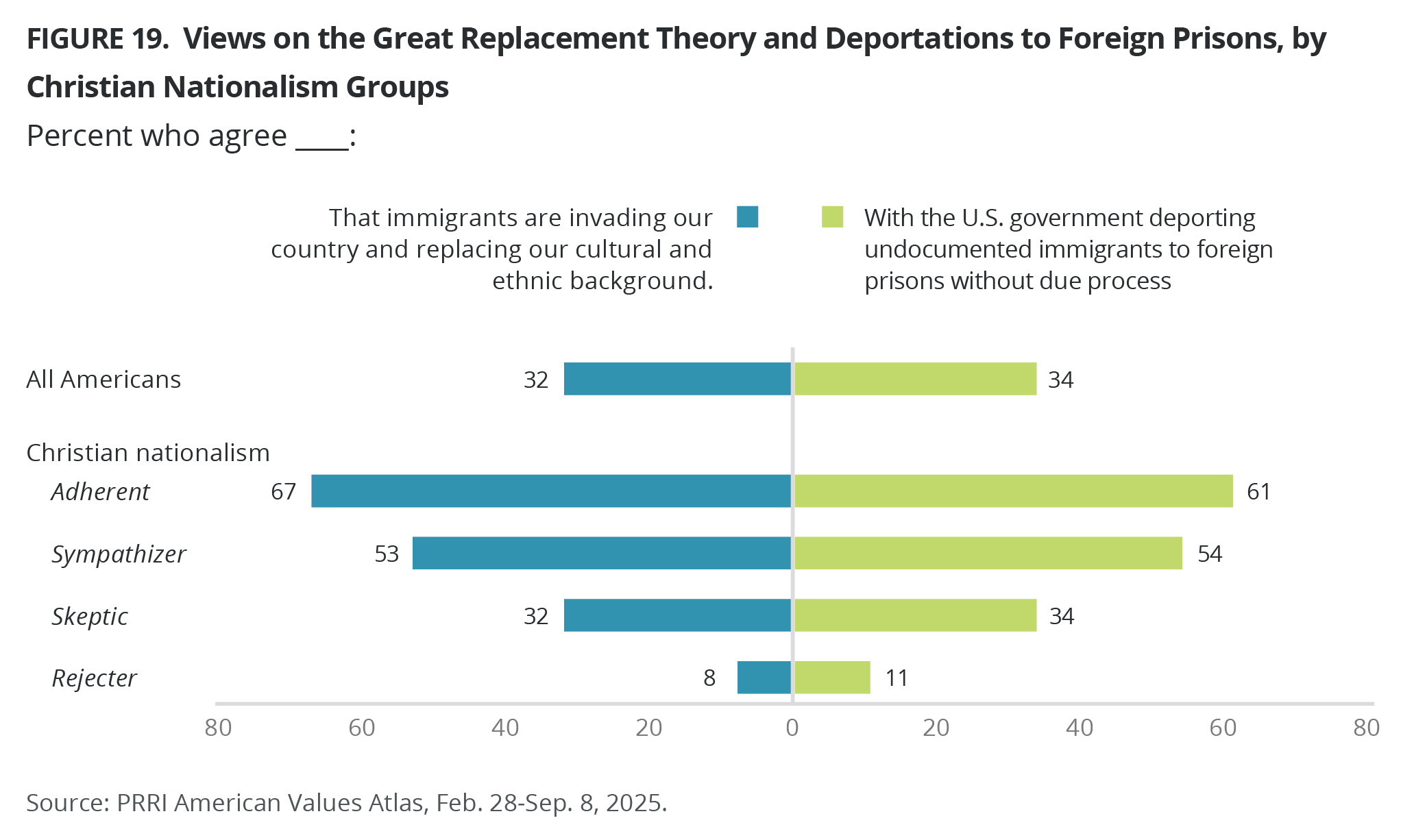
In 2025, just one in three Americans (32%) agreed with the Great Replacement Theory, the idea that “immigrants are invading our country and replacing our cultural and ethnic background.” However, support for that belief is much higher among Christian nationalism Adherents (67%) and Sympathizers (53%), compared with Skeptics (32%) and Rejecters (8%).
Similarly, only 34% of Americans agree with “the U.S. government deporting undocumented immigrants to foreign prisons in El Salvador, Rwanda, or Libya, without allowing them to challenge their deportation in court.” Christian nationalism Adherents (61%) and Sympathizers (54%) are more likely to hold this view than Skeptics (34%) and Rejecters (11%).
Birthright Citizenship
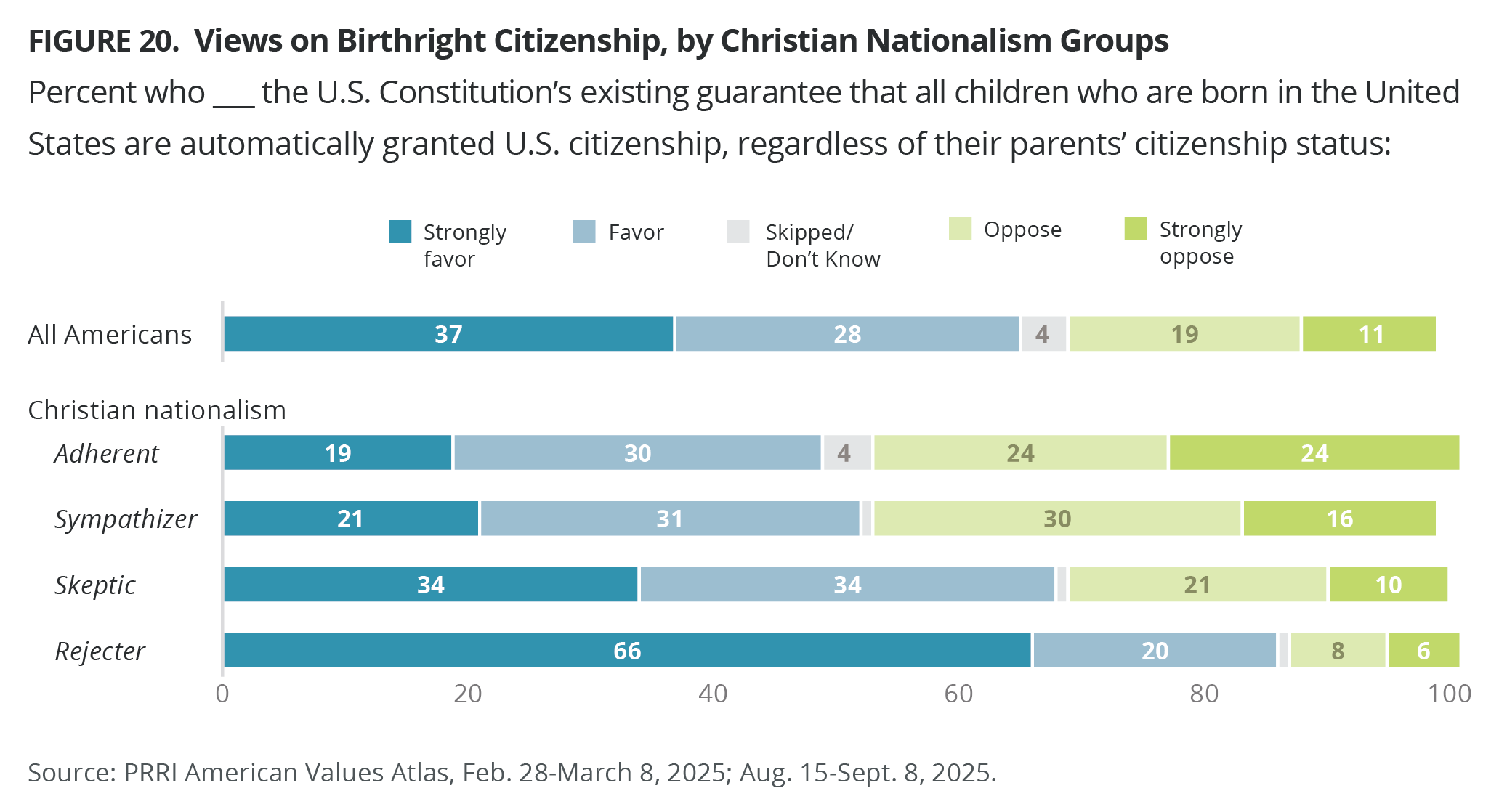
Two-thirds of Americans (65%) agree that “the U.S. Constitution’s existing guarantee that all children who are born in the United States are automatically granted U.S. citizenship, regardless of their parents’ citizenship status.” Only about half of Christian nationalism Adherents (49%) and Sympathizers (52%) agree, while support is higher among Skeptics (68%) and Rejecters (86%).
Stripping Citizenship and Deporting If Deemed a Threat to the Country
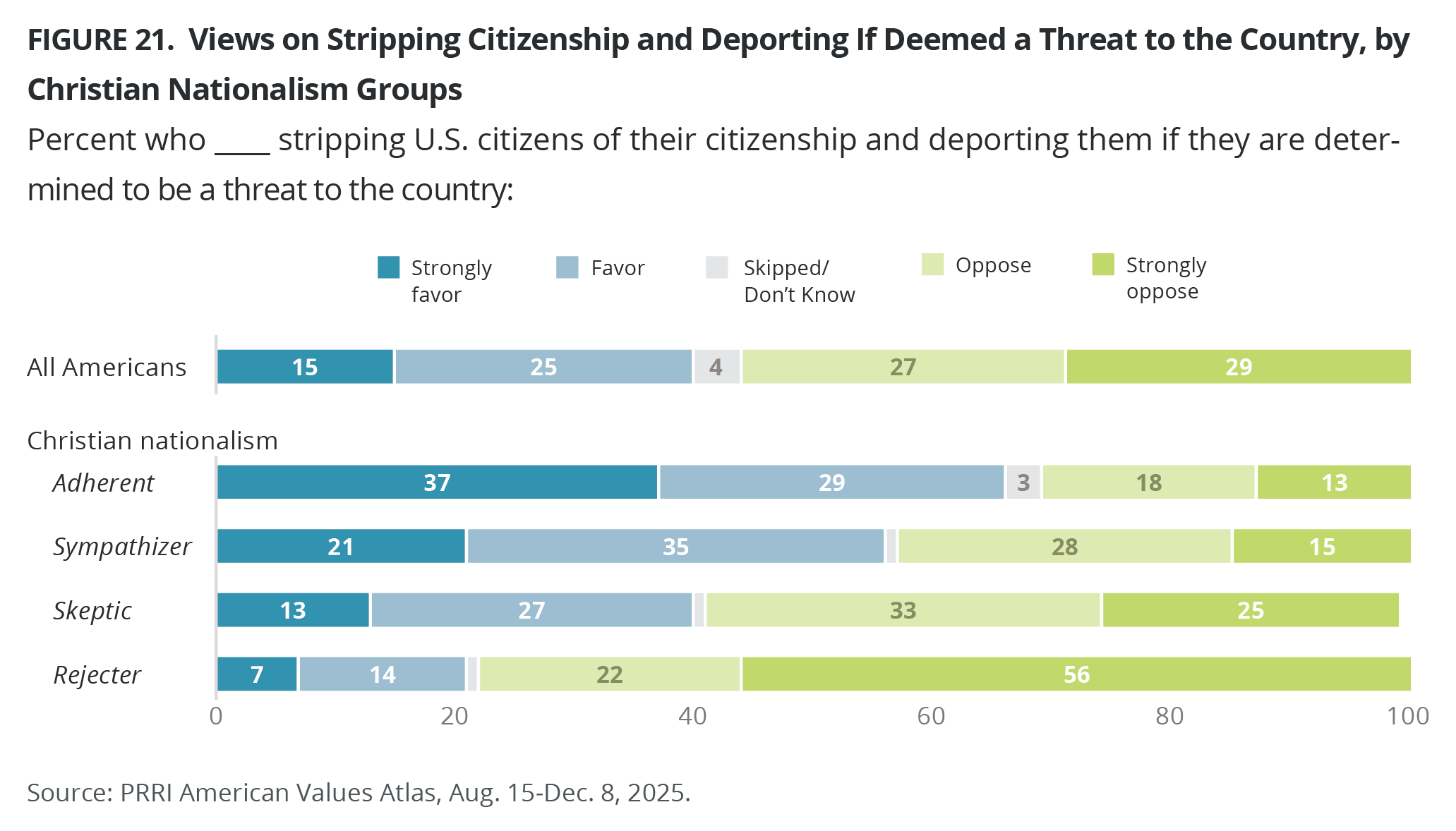
Only four in ten Americans favor “stripping U.S. citizens of their citizenship and deporting them if they are determined to be a threat to the country.” Majorities of Christian nationalism Adherents (66%) and Sympathizers (56%) support such a policy, compared to only four in ten Skeptics (40%) and two in ten Rejecters (21%).
Mandatory Vaccines for Children
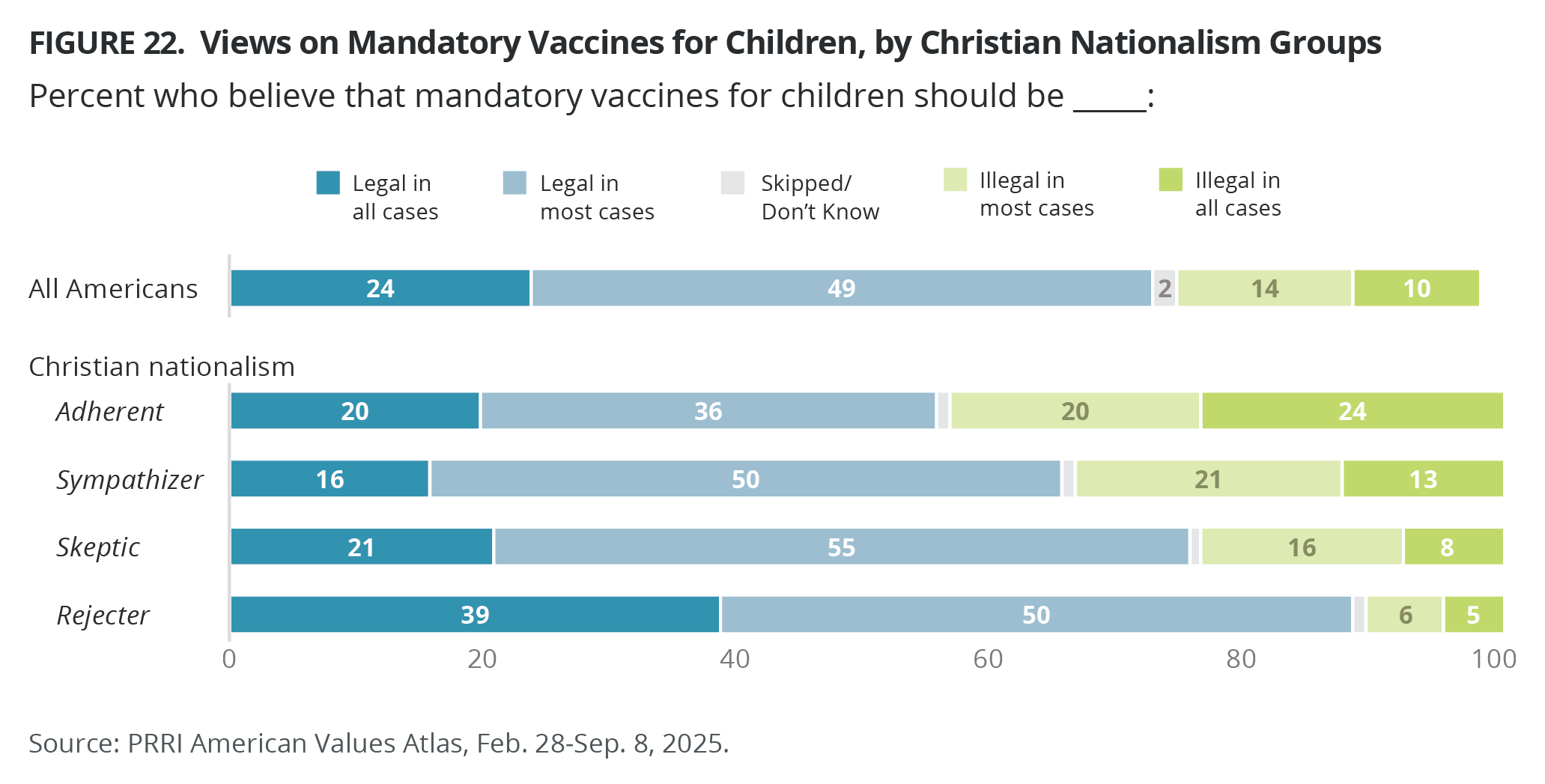
Most Americans (73%) agree that mandatory vaccines for children should be legal in all or most cases; only one in four disagree (24%). However, this view is less prevalent among both Christian nationalism Adherents (56%) and Sympathizers (66%) than Skeptics (76%) and especially Rejecters (89%). In fact, 44% of Christian nationalism Adherents and one-third of Sympathizers (34%) say that mandatory vaccines for children should be illegal in all or most cases, compared with one-quarter of Skeptics (25%) and one in ten Rejecters (11%).
APPENDIX A. Support for Christian Nationalism by State, Coded by Red, Blue, and Battleground States in the 2024 Election
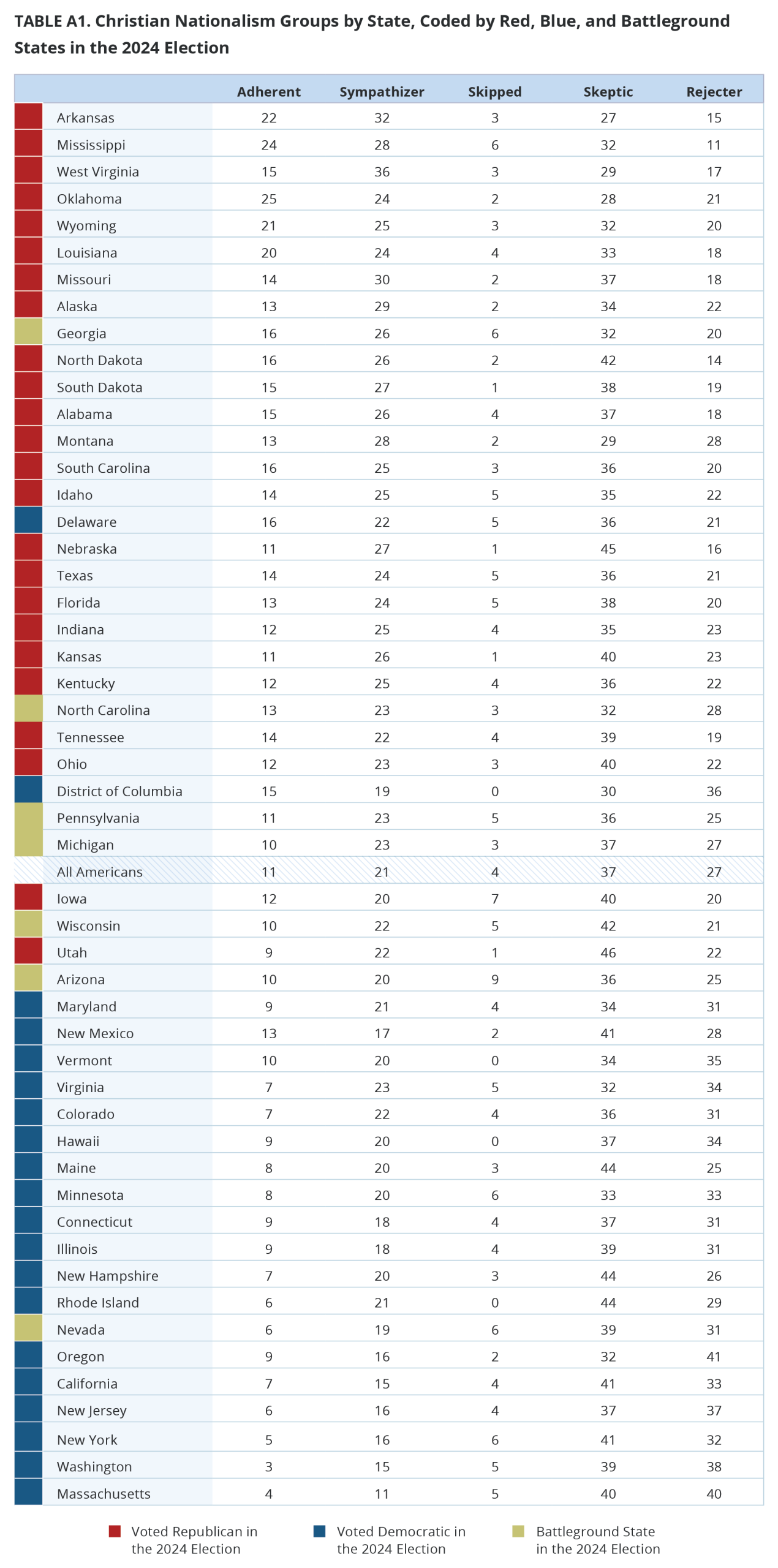
The following table is sorted in descending order by the proportion of residents in each state who identify as Christian nationalism Adherents or Sympathizers. Additionally, rows are coded red for Republican states, blue for Democratic states, and tan for battleground states. As the pattern demonstrates, the proportion of Christian nationalism Adherents and Sympathizers in each state is strongly correlated with the state’s partisan tilt.
APPENDIX B. Survey Methodology
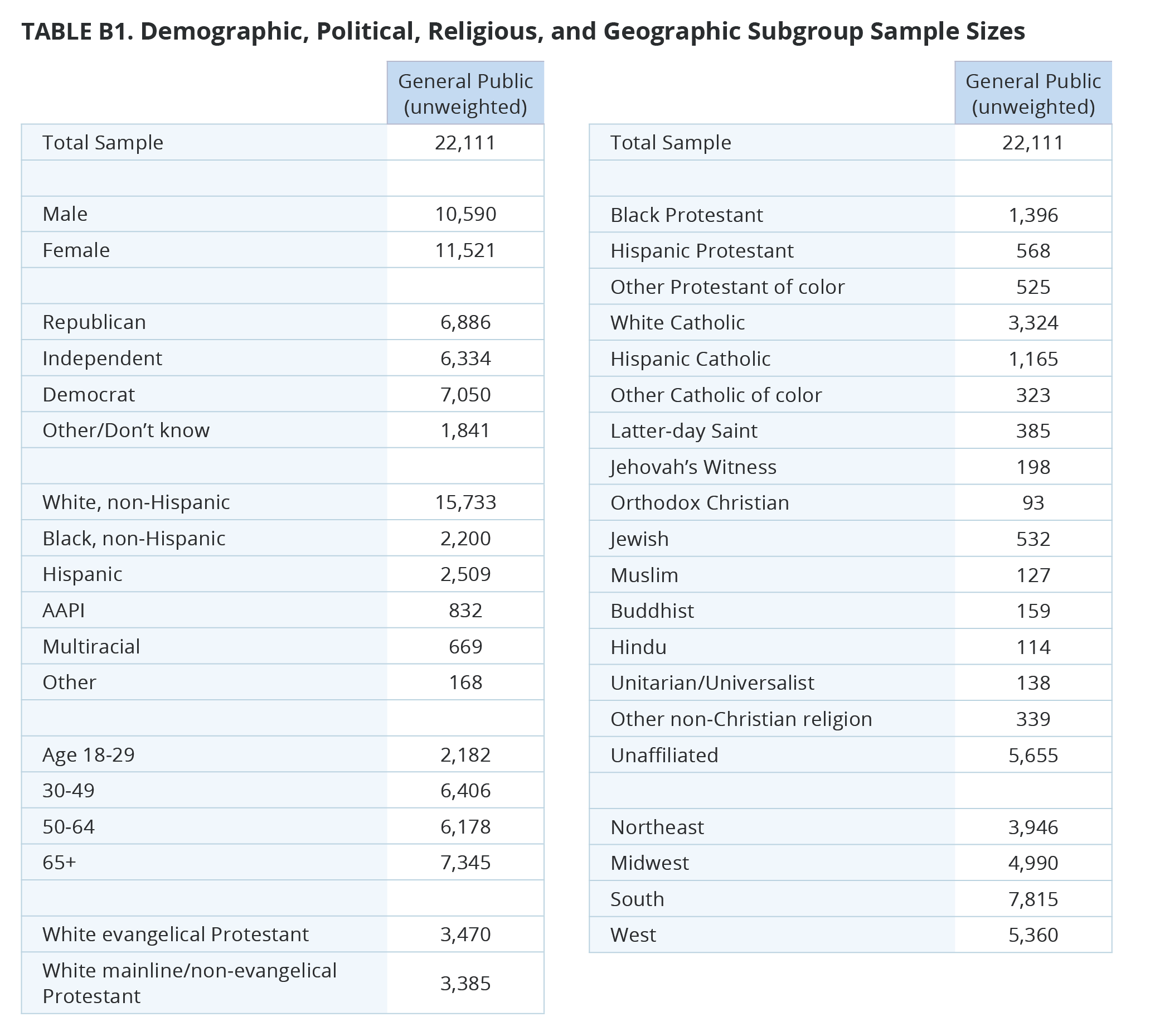
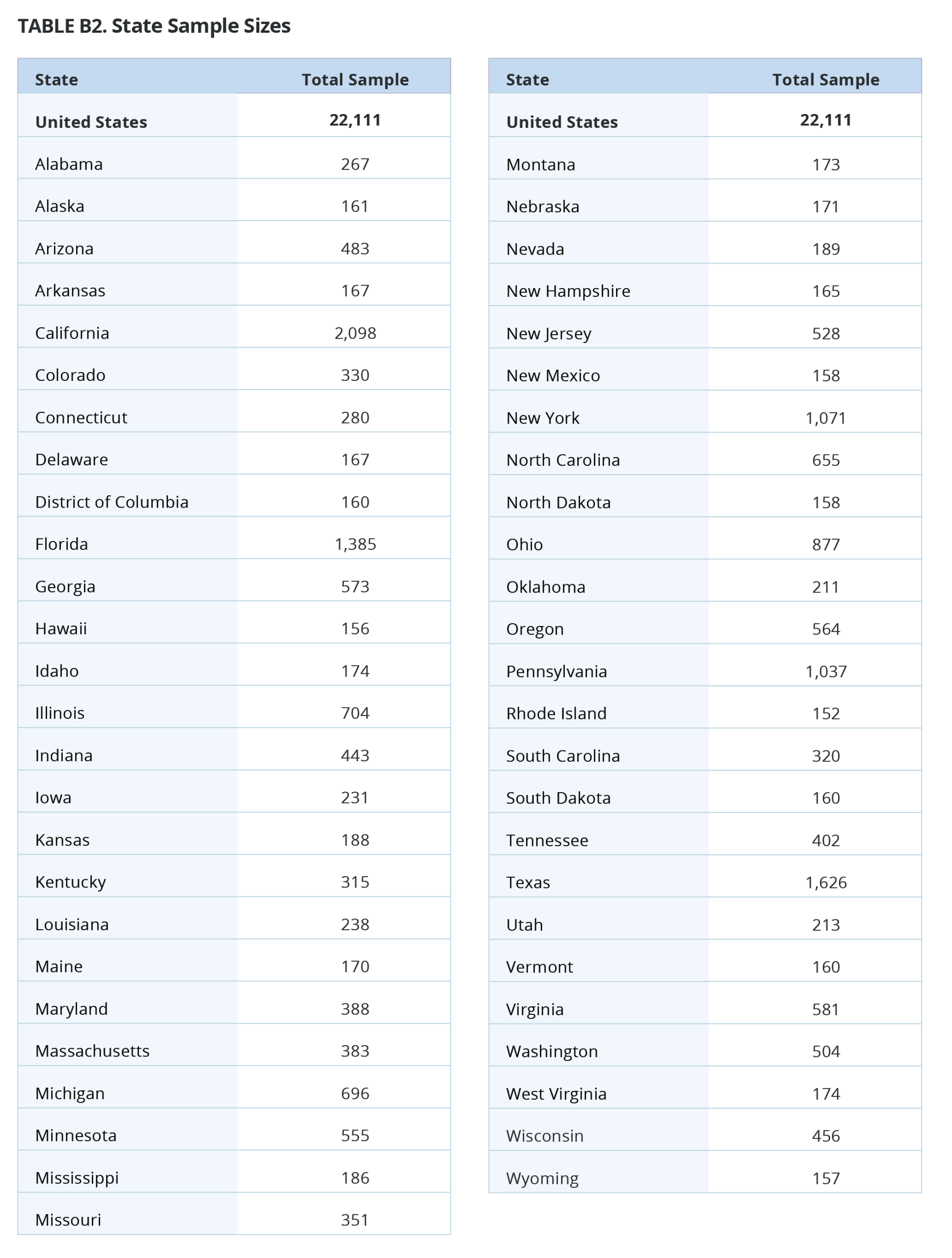
The survey was designed and conducted by PRRI. The survey was made possible through the generous support of the Wilbur & Hilda Glenn Family Foundation, the William and Flora Hewlett Foundation, and the Unitarian Universalist Veatch Program at Shelter Rock. The survey was carried out among a random representative sample of 22,111 adults (age 18 and up) living in all 50 states in the United States. Among those, 20,771 are part of Ipsos’s KnowledgePanel and an additional 1,340 were recruited by Ipsos using opt-in survey panels to increase the sample sizes to a minimum of n=150 in smaller states. Interviews were conducted online between February 28 and December 8, 2025.
Respondents are recruited to the KnowledgePanel using an addressed-based sampling methodology from the Delivery Sequence File of the USPS – a database with full coverage of all delivery addresses in the U.S. As such, it covers all households regardless of their phone status, providing a representative online sample. Unlike opt-in panels, households are not permitted to “self-select” into the panel; and are generally limited to how many surveys they can take within a given time period.
The initial sample drawn from the KnowledgePanel was adjusted using pre-stratification weights so that it approximates the adult U.S. population defined by the 2024 March Supplement of the Current Population Survey (CPS), except language proficiency, which is not available from CPS, were obtained from the 2023 American Community Survey (ACS). Next, a probability proportional to size (PPS) sampling scheme was used to select a representative sample. Additionally, the 2024 vote choice benchmark was obtained from the Associated Press Tabulation of Certified Results and party affiliation benchmark was obtained from the 2025 Pew’s National Public Opinion Reference Survey (NPORS).
To reduce the effects of any non-response bias, a post-stratification adjustment was applied based on demographic distributions from the CPS, plus language proficiency from the ACS and party affiliation from Pew’s National Public Opinion Reference Survey (NPORS). The post-stratification weight rebalanced the sample based on the following benchmarks: gender, by age, by race/ethnicity, Census division, metro area by race/ethnicity, education by race/ethnicity, and income by race/ethnicity, language proficiency, party affiliation, and state population size. The sample weighting was accomplished using an iterative proportional fitting (IFP) process that simultaneously balances the distributions of all variables. Weights were trimmed to prevent individual interviews from having too much influence on the final results. In addition to an overall national weight, separate weights were computed for certain states (AZ, FL, GA, MI, MN, NC, NV, PA, TX, and WI) to ensure that the demographic characteristics of the sample closely approximate the demographic characteristics of the target populations.
These weights from the KnowledgePanel cases were then used as the benchmarks for the additional opt-in sample in a process called “calibration.” This calibration process is used to correct for inherent biases associated with nonprobability opt-in panels. The calibration methodology aims to realign respondents from nonprobability samples with respect to a multidimensional set of measures to improve their representation.
The margin of error for the national survey is +/- 0.87 percentage points at the 95% level of confidence, including the design effect for the survey of 1.7. In addition to sampling error, surveys may also be subject to error or bias due to question wording, context, and order effects. Additional details about the KnowledgePanel can be found on the Ipsos website: https://www.ipsos.com/en-us/solution/knowledgepanel
[1] Based on respondents’ answers to (1) The U.S. government should declare America a Christian nation, (2) U.S. laws should be based on Christian values, (3) If the U.S. moves away from our Christian foundations, we will not have a country anymore, (4) Being Christian is an important part of being truly American, and (5) God has called Christians to exercise dominion over all areas of American society, each respondent receives a composite score on the Christian nationalism scale (with a range of 0 to 1) and is then assigned to one of the four groups. For more information about how measures are constructed, please see our previous reports: “A Christian Nation? Understanding the Threat of Christian Nationalism to American Democracy and Culture,” “Support for Christian Nationalism in All 50 States: Findings from PRRI’s 2023 American Values Atlas,” and “Christian Nationalism Across All 50 States: Insights from PRRI’s 2024 American Values Atlas.”
[2] See PRRI’s report “Support for Christian Nationalism in All 50 States: Findings from PRRI’s 2023 American Values Atlas. Feb. 28, 2024. https://www.prri.org/research/support-for-christian-nationalism-in-all-50-states/.
[3] Red states are those whose residents voted for Donald Trump in the 2024 presidential election, blue states are those whose residents voted for Kamala Harris in the 2024 presidential election, and swing states are those defined by the Cook Political Report, which include Arizona, Georgia, Michigan, North Carolina, Nevada, Pennsylvania, and Wisconsin.
[4] PRRI finds a strong positive Pearson correlation (r=0.80) between Trump favorability and support for Christian nationalism.
[5] PRRI finds a strong positive Pearson correlation (r=0.75) between the proportion of Republicans in a state legislature and support for Christian nationalism.
[6] To measure right-wing authoritarianism among Americans, PRRI’s American Values survey included the following agree/disagree questions: (1) The only way our country can get through the crisis ahead is to get back to our traditional values, put some tough leaders in power, and silence the troublemakers spreading bad ideas. (2) Our country will be destroyed someday if we do not smash the perversions eating away at our moral fiber and traditional beliefs. (3) What our country really needs is a strong, determined leader who will crush evil, and take us back to our true path. (4) Our country will be great if we honor the ways of our forefathers, do what the authorities tell us to do, and get rid of the “rotten apples” who are ruining everything. For more information on our RWA measures, see our report: “One Leader Under God: The Connection Between Authoritarianism and Christian Nationalism in America” and Spotlight: “Inside the Authoritarian-Christian Nationalism Link: Exploring Key Drivers.”