

To view a replay of PRRI’s April 23, 2026, webinar on this topic or the slides presented during the webinar, please click here.
Executive Summary
Most Americans support abortion legality in all or most cases; partisans remain deeply divided.
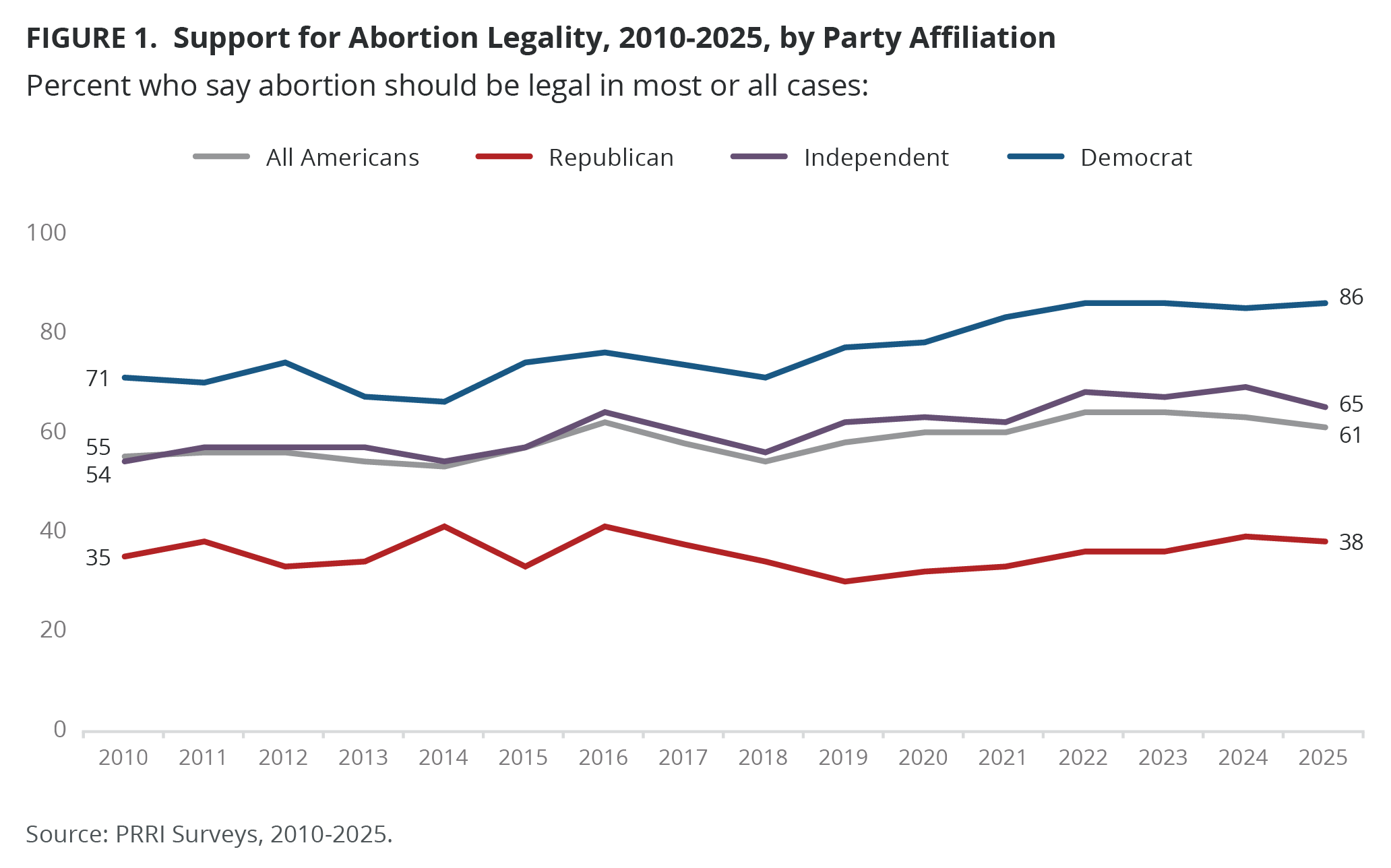
- Six in ten Americans (61%) say abortion should be legal in most or all cases; in contrast, 36% of Americans say abortion should be illegal in most or all cases. Just 8% of Americans say abortion should be illegal in all cases.
- Most Democrats have consistently favored abortion rights, but support has increased from 71% in 2010 to 86% in 2025. In contrast, 38% of Republicans support abortion legality, slightly higher than in 2010 (35%).
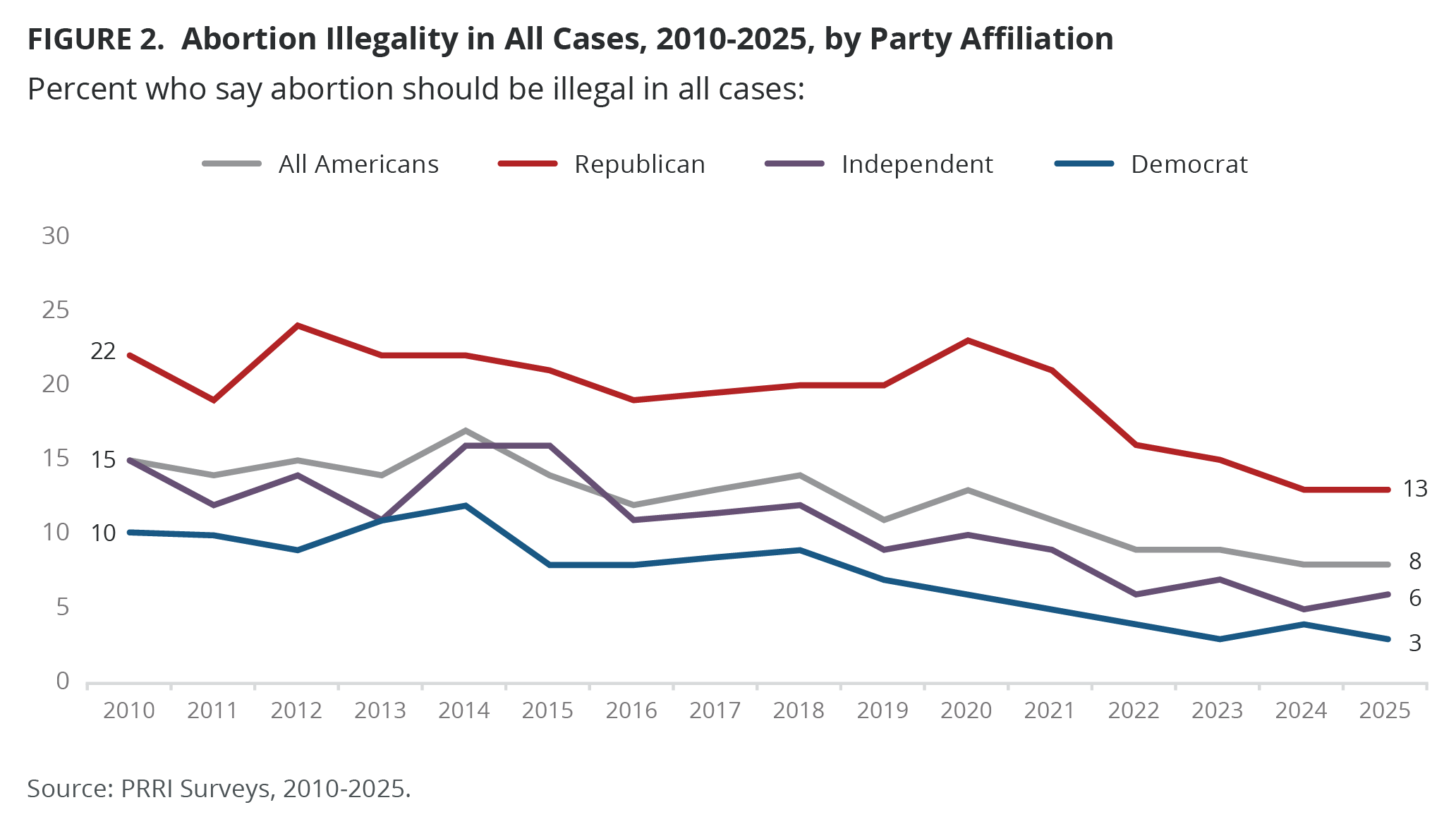
- The share of Americans who say abortion should be illegal in all cases has dropped, from 15% in 2010 to 8% in 2025. Among Democrats, just 3% hold this view, down from 10% in 2010. Among Republicans, 13% hold this view, down from 22% in 2010. Independents closely mirror all Americans, with only 6% saying abortion should be illegal in all cases.
Most religious Americans and Christian nationalism Rejecters and Skeptics support abortion legality. Support for abortion legality increased among those who seldom or never attend religious services.
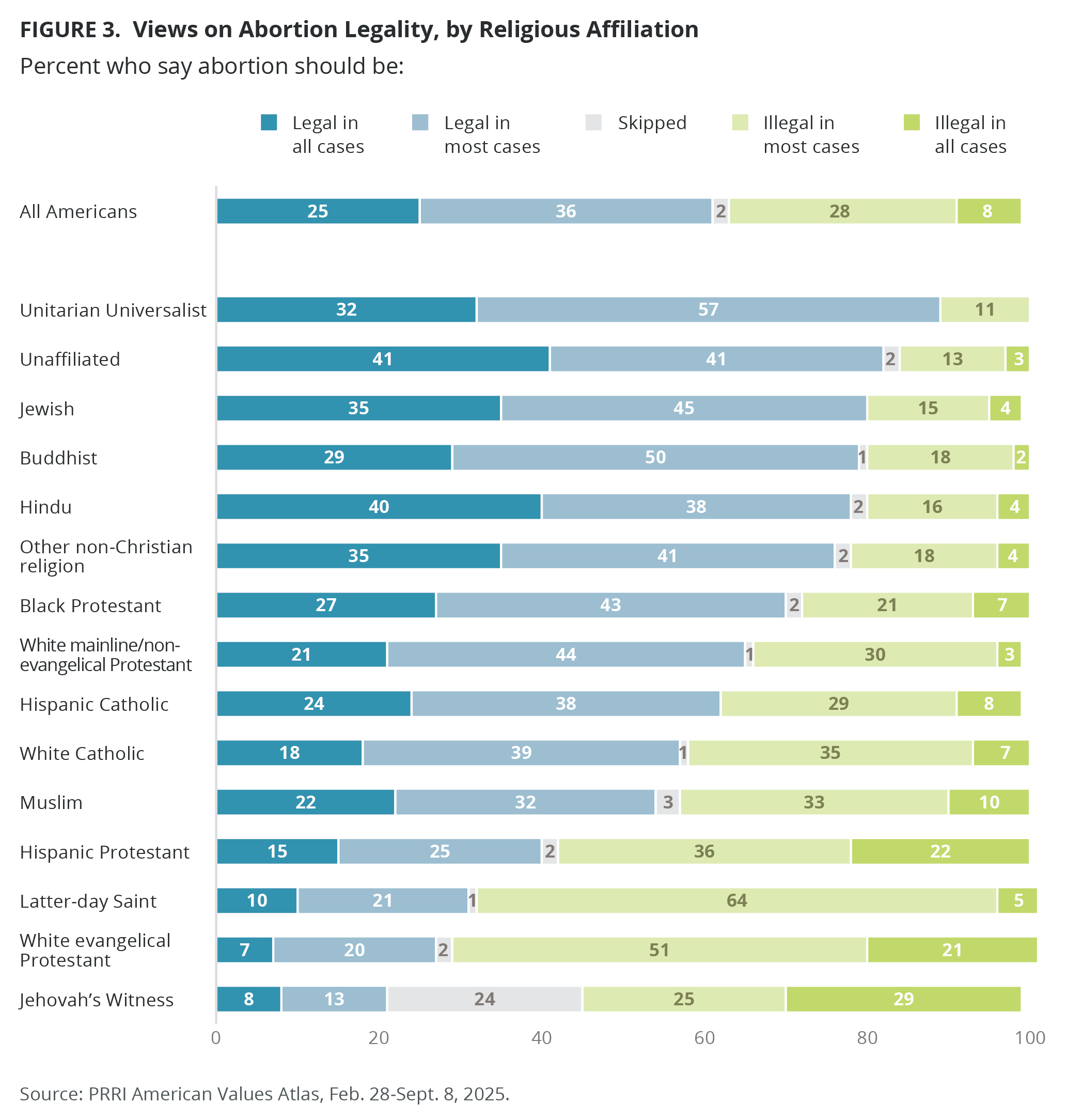
- Majorities across most religious traditions say that abortion should be legal in all or most cases.
- Only four major religious groups lack majority support for abortion legality in all or most cases, including Hispanic Protestants (40%), Latter-day Saints (31%), white evangelical Protestants (27%), and Jehovah’s Witnesses (21%).
- Americans who seldom or never attend religious services (76%) are more likely than those who attend services monthly or a few times a year (61%) and those who attend services weekly or more (32%) to support abortion legality.
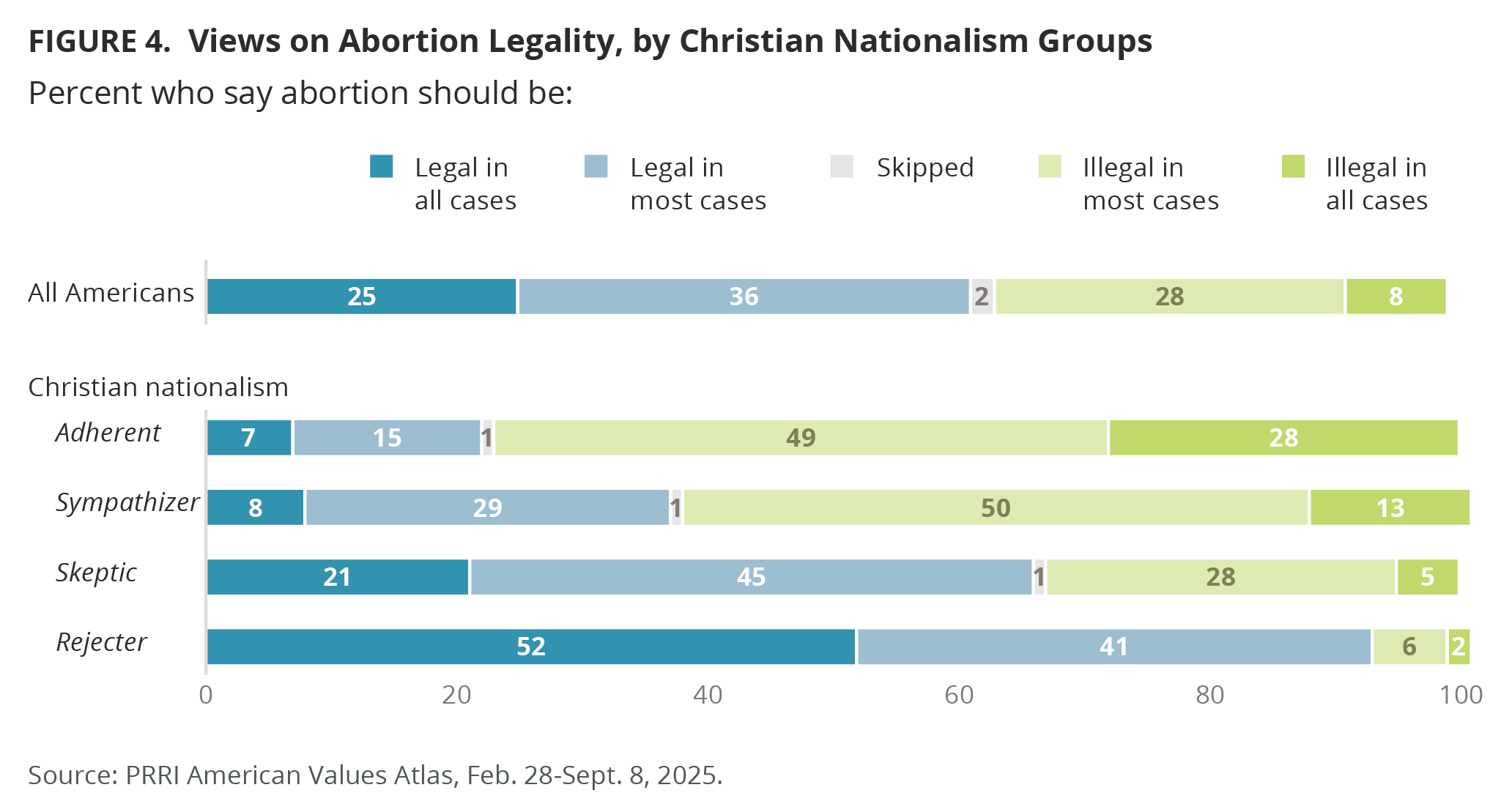
- Americans who qualify as Christian nationalism Rejecters (93%) are more likely than Skeptics (66%), Sympathizers (37%), and Adherents (22%) to support the legality of abortion.
There is a slight gender gap in support for abortion legality, and older Americans have become increasingly supportive.
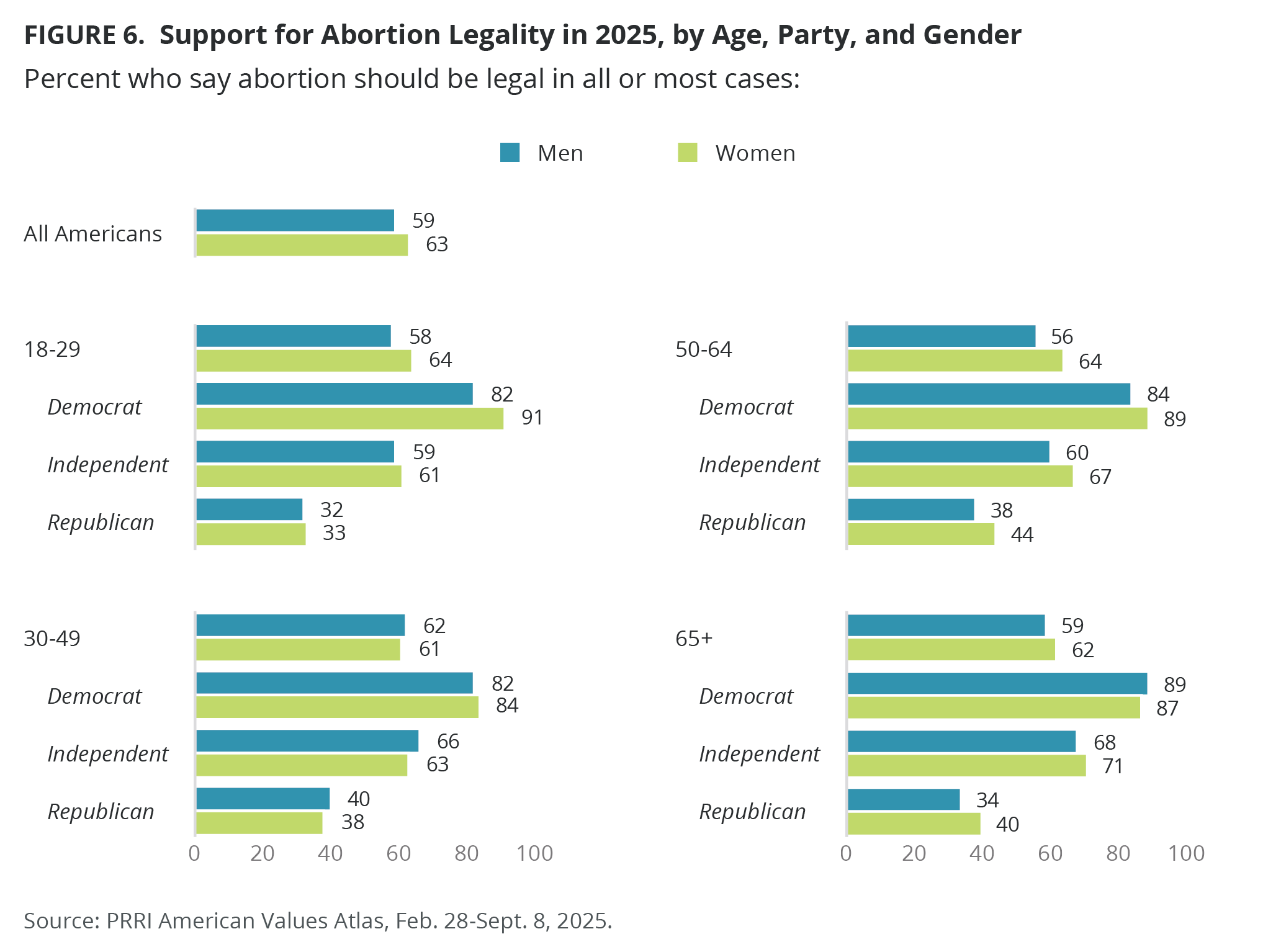
- Women (63%) are more likely than men (59%) to say abortion should be legal in all or most cases.
- There is a slight gender gap between Democratic women (87%) and Democratic men (84%) and between Republican women (40%) and Republican men (37%).
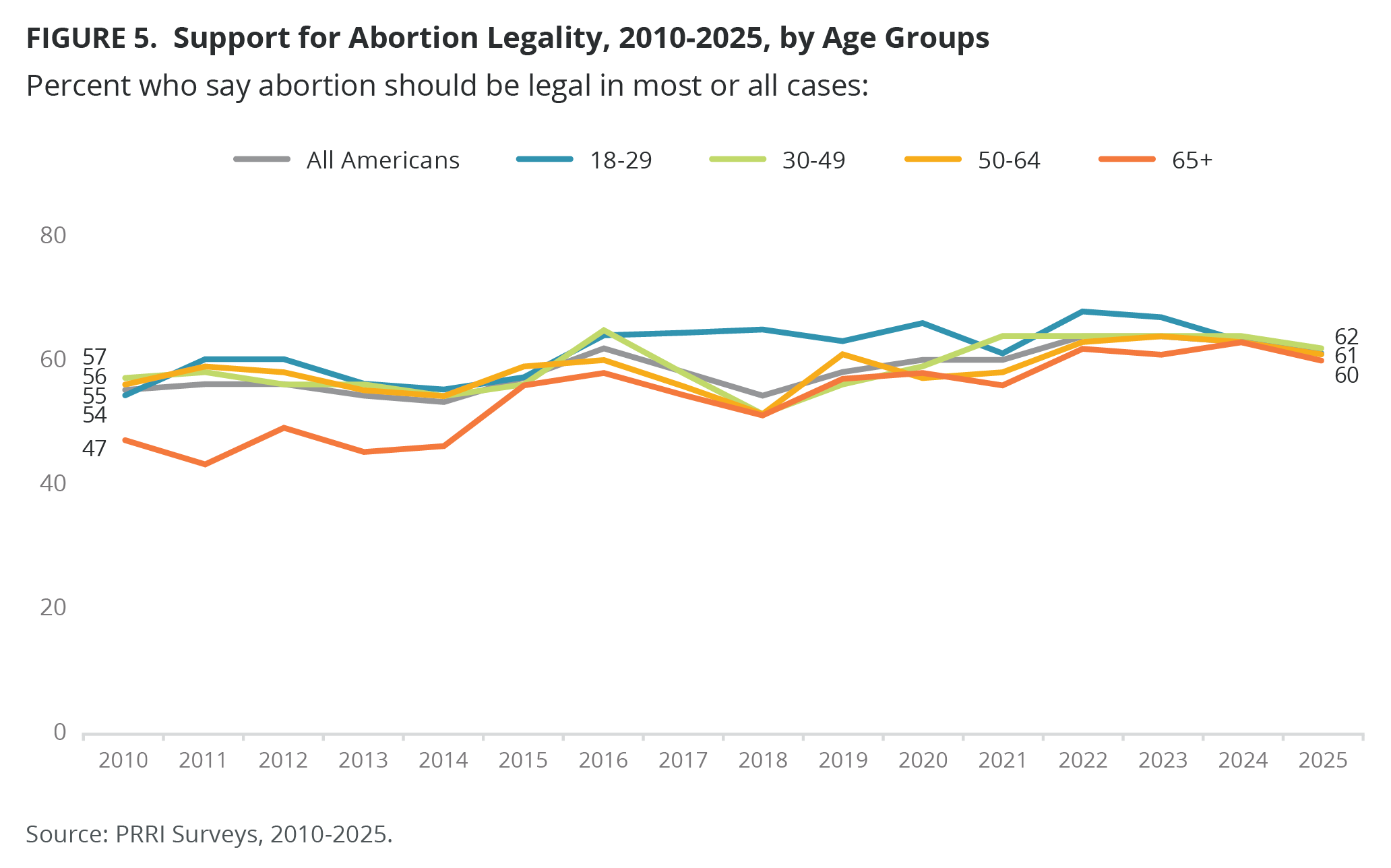
- While most Americans under age 65 have consistently supported abortion rights, Americans ages 65 and older have gradually increased their support, from 47% in 2010 to 60% in 2025.
- Democratic young women (91%) are more likely than Democratic young men (82%) to say abortion should be legal in all or most cases, compared with similar shares of young Republican women (33%) and men (32%).
A majority of residents in most states say that abortion should be legal; few seek limits on abortion access in all or most cases.
- A majority of residents in most states and the District of Columbia say that abortion should be legal in all or most cases. Utah is the only state where a minority of residents support abortion legality (36%), while residents in 15 states are divided.
- Roughly one in ten residents in most states say abortion should be illegal in all cases. Arkansas has the highest percentage (21%).
Abortion legality supporters are more likely to be Democrats, to be women, and to have higher levels of education than abortion legality opponents but are less likely to identify with a religion or engage in weekly religious practices.
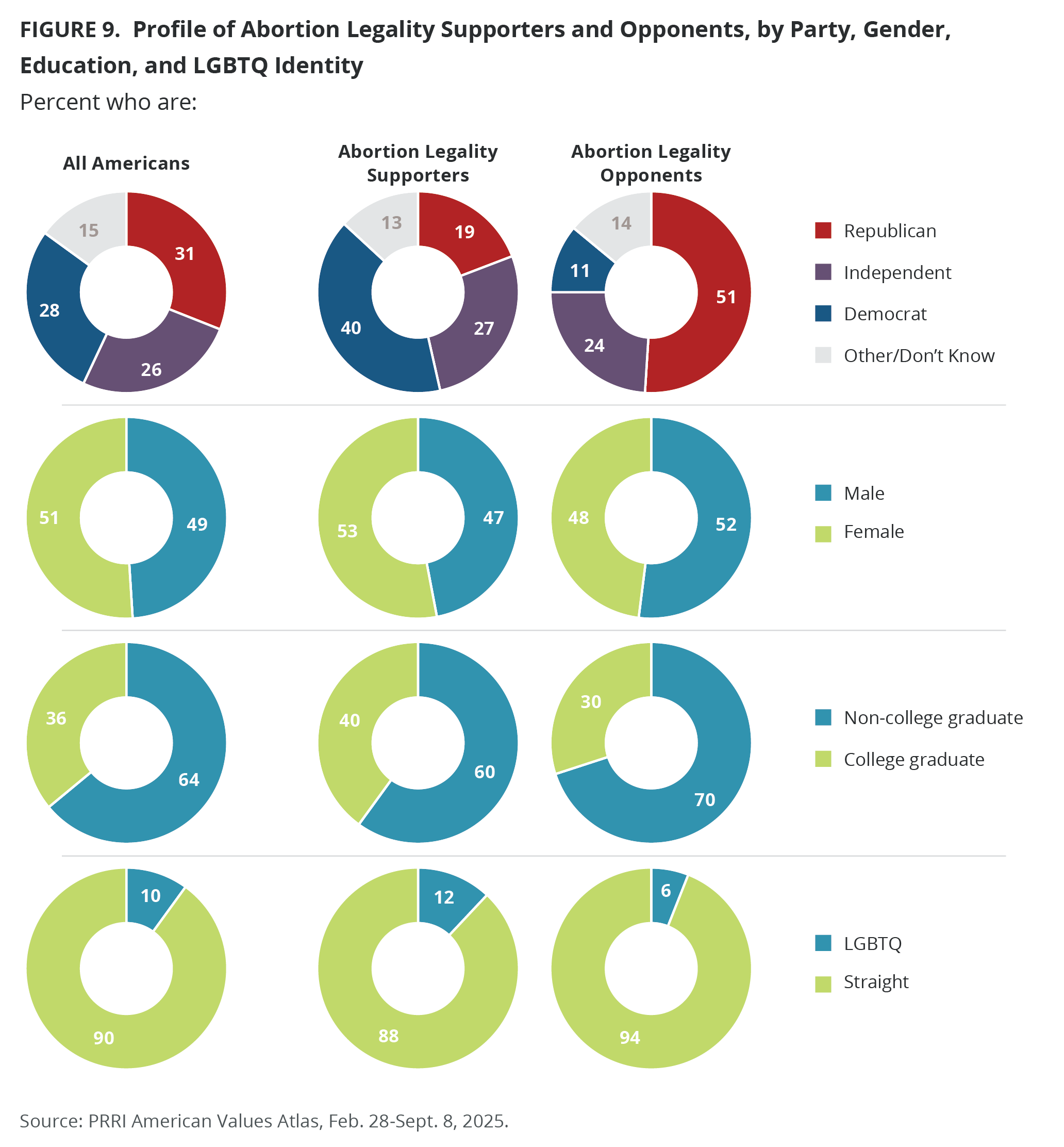
- Abortion legality supporters (40%) are four times as likely as opponents (11%) to identify as Democrats. In contrast, abortion legality opponents are more likely than supporters to identify as Republican (51% vs. 19%).
- Abortion legality supporters are more likely than opponents to be women (53% vs. 48%) and have at least a four-year college degree (40% vs. 30%).
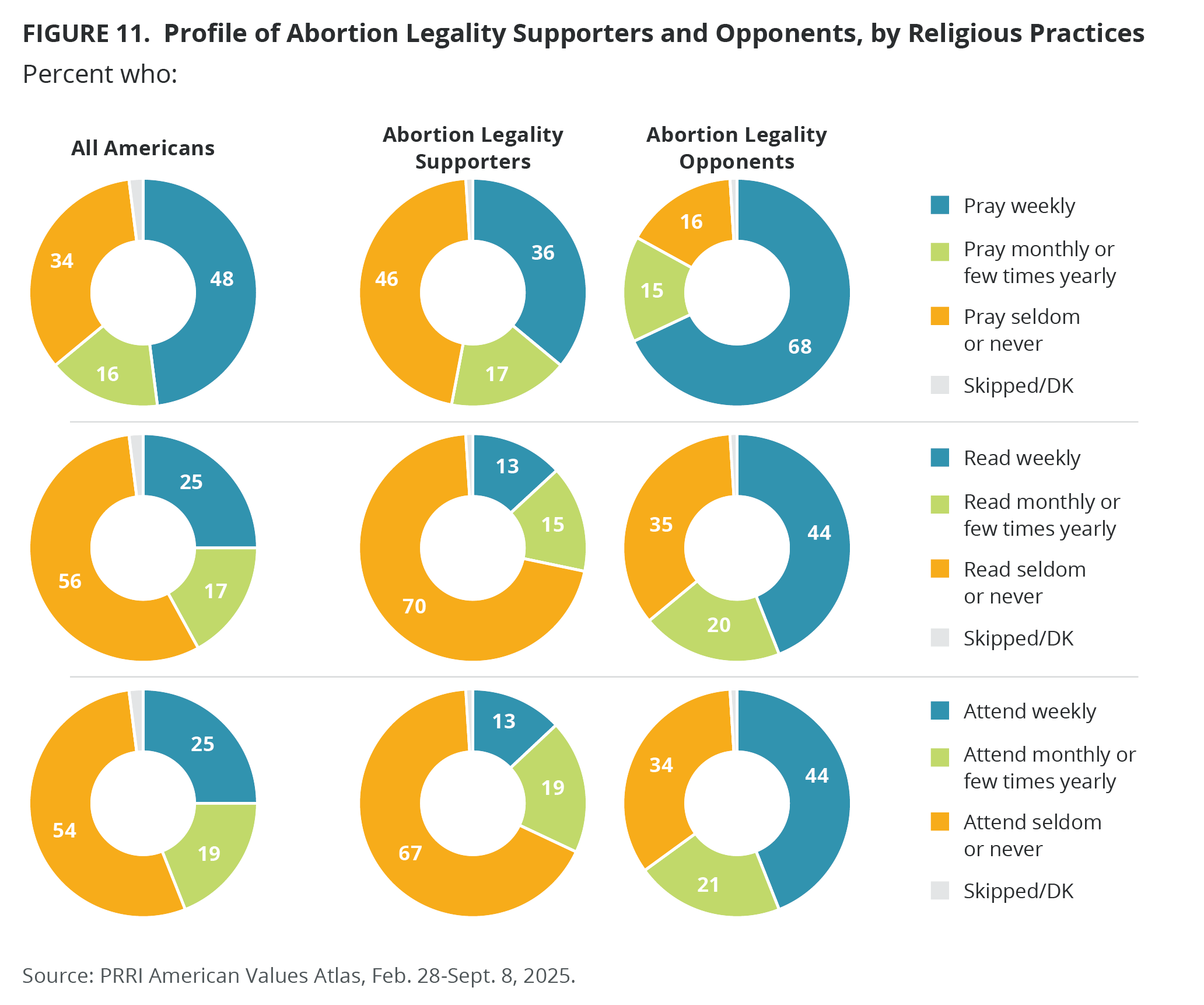
- Abortion legality supporters are more likely than opponents to identify as religiously unaffiliated (37% vs. 12%) and are less likely to exhibit religious behaviors, including praying (36% vs. 68%), reading religious texts (13% vs. 44%), and attending church (13% vs. 44%) weekly.
Abortion legality opponents are more likely than abortion legality supporters to hold pronatalist, patriarchal, and traditional gender views.
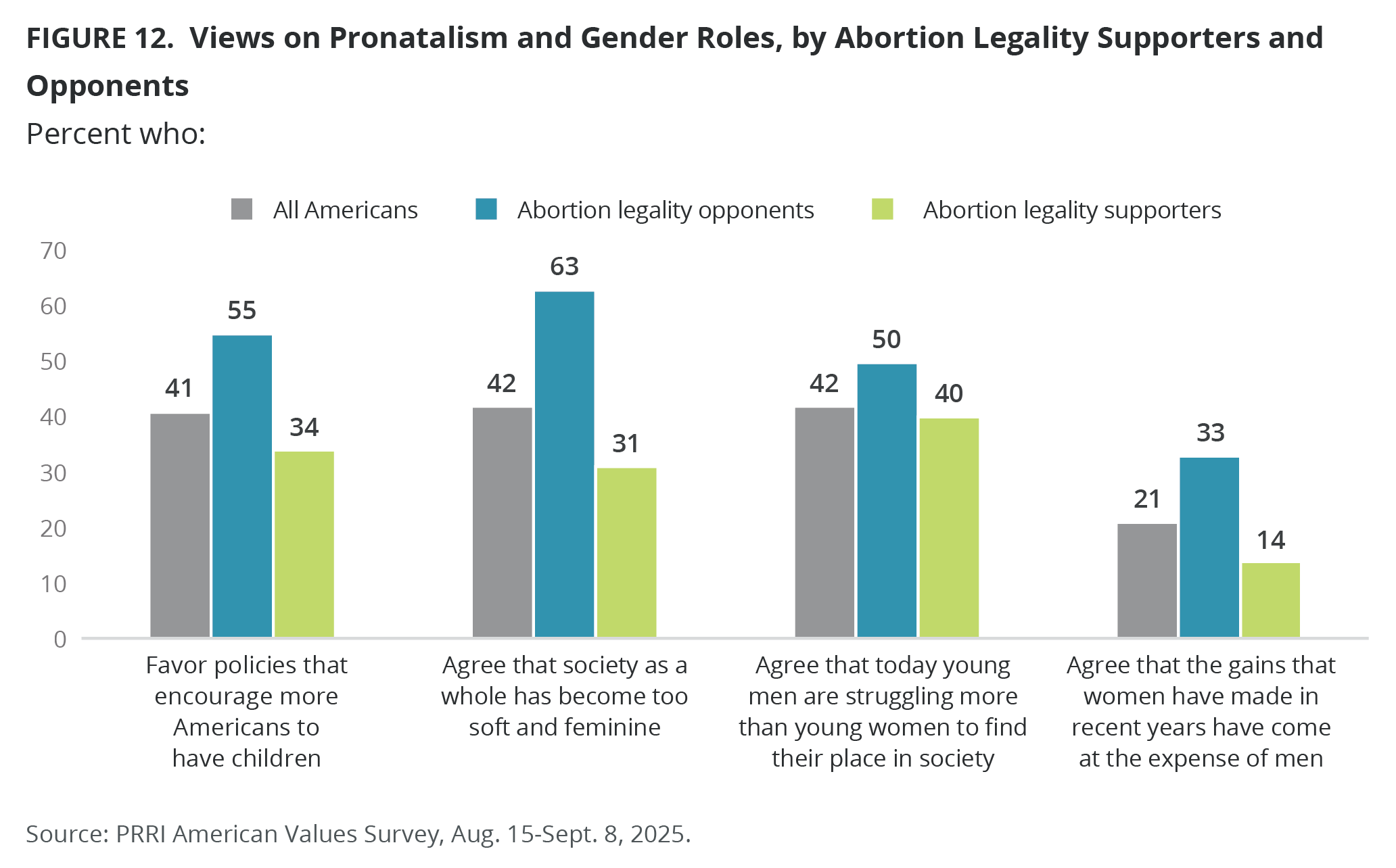
- Among abortion legality opponents, 55% favor policies that encourage Americans to have children, compared with one-third of abortion legality supporters (34%).
- Abortion legality opponents are twice as likely as abortion legality supporters to agree society as a whole has become too soft and feminine (63% v. 31%).
- Half of abortion legality opponents agree (50%) that young men are struggling more than young women to find their place in society, compared with 40% of abortion legality supporters.
- Abortion legality opponents are twice as likely as supporters to agree that the gains that women have made in recent years have come at the expense of men (33% vs. 14%).
Introduction
Throughout 2025, PRRI interviewed more than 22,000 adults as part of its American Values Atlas, providing an in-depth analysis of the demographic, religious, and political factors shaping Americans’ views on the legality of abortion, including the profiles of those who support and oppose abortion’s legality. It also maps support for and opposition to abortion in all 50 states. In addition, this report examines the intersection between religiosity and abortion legality, as well as support for Christian nationalism. It concludes with an analysis of how views on abortion relate to pronatalist views and views about gender.
Six in Ten Americans Support Abortion Legality
Six in ten Americans (61%) say abortion should be legal in most or all cases, continuing a six-year trend in which at least 60% of Americans favor abortion legality, compared with 55% in 2010 when PRRI started asking this question. In comparison, a little over one-third of Americans (36%) say abortion should be illegal in most or all cases, down from 42% in 2010. Today, only 8% of Americans say abortion should be illegal in all cases.
While Democrats and Independents Largely Support Abortion Legality, Republicans Do Not
Most Democrats have consistently favored abortion rights, but support has increased in recent years. In 2010, 71% of Democrats said that abortion should be legal in all or most cases, but after a decline to 66% in 2014, support has steadily risen to 86% in 2025. In contrast, only about four in ten Republicans (38%) say abortion should be legal in all or most cases, slightly higher than in 2010 (35%). Independents (65%) are more likely than all Americans (61%) to support the legality of abortion and have grown more likely to do so since 2010 (54%). Their support increased notably after 2022, when the U.S. Supreme Court’s landmark Dobbs v. Jackson Women’s Health Organization decision effectively eliminated the federal right to abortion, but has declined from 69% in 2024.
A little over one-third of Americans (36%) believe that abortion should be illegal in all or most cases. Republicans (61%) are nearly twice as likely as independents (33%) and more than four times as likely as Democrats (14%) to hold this view. The share of Americans who say abortion should be illegal in all cases has dropped, from 15% in 2010 to 8% in 2025. Just 3% of Democrats now hold this view, down from 10% in 2010, reflecting a steady decline over time. Republicans have also become less likely to say that abortion should be illegal in all cases, with 13% holding this view in 2025, compared with 22% in 2010. Independents closely mirror all Americans, with only 6% saying abortion should be illegal in all cases.
Views on Abortion Legality Differ by Religious Affiliation, Attendance, and Support for Christian Nationalism
Majorities across most religious traditions say that abortion should be legal in all or most cases. Support is highest among Unitarian Universalists (89%), religiously unaffiliated Americans (82%, up from 76% in 2010), Jewish Americans (80%), Buddhists (79%), Hindus (78%), and other non-Christians.[1] Smaller majorities of Black Protestants (70%, up from 56% in 2010), white mainline/non-evangelical Protestants (65%, down from 69% in 2024), Hispanic Catholics (62%), white Catholics (57%, down from 62% in 2024), and Muslims (54%) also say abortion should be legal in most or all cases. In contrast, Hispanic Protestants (40%), Latter-day Saints (31%), white evangelical Protestants (27%), and Jehovah’s Witnesses (21%) are the only religious groups in which a minority say abortion should be legal in all or in most cases. Instead, majorities of these groups say abortion should be illegal in all or in most cases. Notably, nearly three in ten Jehovah’s Witnesses (29%) say abortion should be illegal in all cases.
Americans who seldom or never attend religious services (76%) are more likely than Americans who attend services monthly or a few times a year (61%) and more than twice as likely as Americans who attend services weekly or more (32%) to say that abortion should be legal in most or all cases. Support for abortion legality has remained steady among church attenders, and increased from 72% in 2010 among those who seldom or never attend services.
Americans who qualify as Christian nationalism Rejecters (93%) are more likely than Skeptics (66%), Sympathizers (37%), and Adherents (22%) to support the legality of abortion, compared with most Adherents (77%) and Sympathizers (63%) who say abortion should be illegal in all or in most cases, with 28% of Adherents saying it should be illegal in all cases.
Majorities Across Gender, Age, Race, and Education Support Abortion Legality
Women (63%) are more likely than men (59%) to say abortion should be legal in all or most cases. Since 2010, men and women have largely supported abortion rights at similar rates, though women have grown slightly more supportive of abortion legality than men in recent years. Democratic women (87%) and men (84%) are significantly more likely than their independent (65% and 64%, respectively) and Republican counterparts (40% and 37%, respectively) to favor abortion legality.
While the majority of Americans under age 65 have consistently supported abortion rights since 2010, Americans ages 65 and older have gradually increased in support since 2010, from 47% to 60% in 2025.
In 2025, 91% of Democratic young women and 82% of Democratic young men say abortion should be legal in all or most cases, compared with one-third of young Republican women (33%) and men (32%). Except for Americans ages 30-49 and senior Democrats, these divides between partisans by age and gender remain consistent across other age groups.
Approximately 73% of Asian American and Pacific Islanders (AAPI) and 66% of Black Americans believe abortion should be legal in most or all cases, as do 60% of multiracial, Hispanic, and white Americans. Support for abortion legality has grown significantly among Hispanic (55%), Black (59%), and white (54%) Americans since 2010. Additionally, though majorities of both college graduates and non-college graduates support abortion legality, college graduates (68%) are more likely than non-college graduates (57%) to do so.
Most States Support or Are Split on Abortion Legality; Utah Is the Only Exception
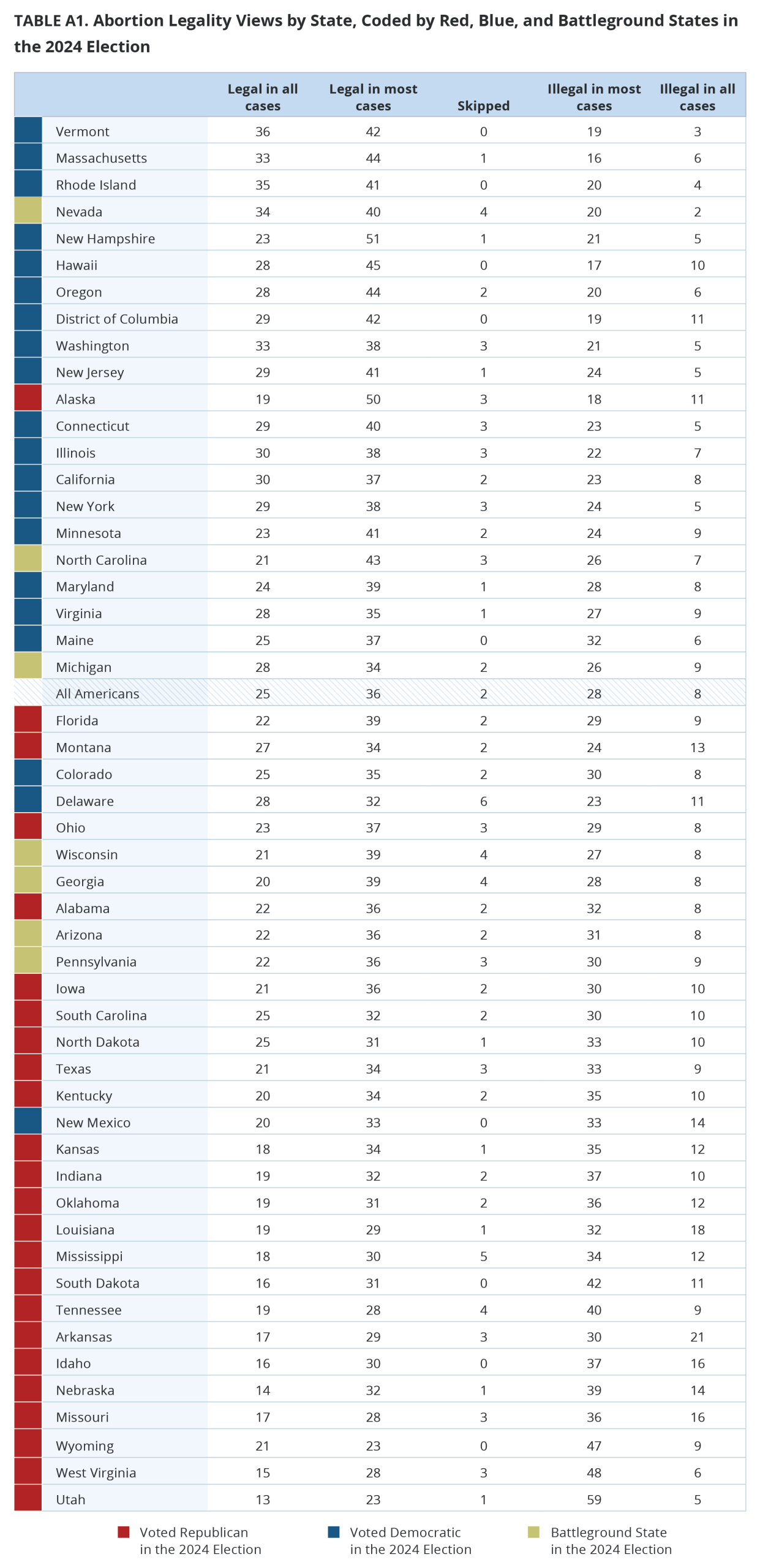
A majority of residents in most states and the District of Columbia say that abortion should be legal in all or most cases. Vermont (78%), Massachusetts (77%), Rhode Island (76%), Nevada (74%), and New Hampshire (74%) are the states with the highest support — all well above the national average of 61%. By contrast, 15 states are divided. Utah stands out as the only state where a minority of residents say abortion should be legal in all or in most cases (36%). Instead, most Utah residents say abortion should be illegal in all or most cases (64%).[2]
In Every State, No More Than Two in Ten Say Abortion Should Be Illegal in All Cases
Arkansas and Louisiana hold the highest shares of residents who say abortion should be illegal in all cases (21% and 18%, respectively), well above the national average of 8%.
Utah (64%), Wyoming (56%), and West Virginia (54%) show the highest shares of residents who say abortion should be illegal in all or most cases. By contrast, Vermont (22%), Massachusetts (22%), and Nevada (22%) have the lowest shares saying abortion should be illegal in most or in all cases.
Profile of Abortion Legality Supporters vs. Opponents
Supporters of Abortion Legality Are More Likely to Be Democrats, Women, and More Highly Educated
Americans who say abortion should be legal in most or in all cases (40%) –– those we call “abortion legality supporters” –– are four times as likely to identify as Democrats as those who say abortion should be illegal in most or in all cases (11%). We refer to this latter group as “abortion legality opponents.” Conversely, the share of Americans who identify as Republican is much higher among abortion legality opponents (51%) than supporters (19%). Independents are similarly represented among abortion legality supporters (27%) and opponents (24%).
Additionally, abortion legality supporters are more likely to be women (53%) than men (47%). Among abortion legality opponents, 52% are men and 48% are women.
While the age distribution of abortion legality opponents and supporters closely mirrors national averages, abortion legality supporters (40%) are more likely than opponents (30%) to have at least a four-year college degree.
Supporters of abortion legality are twice as likely to identify as LGBTQ than abortion legality opponents (12% vs. 6%, respectively).
Supporters of Abortion Legality Are More Likely to Be Christian Nationalism Rejecters and Skeptics, Religiously Unaffiliated, and Non-Christians
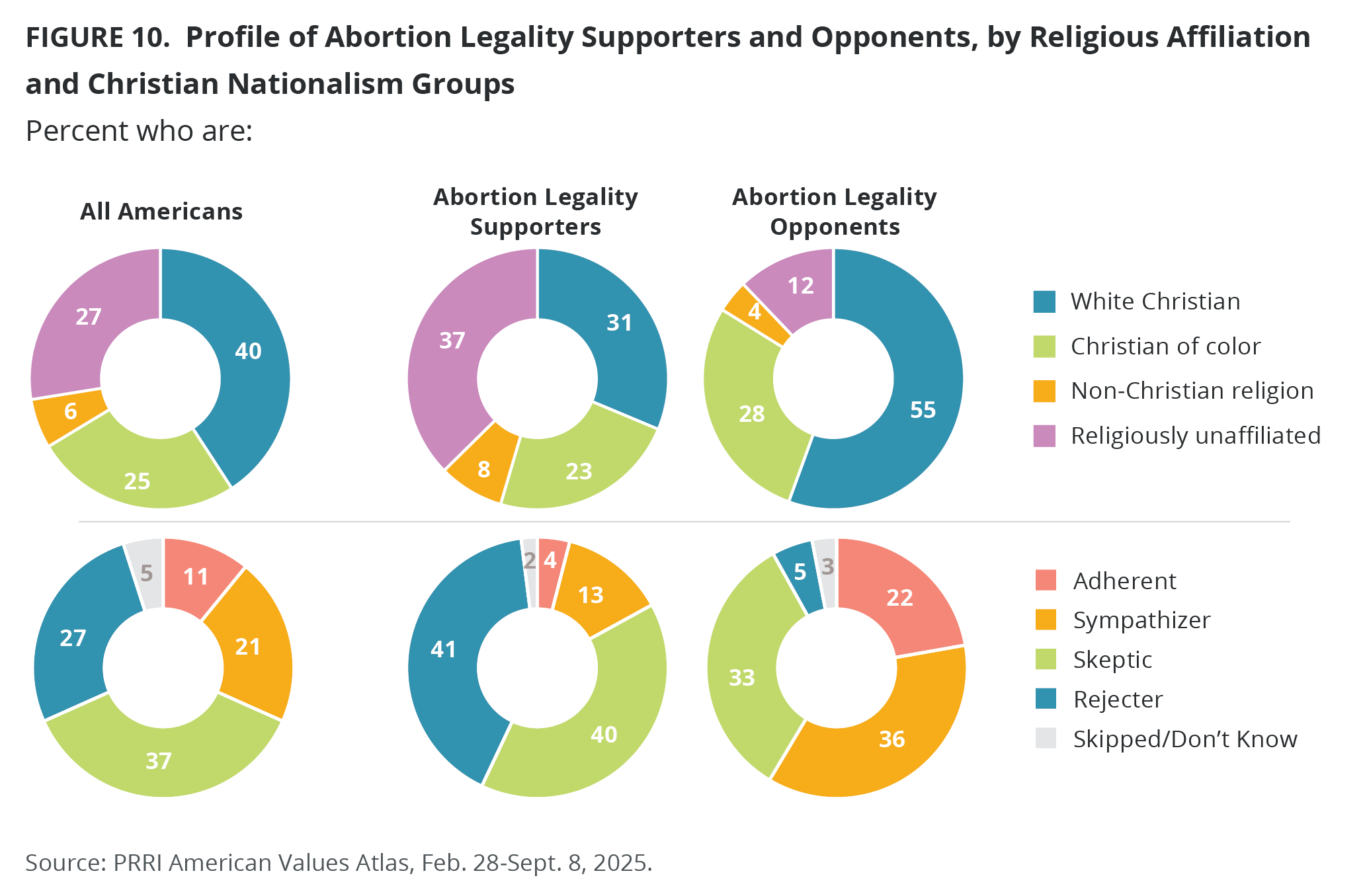
Americans who support abortion legality are about three times as likely as those who oppose it to identify as religiously unaffiliated (37% vs. 12%) and twice as likely to identify as members of a non-Christian religion (8% vs. 4%). Conversely, abortion legality opponents are more likely than supporters to identify as white Christian (55% vs. 31%). This difference is largely driven by white evangelical Protestants, who make up 27% of abortion legality opponents, compared with only 6% of supporters. Additionally, abortion legality opponents are more likely than supporters to identify as Christians of color (28% vs. 23%).
Supporters of abortion legality are also more likely than opponents to reject Christian nationalist ideology. Four in ten of those who support abortion legality qualify as Christian nationalism Rejecters (41%) and Skeptics (40%), whereas 13% identify as Sympathizers, and only 4% as Adherents. In comparison, among those who oppose abortion legality, just 5% qualify as Rejecters, compared with roughly one-third who qualify as Skeptics (33%) and Sympathizers (36%), and 22% as Adherents.
Supporters of Abortion Legality Are Less Likely to Engage in Religious Practices
Most supporters of abortion legality report seldom or never reading a religious text (70%) or attending religious services (67%). Nearly half (46%) say they seldom or never pray (46%). In contrast, most opponents of abortion legality say they pray at least once a week (68%), compared with 44% who say they read religious texts or attend religious services at least once a week.
Abortion Legality Supporters Are Less Likely to Hold Pronatalist, Patriarchal, and Conservative Gender Views
Pronatalism
Around four in ten Americans (41%) favor policies that encourage more Americans to have children, while the majority (54%) oppose such policies. More than half of Americans who say abortion should be illegal in all or most cases (55%) favor pronatalist policies, compared with around one-third who say abortion should be legal in all or most cases (34%).
Society Has Become Too Soft and Feminine
Over four in ten Americans (42%) agree with the statement “Society as a whole has become too soft and feminine,” while most (54%) disagree. However, Americans who oppose abortion legality are twice as likely as those who support it to agree that society as a whole has become too soft and feminine (63% vs. 31%).
Young Men Are Struggling More than Young Women to Find Their Place
About four in ten Americans agree that today, young men are struggling more than young women to find their place in society (42%), while 53% disagree. Half of those who oppose abortion legality agree with this statement (50%), compared with 40% of those who support abortion legality.
Women’s Gains Have Come at the Expense of Men
Only two in ten Americans (21%) agree that “the gains that women have made in recent years have come at the expense of men,” compared with most who disagree (75%). Americans who say that abortion should be illegal in all or in most cases are twice as likely as those who say abortion should be legal in all or in most cases to agree that women’s gains have come at the expense of men (33% vs. 14%).
APPENDIX A. Views on Abortion Legality by State, Coded by Red, Blue, and Battleground States in the 2024 Election
The following table is sorted in descending order by the proportion of residents in each state who say abortion should be legal in all or most cases. Additionally, rows are coded red for Republican states, blue for Democratic states, and tan for battleground states. As the pattern demonstrates, views on abortion legality at the state level are strongly correlated with the state’s partisan tilt.
APPENDIX B. Survey Methodology
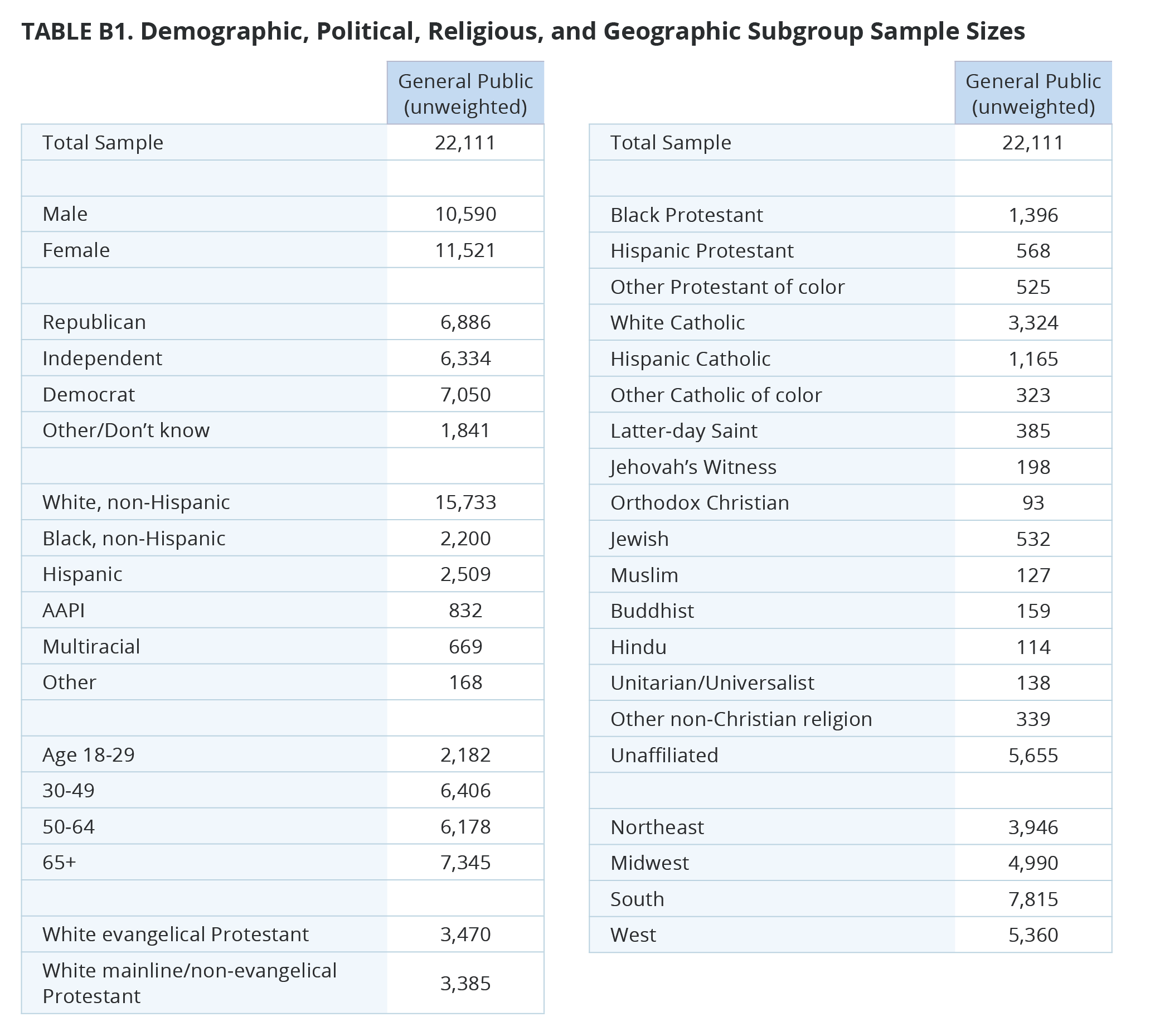
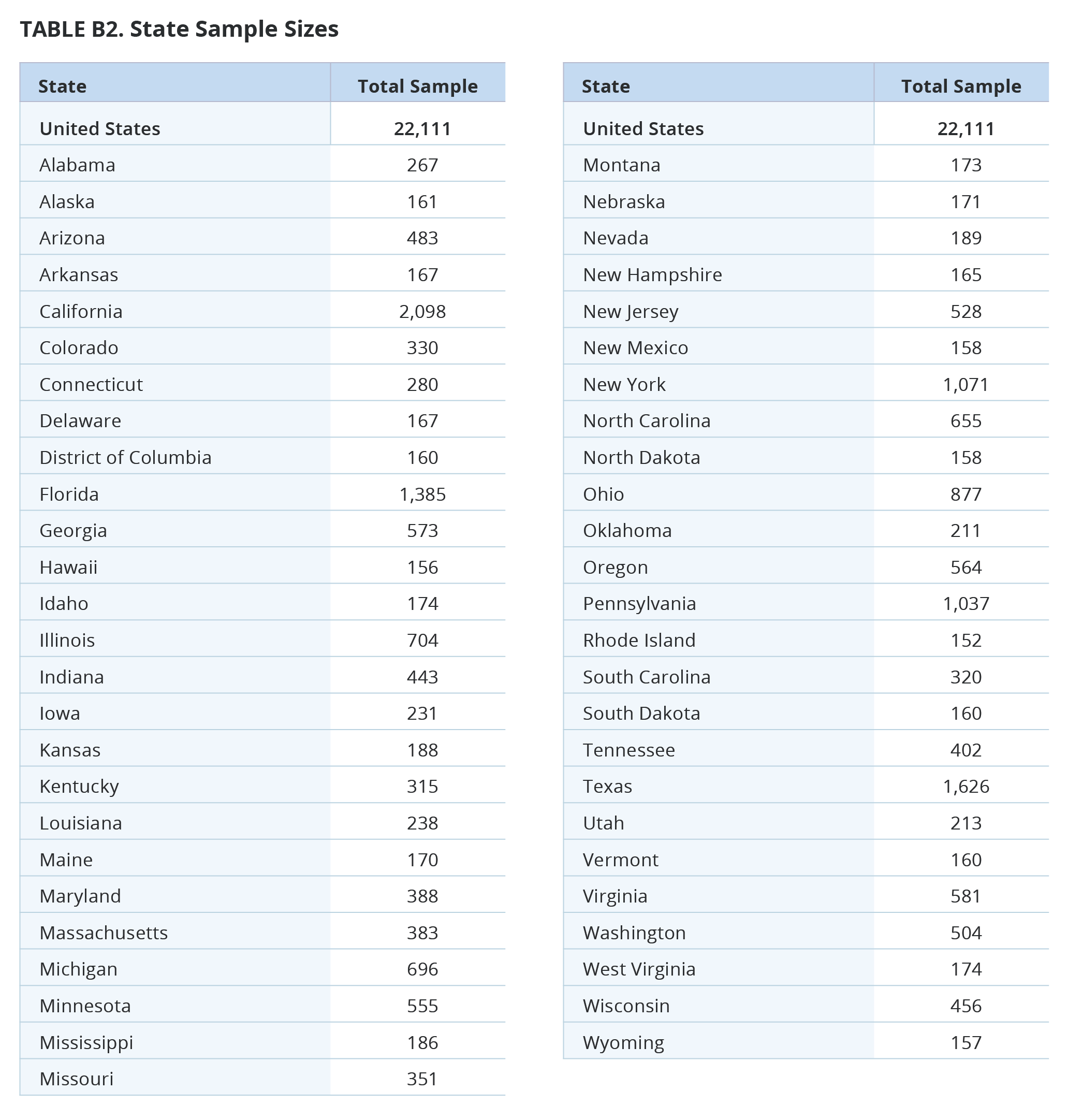
The survey was designed and conducted by PRRI. The survey was designed and conducted by PRRI. The survey was made possible through the generous support of Michelle Mercer and Bruce Golden. The survey was carried out among a random representative sample of 22,111 adults (age 18 and up) living in all 50 states in the United States. Among those, 20,771 are part of Ipsos’s KnowledgePanel and an additional 1,340 were recruited by Ipsos using opt-in survey panels to increase the sample sizes to a minimum of n=150 in smaller states. Interviews were conducted online between February 28 and December 8, 2025.
Respondents are recruited to the KnowledgePanel using an addressed-based sampling methodology from the Delivery Sequence File of the USPS – a database with full coverage of all delivery addresses in the U.S. As such, it covers all households regardless of their phone status, providing a representative online sample. Unlike opt-in panels, households are not permitted to “self-select” into the panel; and are generally limited to how many surveys they can take within a given time period.
The initial sample drawn from the KnowledgePanel was adjusted using pre-stratification weights so that it approximates the adult U.S. population defined by the 2024 March Supplement of the Current Population Survey (CPS), except language proficiency, which is not available from CPS, were obtained from the 2023 American Community Survey (ACS). Next, a probability proportional to size (PPS) sampling scheme was used to select a representative sample. Additionally, the 2024 vote choice benchmark was obtained from the Associated Press Tabulation of Certified Results and party affiliation benchmark was obtained from the 2025 Pew’s National Public Opinion Reference Survey (NPORS).
To reduce the effects of any non-response bias, a post-stratification adjustment was applied based on demographic distributions from the CPS, plus language proficiency from the ACS and party affiliation from Pew’s National Public Opinion Reference Survey (NPORS). The post-stratification weight rebalanced the sample based on the following benchmarks: gender, by age, by race/ethnicity, Census division, metro area by race/ethnicity, education by race/ethnicity, and income by race/ethnicity, language proficiency, party affiliation, and state population size. The sample weighting was accomplished using an iterative proportional fitting (IFP) process that simultaneously balances the distributions of all variables. Weights were trimmed to prevent individual interviews from having too much influence on the final results. In addition to an overall national weight, separate weights were computed for certain states (AZ, FL, GA, MI, MN, NC, NV, PA, TX, and WI) to ensure that the demographic characteristics of the sample closely approximate the demographic characteristics of the target populations.
These weights from the KnowledgePanel cases were then used as the benchmarks for the additional opt-in sample in a process called “calibration.” This calibration process is used to correct for inherent biases associated with nonprobability opt-in panels. The calibration methodology aims to realign respondents from nonprobability samples with respect to a multidimensional set of measures to improve their representation.
The margin of error for the national survey is +/- 0.87 percentage points at the 95% level of confidence, including the design effect for the survey of 1.7. In addition to sampling error, surveys may also be subject to error or bias due to question wording, context, and order effects. Additional details about the KnowledgePanel can be found on the Ipsos website: https://www.ipsos.com/en-us/solution/knowledgepanel
[1] The number of cases for Unitarian Universalists and Hindus is 88 and for Muslims is 91. Results need to be interpreted with caution.
[2] Because some states have smaller sample sizes, their margins of error are larger and as a result, the observed differences in their views on abortion legality are not statistically significant.