
As the second Trump administration reached its 100-day mark, PRRI hosted a panel discussion to examine findings from a new national survey exploring how Americans feel about the current political landscape — and the choices they made during the 2024 presidential election.
The conversation featured political analyst and author Joy Reid, NPR National Correspondent Sarah McCammon, PRRI President and Founder Robert P. Jones, Ph.D., and CEO Melissa Deckman, Ph.D. Together, they unpacked major takeaways from the survey on voter remorse, President Trump’s favorability and job performance, perceptions of Trump as a ‘strong leader’ or a ‘dangerous dictator,’ as well as support for and opposition to his expansion of executive power, recent executive orders, and more.
In an overview of key findings, Jones highlighted stark political and cultural divides in Americans’ views of Trump, noting only a small percentage of Democrats (8%) view Trump favorably, compared to an overwhelming percentage (83%) of Republicans. These divides extend into religion and race breaks, with white Christian groups viewing Trump more favorably than non-white Christian groups, those from other religious affiliations, and the religiously unaffiliated.
McCammon reflected, “I’ve been covering Trump and his coalition in some form for about a decade now, and a lot of my focus has been on religious conservatives, especially evangelical Christians. So, I was struck but not exactly surprised by the extent to which white evangelicals continue to stand behind Trump, even as other groups of Americans are raising alarms and describing him as a ‘dangerous dictator’ in some cases.” According to the survey, a majority of Americans agree that “President Trump is a dangerous dictator whose power should be limited before he destroys American democracy” (52%), compared with 44% who say that “President Trump is a strong leader who should be given the power he needs to restore America’s greatness.”
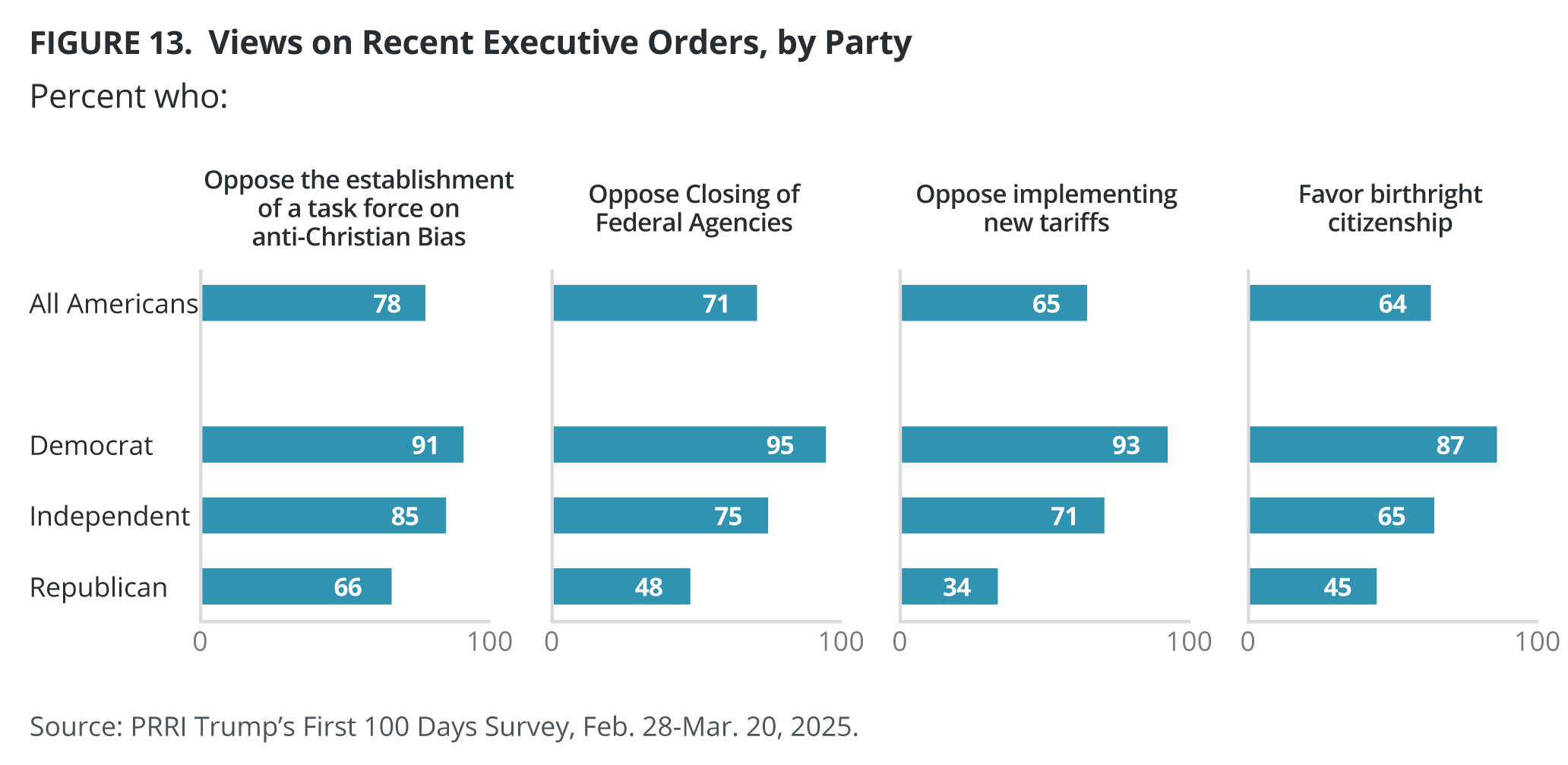
Notably, Jones pointed to the divide between Republicans and the broader American public on views of the president’s recent executive orders, though there is some common ground when it comes to opposing the establishment of a federal task force focused solely on addressing discrimination against Christians rather than all religious groups.
Jones also noted the steep decline in Trump’s favorability among Hispanic Americans, since the 2024 presidential election, with an even steeper drop seen among Hispanic Protestants.
“From a religious angle, Hispanic Protestants have always been more favorable towards comprehensive immigration reform, and hold more favorable views toward immigrants. And I do think that is an important factor in explaining some of that shift,” Deckman stated.
Reid reflected on what initially drove Hispanic Americans to the Trump campaign. “The Latino drift towards Trump was in part, per a lot of the anecdotal evidence, based on their own opposition to undocumented immigrants… their own distancing of themselves from fellow immigrants, and their desire to see a harder line on immigration,” she commented. “And now what you’re seeing is Latinos across this country being picked up, even if they’re citizens, and either held and having their citizenship questioned, or in fact deported.”
View the full event recording here and check out PRRI’s survey report, Democracy at a Crossroads: How Americans View Trump’s First 100 Days in Office.
Slides presented during the webinar are available here.