

Dr. Charles McCrary is a 2025-2026 PRRI Public Fellow focusing on racial justice and white supremacy. He is also an Assistant Professor of Religious Studies and Humanities at Eckerd College.
James Talarico, a Texas state representative and candidate for U.S. Senate, has built his campaign in large part around opposition to Christian nationalism. He is not anti-Christian, though — quite the opposite. Talarico is currently enrolled in a master of divinity program at a Presbyterian seminary, and he speaks fluently and unapologetically in a political theological register. In a widely circulated interview with Stephen Colbert in February, Talarico boldly asserted that “there’s nothing Christian about Christian nationalism.” He is not the only public figure making this argument. In fact, this is a common refrain among Americans, especially progressive Christians, who consciously reject Christian nationalism. This Spotlight Analysis examines how the discourse of Christian nationalism circulates, finding higher awareness of the term among those who reject it may be linked to their media consumption.
Christian nationalism is a malleable term used by social scientists, journalists, and others to identify a certain kind of right-wing Christian and/or the ideology that they hold. Recent PRRI research shows that 11% of Americans qualify as Christian nationalism Adherents and 21% as Sympathizers. More Americans oppose this ideology: 37% are Skeptics and 27% are Rejecters. Other surveys use different questions to identify Christian nationalism, and thus they arrive at varying numbers. But almost everyone agrees that there is something — an ideology, a set of ideas, a specific movement or constellation of movements — to which the term refers. In addition to that, though, it is now a discursive object too.
Whether the ideology or movement itself is on the rise, the term undoubtedly is. Although the term Christian nationalism is not new — the far-right minister Gerald L.K. Smith founded the Christian Nationalist Party, later the Christian Nationalist Crusade, in the 1940s — it has gained considerable traction over the past decade, especially since 2021. Since 2022, PRRI has collected data on how favorably Americans view Christian nationalism. While 44% held an unfavorable view in 2022, that share has increased to 47% today. At the same time, unfamiliarity with the term declined. Over one-third of Americans (35%) had not heard of it in 2022, while just 23% say the same today. Perhaps more interesting, Christian nationalism Rejecters are now the least likely to report not having heard of the term (13%), compared with Adherents (20%), Sympathizers (26%), and Skeptics (28%). Rejecters’ awareness has also increased over time, with a much higher share reporting unfamiliarity with the term in 2022 (19%).
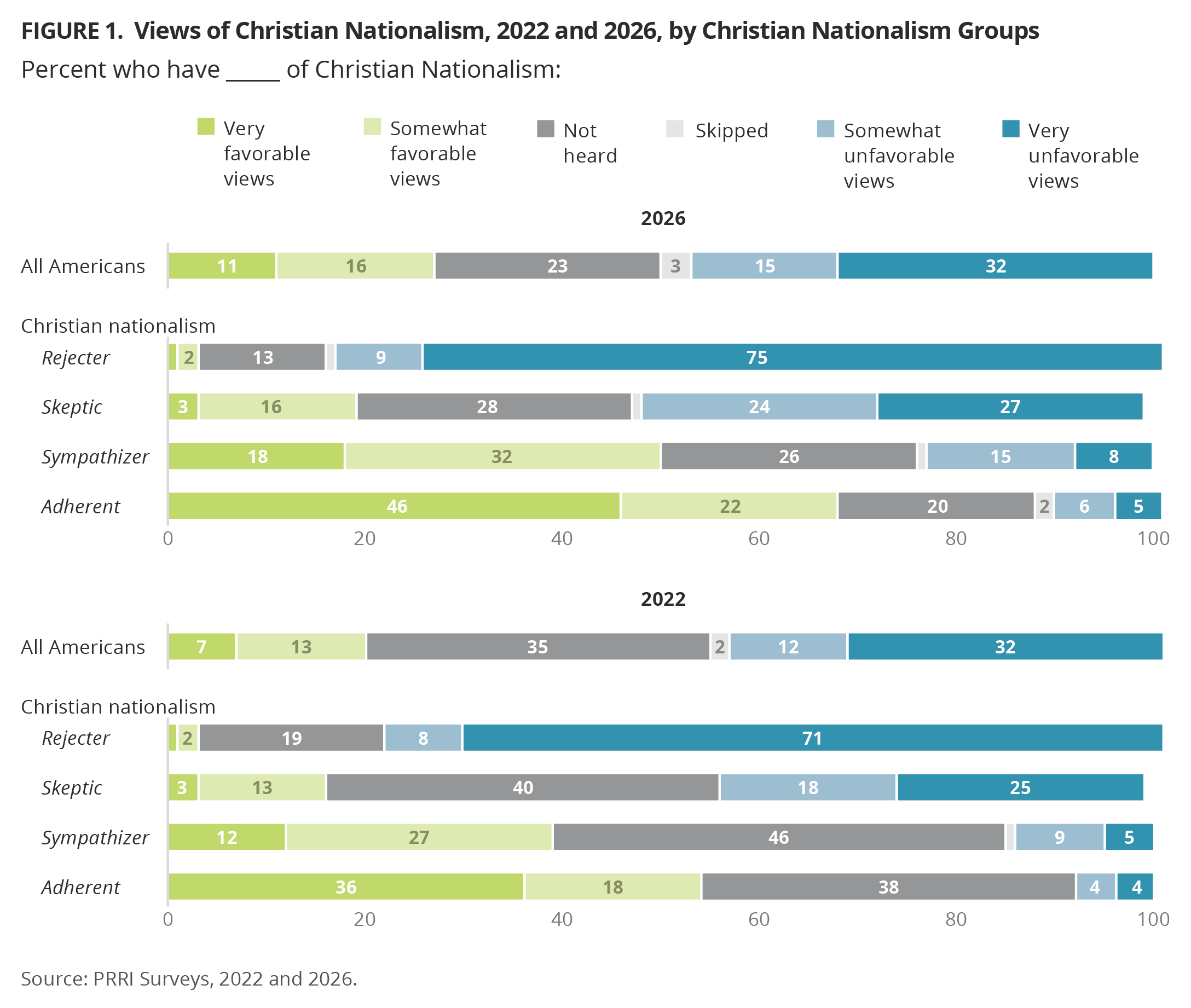
Another way to put it: Rejecters are more likely to name Christian nationalism as that which they’re rejecting than Adherents and Sympathizers are to name it as what they’re supporting. It is not necessarily the case, though, that Adherents and Sympathizers lack terms for themselves and their ideologies. It is that they are less likely to use Christian nationalism and, perhaps more to the point, less likely to consume media that uses the term. They are less likely, we might infer, to be reading a PRRI Spotlight right now.
Christian nationalism is, among other things, a term that circulates. But where does it circulate? PRRI’s 2025 data, which includes measures of media consumption and favorability toward Christian nationalism, shows that Rejecters also disproportionately most trust mainstream TV news (51%) to provide accurate information about politics and current events, followed by 40% who do not trust any TV news. Just 3% of Rejecters trust Fox News and 6% trust other TV sources. No Rejecters trust far-right TV news (0%).
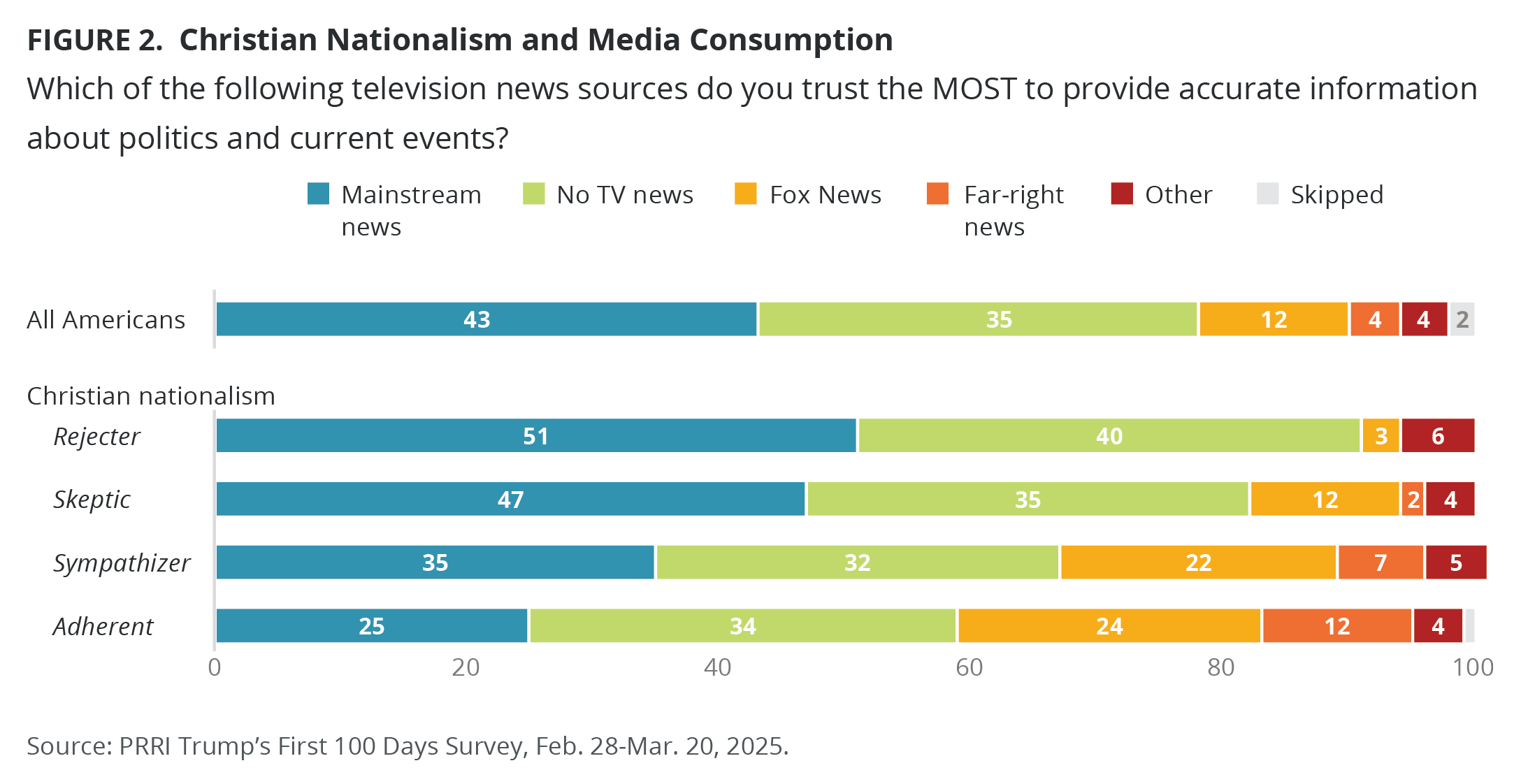
This is in stark contrast to Christian nationalism Adherents who most trust either Fox News (24%) or far-right news (12%), followed by 34% who do not watch TV news, and one-quarter who watch mainstream TV news (25%).
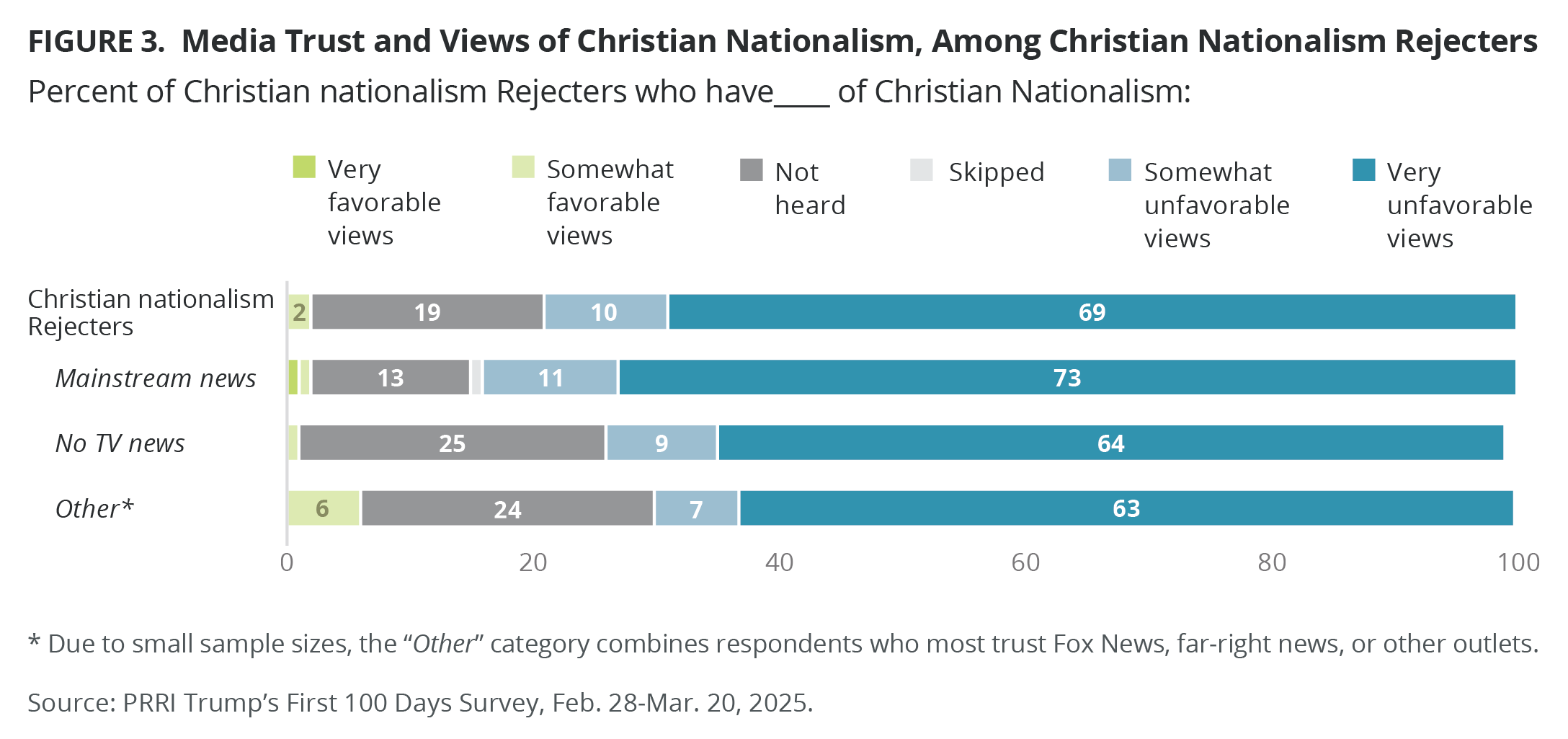
Interestingly, Christian nationalism Rejecters who most trust mainstream news (13%) are about half as likely as those who trust no TV news (25%) or other sources (24%) to say they have not heard of the term Christian nationalism. This analysis suggests that far-right news uses the term, if at all, quite differently from the way mainstream TV media or, say, NPR does.
In addition to tracking Christian nationalism itself, whatever exactly it is, we ought to pay attention to the discourse of Christian nationalism — who uses the term, how, and why. Early qualitative research shows, and seems to be supported by the survey data, that some of the most eager consumers and (re)producers of the discourse are those who oppose its central object. Perhaps, reader, this includes you.